The message was conveyed to the then-commander of all U.S. forces across the greater Middle East.
Communicated through an intermediary, it came from the shadowy general in charge of Iran’s ragtag overseas forces, yet he addressed the U.S. commander, Gen. David Petraeus, as if he were a peer: “General Petraeus, you should know that I, Qassim Suleimani, control the policy of Iran for Iraq, and also for Syria, Lebanon, Gaza and Afghanistan.”
It was, General Petraeus has recounted, and confirmed in a recent email message, an Iranian attempt to signal that the solution to conflicts in the region ran through Tehran.
In hindsight, some analysts identify that message, sent during the Iraq war in 2008, as a milestone marking the start of one of the most far-reaching shifts in regional politics to emerge out of the Sept. 11, 2001, terrorist attacks on the United States: the rise of Iran as a regional power.
After 9/11, Washington invaded Iraq and toppled its president, Saddam Hussein, setting the gears in motion for Iran to dominate its neighbor, previously its main nemesis. That seemed to whet Tehran’s appetite for regional supremacy in ways that continue to reverberate today in the conflict with the United States.
“The war in Iraq really changed everything because it made Iran a much bigger part of the equation,” said Stéphane Lacroix, an associate professor at Sciences Po in Paris who focuses on contemporary Islam. “It opened the way for this kind of Iranian expansionism, this much greater Iranian influence across the region.”
Iran had hoped in vain for decades to oust Mr. Hussein, but achieving the goal came from an unexpected quarter when the United States invaded Iraq in March 2003.
Well before 9/11, the administration of President George W. Bush advocated for regime change in Iraq, arguing that Mr. Hussein had become a destabilizing force in the region, not least by invading Kuwait in 1990. The 9/11 attack provided the pretext, despite the absence of concrete evidence linking Iraq to Al Qaeda.
Days after 9/11, Mr. Bush announced a “War on Terror” focused initially on the Taliban government in Afghanistan, which had harbored Al Qaeda, but he declared that it would extend to every terrorist group with global reach.
In that same period, Benjamin Netanyahu, then a former Israeli prime minister, testified in Congress that overthrowing the Iraqi leader would bring “positive reverberations” across the region, including possibly regime change in Iran.
Within months, Mr. Bush widened the scope, using his State of the Union address in early 2002 to lump Iran and Iraq together with North Korea as an “Axis of Evil” bent on obtaining weapons of mass destruction to use themselves or to supply to terrorists.
Senior members of his administration kept up the drumbeat, suggesting that military action was possibly in the cards against Iran as a sponsor of terrorism. Several U.S. senators introduced legislation to finance groups working toward overthrowing the government in Tehran.
All that rhetoric unsettled Iran, an American adversary since its 1979 Islamic revolution.
Ryan Crocker, a former U.S. ambassador to Iraq and multiple other countries in the region, said that after the “Axis of Evil” speech, Iran became convinced that the United States “was gunning for the regime,” and began mobilizing to challenge the United States in the region more forcefully.
Iran soon discovered that it did not have to deploy its own soldiers, tanks and missiles to fight U.S. and Iraqi government forces, as well as Sunni jihadists who threatened Iraq’s Shiite majority. It could rely on local militias instead. So the Islamic Revolutionary Guard Corps armed, funded and trained militias in Iraq, an effort led by General Suleimani.
“It was just creating enough chaos in Iraq through militants who couldn’t be easily identified to the degree that the United States couldn’t overcome it,” said Afshon Ostovar, the author of “Wars of Ambition,” a history of the modern struggle pitting the United States against Iran.
In tandem with the fight against Iranian-trained militias, the rise of the Islamic State of Iraq and Syria, or ISIS, a Sunni Muslim caliphate, made the American presence in Iraq an expensive albatross for Washington, and eventually it wanted out.
Iran, taking its newfound influence over Iraq as a victory, began to test how it could extend that playbook throughout the region.
Iraq “becomes this magnifier, this intensifier of Iran’s own ambitions to spread its revolution, spread its political influence,” Mr. Ostovar said. “The more traction Iran gained in Iraq, the more its ambitions grew,” he added. “Iraq created the catalyst for Iran to foment its own counter crusade.”
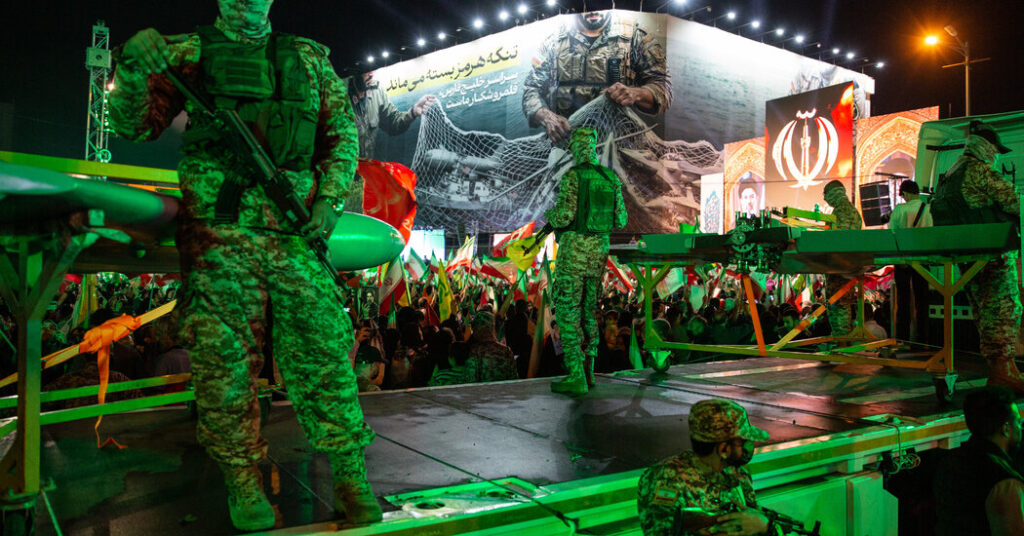
Before his assassination by the United States in Iraq in 2020, General Suleimani ran the Quds Force, the Revolutionary Guards arm that worked outside Iran. To counter American power, the general moved on from Iraq and fostered a string of proxy militias from Syria to Lebanon to Gaza to Yemen, creating what was sometimes referred to as a “Shiite crescent” arcing across the Middle East.
Iran called it the “Axis of Resistance.”
As well as opposing the United States, the Revolutionary Guards had been threatening for decades to destroy Israel. With what was effectively a front line of proxy militias, Iran saw that the prospect of confronting Israel directly was not so far-fetched.
The Islamic Republic sought to encircle Israel, while also creating a buffer to deter a direct attack on Iran itself. Then in 2023 came the Hamas-led attack on Israeli civilians. In response, Israel virtually obliterated the Gaza Strip in an attempt to eliminate Hamas, and leveled large areas of Lebanon in hopes of uprooting Hezbollah, Iran’s main proxy force.
Not long afterward, in 2024, a Sunni Muslim former jihadist from Syria who had broken with the Islamic State took control in Damascus, expelling Iranian militias and removing a key pillar of Iranian influence in the region.
The proxy force strategy all but disintegrated, and failed to work as a deterrent. The United States and Israel both attacked Iran directly in June 2025, the precursor to the current war.
Now the United States is stuck in that war, and the outcome remains in question. Iran’s proxy forces in the region are much diminished, and it suffered massive destruction domestically.
At the same time, Tehran has asserted control over the Strait of Hormuz, one of the world’s major choke points for oil shipments, to try to assure the regional clout it began to build after 9/11. And in recent weeks, Iran’s allies in Yemen, the Houthis, have staged a lightning advance, seizing strategic territory from the Saudi-backed government.
Iran’s strategy in the region, in some ways, analysts said, echoes what the country first learned in Iraq — that it does not have to achieve outright victory — it has to do just enough to deny its adversaries their objective. In this war, the objective of both the United States and Israel was to topple the regime, so the government in Tehran just had to survive.
“Keeping the Islamic Republic intact was a victory, right?” Mr. Ostovar said. “Once the existential threat to Islamic Republic was over, then Iran could really expand and push out the boundaries of what it conceived to be a victory,” he added. “The Strait of Hormuz is the new front line in the battle, but it’s unlikely to end there.”
Sheelagh McNeill contributed research.
The post How Sept. 11 Paved the Way to Mideast Power for Iran appeared first on New York Times.