The European Union has invited Canada to work toward becoming the bloc’s first “associate member,” a title meant to underscore Canada’s growing closeness to the 27-nation union as both face deteriorating relationships with the United States.
President Trump has waged a relentless trade war with Canada, challenging the nation’s economy. The United States has pulled back support for NATO and Ukraine, leaving the European Union scrambling to shore up its defenses. That has left both looking for new partners as the alliances established after World War II shift.
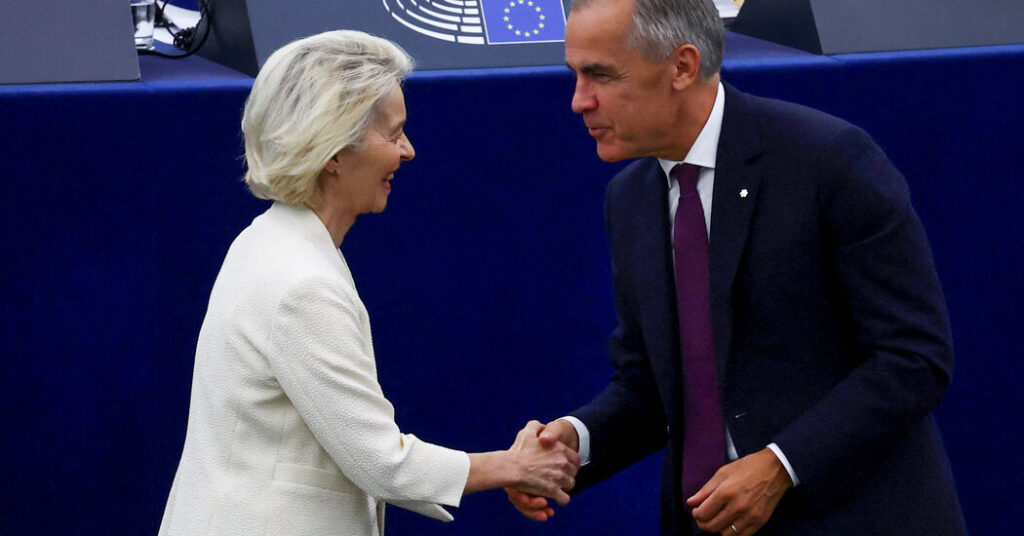
“We must urgently reimagine our partnerships,” said Ursula von der Leyen, the president of the European Union’s executive arm, on Wednesday during a speech in Strasbourg, France. Mark Carney, the prime minister of Canada, was seated directly to Ms. von der Leyen’s left as she made her address.
“I would like to work with you on opening the door for Canada to be the first associate member of the European Union,” Ms. von der Leyen told him.
Though details remain scant and the linkup is not a done deal, the announcement Wednesday was met with a standing ovation from lawmakers, and Mr. Carney and Ms. von der Leyen shook hands warmly as she made the announcement.
Ms. von der Leyen said the proposal was “not a partnership against anyone else, but for our common strength.” But it is clear that Europe and Canada see themselves caught between a competitive China and an at-times-hostile Trump administration.
“China, Russia and the U.S. have turned their backs on international law,” Barry Andrews, a member of the European Parliament from Ireland, said in a statement after Ms. von der Leyen’s speech. “We need new allies.”
Mr. Carney gave a headline-grabbing speech at the World Economic Forum meeting in Davos, Switzerland, this year during which he argued that the world order that emerged from the Cold War was facing a “rupture, not a transition,” and that “middle powers must act together because if we’re not at the table, we’re on the menu.”
Wednesday’s announcement was a vivid demonstration of that strategy.
Ms. von der Leyen did not lay out in detail what associate membership to the European Union might entail. But European diplomats and officials in recent days have made it clear that Canada and the European Union, which will meet for a summit at the end of October, are working toward closer cooperation on technology regulation, trade and the supply of critical minerals.
They are also working to team up on security and defense. Ms. von der Leyen highlighted that point in her remarks, noting that Europe had faced a recent series of drone incursions and other provocations, many of them attributed to Russia.
“Hybrid threats facing Europe are less and less hybrid, and less and less threats,” she said on Wednesday.
Ms. von der Leyen called for a European equivalent to NATO’s joint-defense provision, known as Article 4. The European Union already has a little-known collective defense guarantee, but Ms. von der Leyen pitched “Europe’s own Article 4” and said that when it was “triggered by one member state, all member states would convene.”
She also called for a new leaders’ group, the European Security Council, that would include non-E.U. partners in Europe like Britain, Norway and Ukraine, and also Canada.
The push to bring Canada closer is likely to encounter roadblocks. E.U. member states have warned offering too many benefits to a would-be associate would diminish the value of full membership, for instance.
As Mr. Carney navigates a historic low in his country’s relationship with the United States, the destination for three-quarters of Canadian exports, he has been focused on bringing his country closer to the bloc.
Since trade talks between Canada and the United States collapsed last month, the two countries have been locked in an intensified trade war. President Trump has also repeatedly called for Canada to become the 51st state, prompting a wave of patriotism among Canadians.
By contrast, polls suggest that four out of five Canadians want Mr. Carney to bring their country closer to the European Union and that more than half would like Canada to join the bloc as a member.
Ottawa and Brussels already have a free-trade agreement, and though the deal has not been approved by 10 of the 27 E.U. member states, about 90 percent of trade between the European Union and Canada is tariff-free.
Mr. Carney often calls Canada “the most European non-European country.” European Union leaders have spent years joking that it could join the bloc if only it were not on a far-flung landmass.
“You’re very welcome in this house, and I hope you’re already feeling comfortable amongst the member states sitting here,” Terry Reintke, a German politician who leads the Greens group in the European Parliament, said to Mr. Carney from the podium in Strasbourg on Wednesday, “because we hope to see you there very often in the future.”
The post E.U. Offers to Make Canada ‘Associate Member’ as U.S. Ties Weaken for Both appeared first on New York Times.