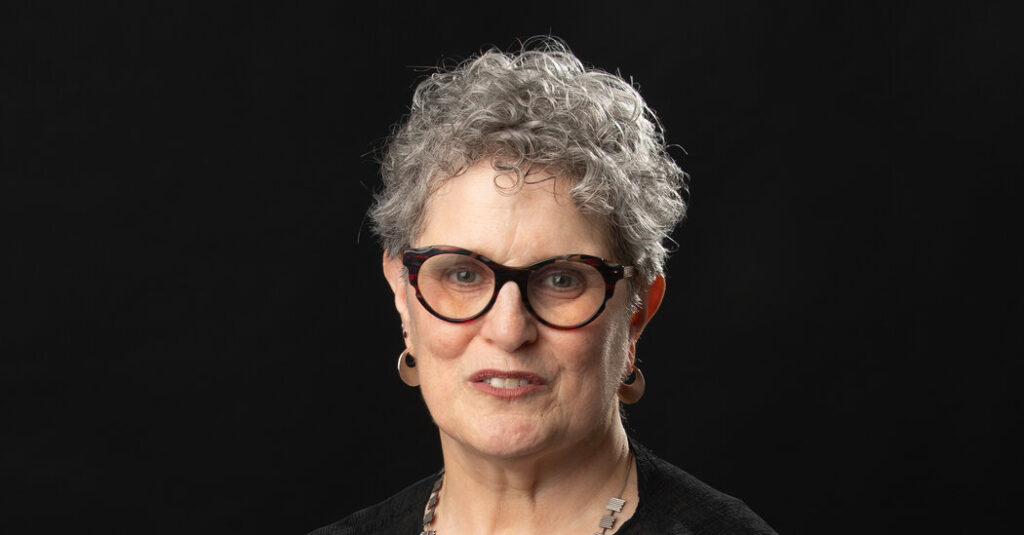
When Ellen Pollock, the longtime Business editor of The New York Times, calls in to a video meeting, she’s often in front of a virtual background resembling the deck of a spaceship. It’s a whimsical touch with a serious message: She is at the controls.
After nearly a decade atop one of the largest news desks at The Times, Pollock has decided to leave the role this month. She took over the desk in 2017 after stints as a reporter and an editor at The American Lawyer, The Wall Street Journal and Bloomberg Businessweek, where she was editor in chief.
She hasn’t announced what she’ll do next in The Times’s newsroom, only that she intends to take a break first. We used this occasion to talk about her tenure, the business world and the challenges facing journalism. These are edited excerpts from our conversation.
Nine years is a long run as a department head at The Times. These are stressful management roles with responsibility for overseeing competitive coverage and a large staff. How did you endure?
Momentum and instinct help a lot. Nobody gets into this kind of work without being aggressive and wanting to win — so that has helped keep me going. If I were a fish, and for the record I’m glad I’m not, I’d definitely be a shark.
But the main thing that motivates anyone in my kind of job is the desire to inform readers and get them the truth — as soon as possible and with as much explanation and nuance as possible. It’s a mission. And even if that sounds kind of corny, it’s true.
Every morning I walk through the front door, past the historic front pages displayed in the lobby, and remind myself how lucky I am — even on days when I’m very grumpy.
What was the toughest story or leadership challenge you faced?
I’m not sure what was the toughest, but certainly Covid was a very difficult time. From a coverage standpoint, it was a monster. We started out covering mask, ventilator and hand sanitizer shortages and quickly moved on to plunging stock markets and job losses suffered by millions of Americans. The government swooped in with benefits, but those benefits would expire. It seemed like the economy — and the finances of our readers — were constantly on the verge of falling off a cliff. Seems like we used the word cliff a lot.
Our job was to guide readers through it all and explain the possible scenarios without predicting the future, because nobody could do that. I think our reporters and editors really rose to the occasion.
At the same time, our staff was scattered to the winds. Just keeping track of how everybody was doing was impossible. We hired people during that period who didn’t know their colleagues or anything about working at The Times.
I spent the first week after the lockdown sitting on the floor of my apartment hunched over my computer, and when I finally stood up I realized my back had gone out. I could barely walk for months and, like millions of other people, I learned how hard it was to get medical help and how brave the medical personnel were during the pandemic.
I was glad to return to the newsroom.
You’ve run coverage, but you’ve also navigated the bureaucratic nature of a large company. Have you ever disagreed with your bosses on a story or approach?
When it comes to our approach to coverage, and what’s important, we almost always agree. We sometimes disagree on priorities, what is realistic and timing. I’m fine with discussing and debating. I think that often yields better and more thoughtful results.
Sometimes figuring out how to follow up on breaking news can be tricky. We jump on the news. But then do we quickly push out a follow-up story? Or do we take an extra day to produce something more in-depth and explanatory? There’s sometimes some tension there.
And I’m grouchy about some meetings and the increasing number of administrative tasks that happen at a growing organization. In general, I’m not fond of the Three Bs: bureaucracy, bullshit and boredom.
You are known as a truth-teller who is unafraid to speak your mind to colleagues and bosses alike, including a sprinkle of salty language. Has it ever backfired?
Backfired! It’s a miracle I still have a job! A year or so ago, I threatened to kill a reporter if his story ended up too long. That was bad — and certainly an overreaction. The “news” got picked up in the press. (I promise you, I’m armed with chocolate not weapons.) Another time I told a boss that she had disrespected me. That didn’t go over so well, either. One thing I haven’t learned yet is to keep my mouth shut. But I have learned to apologize. Next I’m going to tackle groveling.
Some business leaders and readers see Times business coverage as adversarial to companies, C.E.O.s, capitalism, Big Tech and A.I. You’re tough-nosed about coverage, but do you see it as hostile?
I absolutely don’t see it as hostile, and the idea that we have something against companies or A.I. or chief executives really frustrates me — I’m trying to avoid salty language here. We cover business the way we cover anything else. We want to break news, convey the truth without bias and reveal what happens behind the scenes so that readers can understand how money and power work. We are interested in companies and the people who run companies and make policy. We want our readers to understand markets and how their money is invested. If you have a 401(k) or pension, you’re a shareholder. We want you to know how your companies work. Readers are interested in who makes the ice cream they slurp and the computers they pound on. We are here to inform and, when necessary, reveal secrets. That’s it.
I find the view that we are against capitalism to be particularly galling. I love money and want more of it!
Part of your jurisdiction is the media beat — reporting on the journalism industry and the powers and people who shape it. Sometimes that means covering The Times. How does that work?
We try to cover The Times the way we cover any other company, but obviously a host of questions come up that can be a little delicate. Just like covering anything else, sometimes we don’t get all the answers we want, when we want them. Then we have to go digging. That can get a little awkward, but usually it is pretty smooth.
More than once I’ve glared at senior people at The Times and said, “We don’t want to get beat on this story.” That sometimes works.
The Times has been involved in a fair amount of litigation that involves press freedom and copyright. We have been sued by President Trump. All those issues can be complicated, and we need to cover them dispassionately and with independence. So we are constantly checking ourselves and one another.
There’s a tiny bit of fun stuff sprinkled in. In 2022, when the company bought Wordle, the word game, more than one department wanted to write the story. The Business department won out!
You are known in the newsroom for your career advice to women who are early in their careers. Did someone do the same for you?
Not really. I never had an early career mentor. But I had a lot of co-workers who were women, and we all supported one another and made one another laugh. Early on I had an editor, Denise Martin, who taught me the basic skills of writing, and I am forever grateful to her. And many years later I had a boss, Carol Hymowitz, who had arrived at The Wall Street Journal when there were fewer women at the paper. She was incredibly supportive.
During the early years of my career, there was plenty of ugliness. There was harassment. Women weren’t taken seriously and were just plain looked down upon. There was a lot of disparaging language that you don’t hear much today. You kind of had to blast through it, but it was pretty wearing.
And of course men still strut around like they rule the world. So the story isn’t over yet.
You’ve talked about the never-ending news cycle, about interrupted and missed dinners with family and friends. What kind of toll has the job taken on you?
So many times I have raced out of restaurants in the middle of a meal with friends to take a call about news. Inevitably it is either 16 degrees or 98 degrees on the sidewalk. There’s also nothing like dragging a laptop to a dinner party. Hosts love it when you set up an office in their kitchen while everyone else is in the dining room.
There are a lot of novels I haven’t read. I have friends I haven’t kept up with. I’m a lousy friend, and I feel awful about it.
Your daughter has followed in your footsteps. What do you make of her decision to pursue journalism despite all the threats to the industry?
My husband, who retired from The Times, tried to steer my daughter away from being a reporter, but she refused to listen!
My daughter is pretty young and has a good gig in journalism, so I’m very proud of her. When I see her byline, I totally turn 100 percent mom and get so excited. As a mom and editor, I worry endlessly about the news business, which seems beset by one existential threat after another. So I’m keeping my fingers crossed for her and journalism that readers stick with us and that the demand for independent news gathering goes up and not down.
What are you watching for next in the business world?
I’ve stopped predicting what’s going to happen. The economist Paul Samuelson once said something to the effect that Wall Street indexes had predicted nine out of the previous five recessions. I’ll just go out on a limb here to say that in the next year markets will either go up or down. Unless they stay flat.
The post A ‘Shark’ of a Business Editor Steps Down appeared first on New York Times.