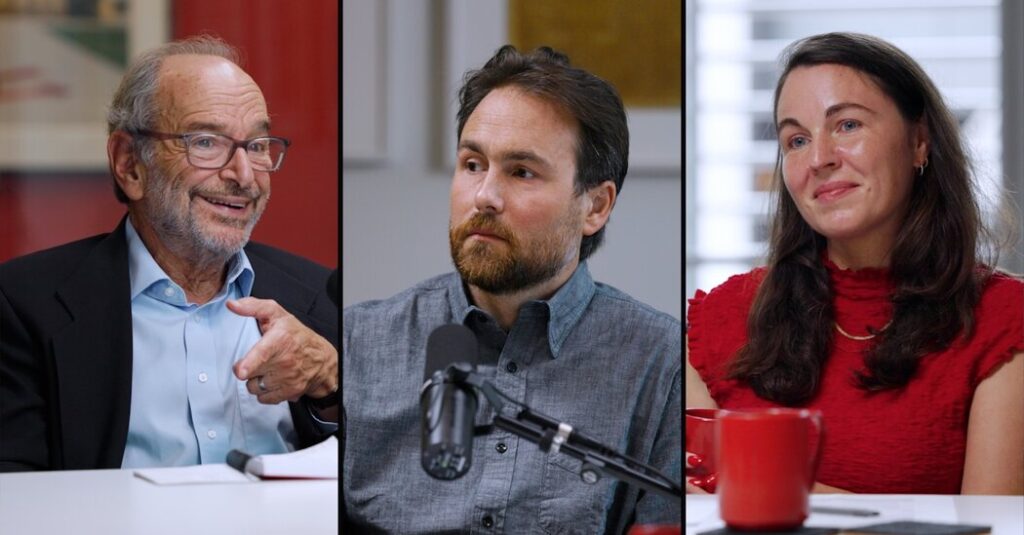
Robert F. Kennedy, Jr. and the MAHA movement are hoping to curtail the use of S.S.R.I.s — a class of drugs commonly prescribed for anxiety, depression and a host of other psychiatric issues. How should patients think about starting and staying on S.S.R.I.s today? In this episode, the Opinion writer David Wallace-Wells and the contributor Dr. Rachael Bedard talk with the psychiatrist and professor Dr. Anthony Rostain about what we know — and don’t know — about S.S.R.I.s and how doctors and patients should navigate the uncertainty.
Below is a transcript of an episode of “The Opinions.” We recommend listening to it in its original form for the full effect. You can do so using the player above or on the NYTimes app, Apple, Spotify, Amazon Music, YouTube, iHeartRadio or wherever you get your podcasts.
The transcript has been lightly edited for length and clarity.
David Wallace-Wells: I’m David Wallace-Wells. I’m a writer for New York Times Opinion and a columnist for The Times Magazine.
Rachael Bedard: And I’m Rachael Bedard. I’m a primary care physician and a contributing writer at New York Times Opinion.
Wallace-Wells: One in six Americans is on antidepressants. And a lot of Americans think that number is too high, that we’re prescribing too many S.S.R.I.s, that we’re giving them to children too young and that we don’t really know how to get people off those drugs, even when they want to. The nation’s top health official, Robert F. Kennedy Jr., is kind of leading the charge.
Archival clip: Health and Human Services commissioner R.F.K. Jr. is starting a new initiative targeting the overuse of psychiatric drugs, especially in children. The new plan urges doctors to prioritize holistic care, like exercise and nutrition, instead.
But R.F.K. and MAHA are not alone. People have been debating these drugs and their effect on our society for decades. We’re in a new moment now, where people are arguing about it more — and Rachael and I have been talking a lot this summer about these issues. But that conversation is often at the highest level and ignores a lot of the clinical experience — what this looks like on the ground between patients, kids, their parents and their doctors.
Bedard: As a primary care doctor, I currently work in a homeless clinic. I previously worked on Rikers Island, in the New York City jail system. I’ve always worked in populations where there were very high incidents of comorbid mental health issues. And as a primary care doctor, I’ve prescribed antidepressants and medicines for anxiety to patients hundreds of times, probably thousands of times, and have thought about these questions a lot myself, around how I’m selecting patients who are good candidates for medicine — and when I’m choosing to medicate them, frankly, because I can’t get them access to other services I wish I could get them access to, like talk therapy.
So to hash this all out, we’ve invited Dr. Anthony Rostain to join us today. Dr. Rostain is the chair of psychiatry and professor of psychiatry and pediatrics at Cooper Medical School of Rowan University. Thank you so much for being here.
Anthony Rostain: I’m so happy to be here. Thanks.
Wallace-Wells: So let’s start with some history. Where did S.S.R.I.s come from? Why did they seem like a very big deal? And how did they become so successful, in the sense of so many Americans coming to use them so prolifically?
Rostain: Well, first of all, the S.S.R.I.s ushered, from my point of view, a new era in psychopharmacology.
Wallace-Wells: And when was that?
Rostain: It was introduced by — the F.D.A. approved it in 1987. I happened to have been at Penn when it was being tested, so — as I was a resident — and I saw that patients who were taking it were getting better, and that they weren’t having side effects that some of the other antidepressants had. At the time, the primary antidepressant in use were in classes called tricyclic antidepressants, which are still used occasionally. And they had a lot of side effects and potentially harmful side effects: arrhythmias; people could accidentally or on purpose create situations where they would die from an overdose.
So the fact that this medication came along, there was really, really a tremendous relief at the ability to prescribe something that’s safer and better tolerated. How they evolved is a whole story in and of itself, of how science, medicine and society evolved; because initially, they were approved primarily for depression, and little by little, the use was extended to anxiety, to obsessive-compulsive disorder, to social anxiety and to PTSD.
Suddenly, we saw many uses that we could use the same medication for. And we’ve all wondered, in the clinical field and in the general policy field, at what point are we doing this safely? And I think it’s healthy, actually, to be having this conversation right now.
Wallace-Wells: So you mentioned there, in talking about that history, the contrast with the previous class of drugs, primarily in terms of the safety — that you could feel comfortable giving this to more patients, because the risk of some serious side effects was much, much lower. Back in time — we imagine we’re still in the late ’80s, early ’90s — how did the contrast look in terms of efficacy? Was there also a marked benefit that hadn’t been seen in the previous class?
Rostain: There was a sense that these were as efficacious and better tolerated, forgetting about the serious side effects. I think the overall early studies showed that yes, you could have a really good impact on moderate to severe depression with these S.S.R.I.s.
Bedard: I’m wondering if we can talk a little bit about mechanism, and how the theory of mechanism has changed over time from one that was quite simple — the idea that the S.S.R.I. meant that you had more serotonin, a happy transmitter, soaking your brain — to where we are now, where there’s more nuance to how we think they work.
Rostain: Yes. So it’s true. I trained at a time when everybody had hypotheses. If you had schizophrenia, you had too much dopamine. If you had depression, you had too little serotonin. It isn’t that simple, and the brain is obviously more interesting, and we understand it better than just a chemical imbalance.
So what we think, No. 1, we know that all S.S.R.I.s do the same thing: They slow down the recycling of the serotonin molecule, which is a neurotransmitter — a very important neurotransmitter. But what it really is doing over time is reshaping the circuits in the brain that affect our mood, that affect our ability to handle stress, that allow us to make less reactive kinds of decisions. And over time, what we’ve really come to look at is neuroplasticity — which is the term we use now.
When we’re stuck in a depressed state, or when we’re anxious all the time, we can’t learn, OK? Our brains are locked into a pattern, and neuroplasticity is actually the mechanism by which we learn. So clinicians talk — we talk to our patients about the idea that if we give you this medication, not only will you feel less depressed or less anxious, but you’ll be able to learn some new tricks. And that’s the idea — that this helps your learning and adaptation.
Bedard: And that’s really interesting, because the notion of depression as a chemical imbalance was sort of culturally accepted for a long time, and was the way that people conceived of this. And frankly, it was the way that I think lots of doctors spoke to their patients about it: There’s a chemical imbalance, and we can give you this medicine that will resolve that. I don’t know that people think of depression as something where their brain needs to be rewired — and that idea can be pretty scary for people, I think.
Rostain: Of course. That’s what people want to know. Is this going to change my brain? And if so, is that going to be a good thing? So what we’re trying to get at with depression — we sort of have this model in our minds now, that the circuits in the brain that modulate your mood seem to not be allowing you to feel positively, and you’re so stuck in this circuit of negative emotions.
Actually, the brain has two different circuits: one for positive emotions, one for negative emotions. So one way I explain it to patients is to say, the positive emotional circuits are underpowered right now, and the negative ones are running the show. This might quiet the negative and allow the positive ones to be more present. Is it a permanent rewiring? No, because if we stop the medication, you go back to base line. But hopefully, when you do come off the medication — say your depressive episode is over — you will have learned how to feel better, and you will be able to push back against the negative more effectively.
Wallace-Wells: I think we’re going to talk, in a minute, about going off the meds, but just to stick on this point for a second — and to raise an ignorant reflexive response — how strange is it that we developed this tool of drugs with one theory of depression, have evolved past that theory of depression, observed the drugs still basically working and are continuing to prescribe them? How unusual is that? How unnerving should that be? Do you understand it when patients express alarm about this?
Rostain: Let me say, to be quite honest, we still don’t know what depression is.
Bedard: Or exactly how these drugs work.
Rostain: Or exactly how these drugs work. And that doesn’t stop us from using them, because people are coming to our office saying, “I’m in pain. I need help.” I mean, the same, by the way, is true for pain medications and pain syndromes.
I mean, these are really interesting. The brain is a fascinating organ, and unfortunately, we have to simplify this, because we don’t have any better way of explaining it at the moment, with new nonpharmacologic interventions, like transcranial magnetic stimulation. We can begin to think about, oh, maybe we can change your brain in positive ways without you having to be on medication.
Wallace-Wells: So this is where some of my own, I guess I would call it a kind of naturalistic fallacy, comes in. I have some tendency to think if we understand the precise mechanism — that insulin regulates blood sugar in the blood — I trust that it’s appropriate to intervene when that’s necessary. But if we’re much more confused about the system, I have a little bit of a pause about the idea of taking meds like this, and certainly prescribing them en masse as we’ve done. And I wonder if we could just talk a little bit about what we know, at the level of population, about how effective they are.
How should we think about putting aside the mechanism, just looking at whether they’re working or not? What’s the lay of the land, state-of-the-art understanding of that question?
Rostain: Well, to begin with, what we’ve learned from all the studies is that even if they are effective for a population, the patient in my office is going to have their own idiosyncratic response.
Wallace-Wells: Of course, yeah.
Rostain: So therefore, it’s not a one size fits all. Like, no, S.S.R.I.s don’t work the same for everybody. So these population studies tell us that there are good effect sizes, not curative to everybody. There’s still a lot of treatment-resistant depression. People are started on this medication, and they’re still depressed fairly commonly. And as a psychiatrist, I see the cases of people who haven’t been effectively treated by the first line of treatment.
The second thing — and this is really important — I always like to say, yeah, insulin and diabetes is a beautiful mechanism. We know it. And sickle cell, we know that. But what about hypertension? What about risks for stroke? What about even obesity? We don’t know how these things are actually operating. We know lifestyle affects those, but there’s genetics as well. We don’t understand the genetics of these disorders as well as we’d like, because we don’t really know how to translate the clinical phenomenology back to the genes, or to the mechanism of whatever life did to you over the course of time that made it harder and harder for you to feel like “I can get up every day.”
Wallace-Wells: It’s interesting because I also think we sometimes ask harder questions of the brain drugs than we do — if I’m taking a pill, and it’s like, “This is going to reduce my risk of stroke by 80 percent,” do I have to understand the mechanism? No, I’m going to take it. But something about the fact that this is affecting our brain makes us intuitively a little bit more worried.
Bedard: I mean, I think the brain is more of a black box — and certainly of the organs, we understand it the least, and we have the least amount of visibility into it. I also think that people feel that who they are is located in their brains.
Rostain: That’s right.
Bedard: And this anxiety that people have, I think that’s quite understandable — that if I take something that changes how I feel, does that change who I am? Or does that change aspects of myself that I don’t want to change? And you don’t feel that way, generally, when you’re prescribed a high blood pressure medicine. I wanted to ask you, Dr. Rostain: When we’re talking about efficacy, talk therapy is also effective, and we think it works ——
Rostain: Hugely important.
Bedard: In similar ways, right?
Rostain: Well, I’m glad you brought that up. So first, let me emphasize: I think the ambivalence that humans feel about taking medication that affects their brain is a healthy thing. We should always ask, “Is this the right thing to do? And am I pleased or not with the results? And if I don’t like what’s happening, I better tell somebody about it.”
Because patients vote with their feet. They’ll stop taking these meds if they don’t like the way they feel, or if they feel that the long-term effects are not what they’re looking for. It’s very hard to get access to therapy. Our mental health system is in crisis. Mental health in general, in the United States, is not in great shape right now. But the ability to get that therapy makes it really unbelievably challenging for patients who don’t have good insurance, or who don’t live in cities where there are therapists.
And so, the tendency of most of us would be to say, “Well, let’s get you started on this medication.” But I see this a lot in child psychiatry and pediatrics. We always recommend therapy, because therapy actually works better and has longer-term effects on people’s mood and anxiety. So that’s where I would agree with the comment you made, that if the goal is to be able to manage one’s emotional states more effectively, then meds alone generally don’t do the job. And I always say that to patients: “Listen, I can start you on this medication, but we really need to talk about, ‘How are you living your life? What can you do to feel better?’” Behavioral activation is probably more effective than most medications.
Bedard: What do you mean when you say “behavioral activation”?
Rostain: Getting up every morning and doing something, moving your body — exercise. I mean, incredibly powerful studies show that if you get up every day when you’re depressed, and you start exercising, your mood improves. And if you do it preventively, people don’t get as likely to get depressed, just because moving your body is good for your brain.
Bedard: Right. There’s, sort of famously, studies about the benefits of dancing being as potent as some of the S.S.R.I.s, right? But as you’re saying, there are two things: One is it’s easier to get access to the person who can prescribe the pill than it is to get access to the clinician who can prescribe ongoing meaningful therapy.
Wallace-Wells: Or provide it.
Bedard: Right. And then the other thing is that the pill is the pill. Therapy is an incredibly variable intervention, right? And its efficacy depends so much on who’s delivering it, the modality that they’re delivering, whether you’re doing something that’s psychodynamic or whether you’re doing something that’s more cognitive behavioral therapy or whatever.
Wallace-Wells: And the commitment of the patient, I assume.
Bedard: The commitment of the patient.
Rostain: Huge.
Bedard: The relationship between the patient and the provider, all of those things. One of the things that I think gets really murky here is we talk about categories of interventions as though they have sort of inherent benefits, when actually there’s a ton of variability across therapeutic relationships around what you’re actually getting.
Rostain: I mean, the field of psychiatry and mental health needs a lot of allies, OK? We need everybody — teachers, parents, people in primary care — to really ask the fundamental question: What’s going to make a difference for this individual, to get them out of the crisis they’re in, to help them function better, to help them feel more hopeful about the future?
And like I said, if you’re living in terrible circumstances — you have food insecurity, or you have no real strong relationships because you’re lonely — then that’s where the epidemic of loneliness comes in, right? We’re not going to give a lonely college student an S.S.R.I. and think that’s going to solve the problem. The issue’s going to be, no, you need to not only take the medication, but we need to help you find friends and/or get somebody to support you in your efforts to succeed in what you’re trying.
Bedard: I work at a homeless clinic now, and for years I worked in jail, and I was a jail doctor. That’s not a place where giving someone 10 Lexapro is going to crack the case on the distress that they’re living through, right?
Rostain: Exactly. Exactly. So in a way, we could say that we have to address the social determinants and the relationships, because I think Americans are suffering right now from a shortage of positive relationships in their lives. One other thing about therapy is, therapy is not fun.
Therapy is work, and a lot of patients find the work itself too difficult. So the therapy may be very effective, but is the person in the state where they can actually do the work involved in the therapy? And that’s something we gauge all the time. And the third component, along with that: Is the social environment the cause? And if so, why are we giving a medication when, in fact, the cause is not in that individual?
Wallace-Wells: Well, one answer would be that it’s a lot harder to intervene, at a large scale, in social environments. But I wanted to pick up on something you said a few minutes ago, when you said that mental health needs allies. And Rachael said, in response to your saying about the environment producing some of these effects — that’s a very Kennedy-like statement.
And I wonder how you think about that, this present moment, where we have America’s leading health official and a loud social movement, MAHA, talking about these questions in pretty combative terms; whether you think that those questions are helpful, whether you think the movement is productive, whether you can count them as allies of mental health or whether we should think about them in some other category. It’s a complicated moment, coming out of the pandemic.
Rostain: It is a critical moment. I think they’re coming at this with good intentions, the best of them. I think that they’re using a bludgeon instrument to attack people who are otherwise doing the best they can to help others. So I’m very cautious right now, in what I might even say on a broadcast like this. Because the way in which the MAHA report came out made it sound as if there is an epidemic of prescribing stimulants or prescribing S.S.R.I.s when there’s no evidence that that’s the case. This is a political agenda they have.
And I’ve had my time with Scientologists and people who think that all of psychiatry is out to hurt people. So if we come at it with that attitude, I think that’s not a good approach for America’s health. American people need reliable sources of information that bring the truth forward. I don’t think S.S.R.I.s are harmful; otherwise, I wouldn’t be prescribing them. But I do think that there are times when they’re misused, or they’re not monitored safely enough, or people have problems with them, and we need to address them. And I certainly think that therapy needs to be available.
If R.F.K. and the current administration said, “We’re going to devote a billion dollars to making sure that every child in America, and their family, has access to child therapists — and in the schools, not just in offices” — I’m there, because we’re so underfunded right now. We are so underresourced in this field. And if you talk to my colleagues — whether they’re psychologists, psychiatrists, social workers — we all feel assaulted by this approach, rather than wanting to join it, right? Why don’t you invite us, in a way that isn’t political, to actually ask the basic questions?
What’s wrong with the way we’re living? How do we improve our lifestyle? How do we build structures that are really meaningful to people, that get them to feel safe, that get them to feel like their lives have a purpose and that help them when they’re struggling without stigmatizing?
Bedard: You mentioned the MAHA report. So that was, for folks who may not know, earlier this year. There was a report that came out about the use, the potential overuse, of psychiatric medications, and then specifically around the challenges around deprescribing and concerns about prolonged withdrawal that actually ends up making people feel worse than whatever their initial reasons for going on the meds were. In response to that, I think for the first time, the American Psychiatric Association got together and put out a statement, I think, about deprescribing.
One criticism I’ve heard that strikes me as somewhat legitimate is that that report was overdue, that thinking seriously, in public, about the challenges around deprescribing is something that we should have done before — we, in medicine, should have done before MAHA came out with its attack first.
Rostain: I agree 100 percent. I mean, we had not spent enough time asking the question: Why are we giving so many meds to some of our patients? Especially in psychiatry. And one of the first things I’ve always done when people come to see me is if they’re on four or five different medications, the first thing I ask is, “What can we take you off of?”
But it’s great. Even if the prompt was kind of a smack in the head, it is time to ask what medications we are prescribing. How are they working for our patients?
Wallace-Wells: And how can we safely get them off ones that aren’t? How can we safely deprescribe?
Bedard: Yeah. And so, one of the things that I think is challenging is that there’s a wide gulf between what best practice looks like and the way that these medicines are used and how they end up getting used in the real world. The best practice is that you would diagnose a patient, decide that they were an appropriate candidate to try the medicine and counsel them about potential side effects; start them on the medicine, get them to a dose that worked for them; and then once it had been working for a period of time, and you thought that they were better, you would try to get them off of that medicine.
They’re not intended to be used forever. But what we know is that while most people do stop within the first year, we don’t know why they stop, and we suspect that many of them stop because they didn’t tolerate it or it didn’t work for them. They didn’t like taking it for some reason, not because they were getting that standard of care.
And then, amongst people who do stay on the medicine, they end up staying on for years. The median is something like five years. And for those folks, the trials were not conducted over yearslong periods, right? They were conducted over short, monthlong periods. So I’m wondering if you can talk about how you think about that, including how you think about who should be on these medicines for years, and then how that complicates efforts to get them off to do this deprescribing work.
Rostain: So the heterogeneity of people, and of diagnoses that we use the S.S.R.I.s for, makes that answer to that question very hard, OK? For, say, a single episode of depression, the standard practice would be you stop it after six to 12 months of normal mood, and you do it in a systematic way. How often is that actually happening? We don’t know. But that’s what the guidelines suggest.
When people aren’t better, or when they’re better but they don’t want to come off, we have a different situation. Many patients will say, “Oh, no, this is really helping me. Can I stay on?” And what we answer is, “It seems safe. We don’t know how long it’ll work, but if you’re doing well and you’re choosing to stay on this, we can work with that.” You’re not going to say, “No, I won’t prescribe your medication that seems to be working.” Patients will not be happy with that, OK? So we do have to work at what their beliefs are about the medication. Is it worth the risk to them or not? It’s all about risk-benefit.
When we’re talking about things like obsessive-compulsive disorder, how long do you stay on that? It’s a much more difficult disorder to treat, and therapy is indicated, but it’s not always that effective. What about generalized anxiety? We hope for all of these kinds of disorders, people stay on the medication only as long as “needed,” but the “needed” isn’t defined by number of months or years. And in the real world, I think I can tell you that, at least in my practice, I’m always asking the patient: “Do you feel ready to come off the medication?” And if they say no, I ask them, “Why don’t you feel ready?” And if I think they should, I try to engage them in considering it slightly — a slight reduction.
Wallace-Wells: And how do you make that assessment?
Rostain: Well, an interview. We ask them how they’re doing, and scales. We’ll use standardized scales from ——
Wallace-Wells: But what I mean is, if you’re talking about two different patients, one of whom you think should stay on for a long duration and one you think is a good candidate for tapering off — what distinguishes those two cases for you?
Rostain: Well, how they’re functioning in the world. Do they have the supports in place? Have they learned the skills? Are they, in fact, truly free of that, whatever condition they were having at the time? And in terms of the natural history of what’s wrong with them. Like, for example, I see people with Tourette’s syndrome and anxiety and O.C.D. and depression.
Their brains are a little bit more wired differently than the rest. So with them, I’ll say: “Hey, you know, you may need these medications longer than, what, six months or a year. How are we going to work out a plan for deciding together?” And then, once we do, we have to decide very slowly how to taper. Versus someone who had a single episode of depression, it’s not as complicated for them to stop the medicine.
Wallace-Wells: And when you’re thinking about tapering, what are the worries there? I mean, it seems to me like every few months there’s a new viral essay of someone saying, “I tried to go off my S.S.R.I.s, and I had a really hard time” ——
Rostain: OK, so now we’re talking about discontinuation syndrome. You mentioned a moment ago that a lot of patients just take themselves off the meds. And some of them will just go cold turkey, and they’ll just deal with whatever it is, and they don’t experience a major problem. So there is a subset of individuals — and I believe it is more genetically determined — they won’t do that well when we stop this, how their brain adapted to it, where you have to go very, very slowly.
And so, that’s what we’re learning now, is that the rate at which you stop the medication can really make a difference as to whether you can do it successfully. I’ll give you one quick example. I have a patient who I’ve known since he was a little boy, and then he came back to me as an adult, and he was taking escitalopram when he was younger. And he was having some sexual side effects as a young adult, so he tried to take himself off of it, and he experienced terrible discontinuation. So he came back to see me, and we’ve been working together for about a year to figure out, OK, how do we lower you slowly?
And he’s going down by 0.2 milligrams of his dose every two months, because going any quicker causes him to have major, major anxiety, panic. And how much is that discontinuation syndrome versus just that his underlying nervous system is not quite regulated? And when he comes off completely, he might have to stay, go back and make that decision to go back on, because his nervous system doesn’t quiet itself.
Bedard: Dr. Rostain, as a pediatrician and psychiatrist, I’m particularly interested in how you think about these issues as they apply to children and adolescents in whom we have even less data, maybe, than we do for adults to guide our decision-making. One of the charges that the MAHA movement makes, and others I think agree with, is that we’re overmedicating kids. How do you think about that?
Rostain: Well, I think we have to take that question seriously, but not lead it as a conclusion, because ultimately, what is the right amount of prescribing of these medications is not something, I don’t think, anybody has an answer to right now. So it’s got to be boiled down to a few questions. No. 1, why are we using a medication with a child who has behavior problems or mood disorder or learning difficulties? Is there a bona fide reason for using it? And once we decide we’re going to use it, is it working without major side effects? Every parent worries when they start their children on a medication: Am I doing the right thing? And we don’t need to make their decision making even more complicated with accusations that they’re doing a bad thing.
I don’t think this should be part of a moral discussion here. It’s a practical question. Medications are a tool. Does this tool work or not for your child? What are the risks? We have to bring the risks to the table, but also, what are the benefits? And ultimately, what every parent has to do is decide, in the benefit-risk analysis, if the benefit outweighs the risk. And then, to see if it’s actually the case. Because if we’re not listening — not just to the child or the adolescent, but to the teacher and the parents, for example, who are observing that child — then we, as the prescribers, aren’t making good decisions. We need data. Give parents the whole blueprint, and then get feedback from the child as you’re going through this, because kids will have opinions, and that’s important to us, right?
If the child says, “This is really helping me,” OK, that’s really important. If the child says, “I don’t like the way this makes me feel,” or, “This isn’t helping me,” we need that information. And then the last thing is — I’ll just think that the question we’ve asked all along in this conversation is — are Americans really trying to find answers from medications that they need to find from other aspects of life? Are we overrelying on medicine as opposed to over-medicating?
Wallace-Wells: So when we think about side effects, and worrying about side effects, what are the big common side effects that people worry about that you worry about?
Rostain: So when you start the medicine, you might feel nauseous, you might have G.I. upset. There’s a possibility of weight gain on some of these medications. Sexual side effects are the big one — decreased sexual desire, trouble with orgasm. There’s also the problem of having this emotional blunting, where people don’t feel like they’re themselves. There can be sleep disturbances. In some individuals, you can actually become activated and become feeling too good, and that might be a sign of something else. Like, this is triggering a mood episode in you. And then there, I guess, is a sense of fogginess, of not being able to concentrate.
And then I guess the other is for the black-box warning that was put in the early 2000s, that there were reports from the trials that occasionally individuals felt like they were thinking about suicide more. So back in 2003, 2004, the F.D.A. said, “OK, we’ve got to warn people that this could cause suicidal thinking or suicidal ideation.” Everybody got worried about that, and a lot of primary care practitioners, pediatricians and family physicians and internists who were prescribing these medications backed off, especially for kids.
And at that point, we saw a rise in the subsequent years of adolescents presenting to the emergency room with suicidal thoughts, not because they’d been on these medications, but they’d had a harder time getting started on them. We still have the warning, but I think people don’t use the warning as a total “don’t start this.” It’s more like “OK, just be aware of it.” And it’s, I think, finally been integrated into best practices — you know, so watch for this. But it’s led, I think, primary care to be more comfortable once again using it as indicated.
Bedard: It’s one of the things that I find quite tricky as a prescriber here, which is that the risk-benefit weighing is quite complicated. And that’s true for the withdrawal piece as well, right? That when people are coming off, it’s quite hard to distinguish: Are they feeling bad because their underlying depression, anxiety, O.C.D. is rearing its head? Are they feeling quite bad because they’re withdrawing from the medicine? I find there’s a lot of diagnostic uncertainty here.
Rostain: I think it’s important to recognize that and be humble about it, and be honest with patients about it. The choice to stay on a medication is ultimately the patient’s. We will make modifications if they’re saying it’s not working, but we also have to be honest with them that we can’t predict, if you’re coming off of a medication, you might experience a discontinuation syndrome, which is where you feel lousier, you just don’t want to do anything, you really feel worse depression or worse anxiety.
And so, what I generally say is, “If that’s happening, we will slow the rate of decrease down.” But I think diagnostic uncertainty is the nature of the game, and I think that if we’re not honest about that, patients are going to know it.
Wallace-Wells: Can I ask you to just pull back on diagnostic uncertainty for a second? Because one of the features of this moment, I think, is that we have a conventional wisdom sense that rates of mental illness are dramatically up over the last couple of decades, maybe most dramatically among kids, but across the population as a whole.
And in some crude way, that’s true. The lines are higher than they were in the past. But I’ve always been suspicious about what that really means and encodes, because we’re living through a period in which so many more people have access to health care. The taboo against treatment is so much lower.
Variable access in different communities tells you that the actual number of people getting diagnosed with major depression or anxiety has to do with a lot of stuff other than how much they’re suffering and how much distress they’re in. How do you think about this big-picture question, when people talk about the mental health crisis? How should we make sense of that, take stock of that?
Rostain: I’ve checked some textbooks that I read when I was in training, and also in the early 2000s, and there was a mental health crisis back then. It’s been part of the modern world. I think what’s changed recently are factors like the pandemic, like the globalization of the economy that leads everybody to feel wondering, “Am I going to have a job in the future or not?” And I think the breakup of communities and of families and the atomization of our society.
So I’m always aware of that. I feel that “Where am I in the world?” is a question people ask themselves a lot; and I think they have to have somebody to talk about that. And that will make their choice, their decision making, better. So I think the number one question we have to ask people who are depressed is, “Do you have anybody to talk to? And if so, are they able to listen to what you have to say?” And if they say no, then say, “OK, we have to do something about that.”
With respect to the growing acceptance and the destigmatization, I’ll say that’s good news. It’s really good news that people are not as ashamed about admitting that they have a mental illness or a disorder. But there’s still tremendous stigma. In some of our communities still, people will not go for help. And that, to me, is worrisome, because the shame that people feel when they don’t feel like they’re doing the right thing or they’re not measuring up to others — if they’re not able to confront that and say, “I need help with it,” to me, that’s a very big risk factor.
Wallace-Wells: Do you worry at all about a diagnosis being kind of self-perpetuating or self-creating ——
Rostain: Yes, so that’s the other thing — the search for identity that we talked about earlier. Sometimes people search for identity through a disorder instead of, “I have this disorder, and I need to do something about it.” So how much do we identify ourselves with this thing called depression or A.D.H.D.?
I think that’s dangerous. I think we need to say to people, “You have a condition that is a reflection of your mind, your brain, and your past and your way you’ve grown up that leads you to do certain things, feel certain ways and think in certain ways.” And we need to understand better what’s the role of medication, what’s the role of therapy, what’s the role of changing your lifestyle or getting out of the situation you’re in.
And all of that means you have to start to make some decisions. The last thing I’ll say is, I see medications as a tool. They’re not magic pills that solve everything, and some people would like that to be the case. But they’re tools, and if they’re not working, then don’t use that tool. You know, tools help us change. And I really do believe the ultimate answer to what you’ve been asking is, in the future we’ll have better ways of mapping the disturbances in the brain, etc., but we do know that if you don’t have a good social support system, and if you’re not living a healthy lifestyle, and if you don’t know what your future is going to look like for you, you’re more likely to suffer from a condition we would call anxiety, depression or some variant there.
I also think that, from my standpoint, unless society invests in training people — whoever they are, in whatever place they are — to feel comfortable talking to people about how they feel and what’s going on with the individual in a way that enables them to feel they have somebody they can trust, without that, we’re going to still have this problem in 10 years or 20 years. Fundamentally, I’m a humanist. Human beings have to figure out for themselves how to make the world a livable place, and we owe it to one another to have a commitment to that. Medications can be used in an antihumanistic way, and I don’t think that’s right.
Wallace-Wells: I mean, one way of reading that story is to say that we’re trying to solve a problem with a pill that we should be solving in other ways. But another way of looking at it is that our society is jagged and ——
Rostain: It’s very jagged.
Wallace-Wells: Imposes pain on people, and the work of repairing that is going to be complicated, piecemeal, generational. And in the meantime, we have a lot of people who are struggling.
Rostain: Right.
Bedard: I’m wondering if you had R.F.K. Jr.’s ear, or if you were empowered to think about what the first step should be towards a more effective and humanistic approach to this crisis. Do you have ideas about where you’d start?
Rostain: Yeah. I think family support and education and schools need a lot of help right now, with kids coming to school who are in crisis. Same in workplaces. I think every place right now needs to ask, “Are we doing the best we can to keep the people who are here healthy?” And I would come in at it from a health perspective, a public health perspective.
And then, those that are struggling, get them the help sooner, because don’t wait until the bottom falls out. So yeah, I would tell R.F.K., I would love to hear what you’re thinking of when it comes to really providing the resources to families that will enable them to eat better, that would enable them to spend time together, that they won’t be constantly feeling like they’re always running to stay in place.
And how do we teach families about mental health? It should be done right from the start. America really needs to demystify what we know about the brain — how we can improve our brains — and then how we use medications, how we use therapy and how we use what I would call social support structures to improve our mental health.
Wallace-Wells: I think that’s a great place to end. So thank you so much for coming and talking to us today.
Bedard: Thank you so much for being here.
Rostain: Thank you for having me.
Thoughts? Email us at [email protected].
This episode of “The Opinions” was produced by Jillian Weinberger. It was edited by Kaari Pitkin. Mixing by Carole Sabouraud. Video editing by Brandon Belk-Yee and Kristen Williamson. The postproduction manager is Mike Puretz. Original music by Pat McCusker and Aman Sahota. Fact-checking by Mary Marge Locker and Kate Sinclair. Audience strategy by Shannon Busta and Kristina Samulewski. The director of Opinion Video is Jonah M. Kessel. The deputy director of Opinion Shows is Alison Bruzek. The director of Opinion Shows is Annie-Rose Strasser.
The Times is committed to publishing a diversity of letters to the editor. We’d like to hear what you think about this or any of our articles. Here are some tips. And here’s our email: [email protected].
Follow the New York Times Opinion section on Facebook, Instagram, TikTok, Bluesky, WhatsApp and Threads.
The post Why We Can’t Stop Arguing About S.S.R.I.s appeared first on New York Times.