Some of the most detailed information about the Iran war has come not from the office of the defense secretary or the White House, but from a report released by the Defense Department’s inspector general.
The independent oversight agency offered glimpses into the U.S. military’s inventory shortfalls, and the damage from Iranian counterattacks to consulates and other diplomatic facilities in the region.
The document, which was issued on Monday, covered only the first four months of the war, from Feb. 28 to June 30. On Tuesday, the nonpartisan Congressional Budget Office said in a separate report that war had cost the United States roughly $38 billion through Aug. 1.
Here are some key takeaways from the inspector general’s report.
A secret mission statement
The Pentagon and White House have said that their goal in Iran is to destroy its nuclear programs, attack drones, ballistic and cruise missiles, and its means of producing those weapons.
But the inspector general’s report noted that the Pentagon’s full mission statement for the Iran war “is classified.” That suggests that the military may have other goals that have not been made public.
Costs
The inspector general said that “it can be difficult to calculate the total ‘cost’” of the Iran war, given that the Pentagon has never had a separate appropriation from Congress to fund it.
Noting that Defense Secretary Pete Hegseth did not request additional funds from Congress before launching combat operations, the report stated that funds for the war are coming from the department’s existing budget for training and maintenance of the force.
The costs to repair or replace U.S. military facilities damaged or destroyed by Iranian attacks — such as the Navy’s base in Manama, Bahrain — have not been calculated, as the Pentagon has indicated it may choose to close or not rebuild them.
On June 24, the report said, the White House submitted a $67 billion supplemental funding request for the war, of which $21 billion was slated for replacing munitions expended up to that point.
The inspector general also said that the State Department estimated that its embassies, consulates and other diplomatic facilities in the Middle East had suffered about $184 million in damage from Iranian strikes.
The U.S. diplomatic mission in Iraq was hit by “more than 600” Iranian attacks just in the first four months of the war, sustaining more than $157 million in damages.
Shortfalls of munitions
The Pentagon’s top acquisition office told the inspector general’s office that the expenditure of munitions in the Iran war “has resulted in strategic inventory shortfalls.”
Military leaders have tried to speed up the production of munitions, the report noted, but added that “the defense industrial base requires ‘significant lead time’ to expand production capacities” for weapons.
Bottlenecks persist in the production of solid rocket motors that missiles rely on, as well as the supply of “high-grade explosives and propellants.”
The Congressional Budget Office report also found that the war had significantly depleted U.S. munitions. In response, Pentagon spokesman Sean Parnell said that “claims of U.S. munition shortages are false.”
Troops, ships, aircraft and buildings
The U.S. military force in the Middle East supporting the war has numbered roughly 50,000, even as units rotate on deployment.
According to the inspector general’s report, the war has seen “a dozen each” of fighter squadrons, destroyers and air defense batteries deployed as well as mobile launchers for artillery rockets and guided missiles like ATACMS and PrSM.
The war has also seen the deployment of four aircraft carrier strike groups thus far, and a “partial deployment” of the 82nd Airborne Division.
Iranian counterattacks damaged and destroyed “hundreds of buildings and structures” at U.S. military bases in Bahrain, Iraq, Jordan, Kuwait, Oman, Qatar, Saudi Arabia and the United Arab Emirates, the report said.
Additionally, dozens of U.S. military aircraft have been damaged or destroyed, including 30 Reaper drones, 12 KC-135 aerial refueling planes, four F-15 fighters and an A-10 attack jet.
Casualties and medical support
The Defense Department has limited medical treatment facilities at every location where U.S. forces are deployed in the region, the report said, and has built more advanced facilities to provide surgical support in several countries.
For care beyond what those facilities can provide, the Pentagon has relied on hospitals in those host nations.
Medical evacuation helicopters in Iraq and Kuwait had to be relocated after Iranian strikes, the report said, adding that the “the nature of operations” during the war has meant most U.S. casualties have been transported by vehicles and ambulances to medical treatment facilities.
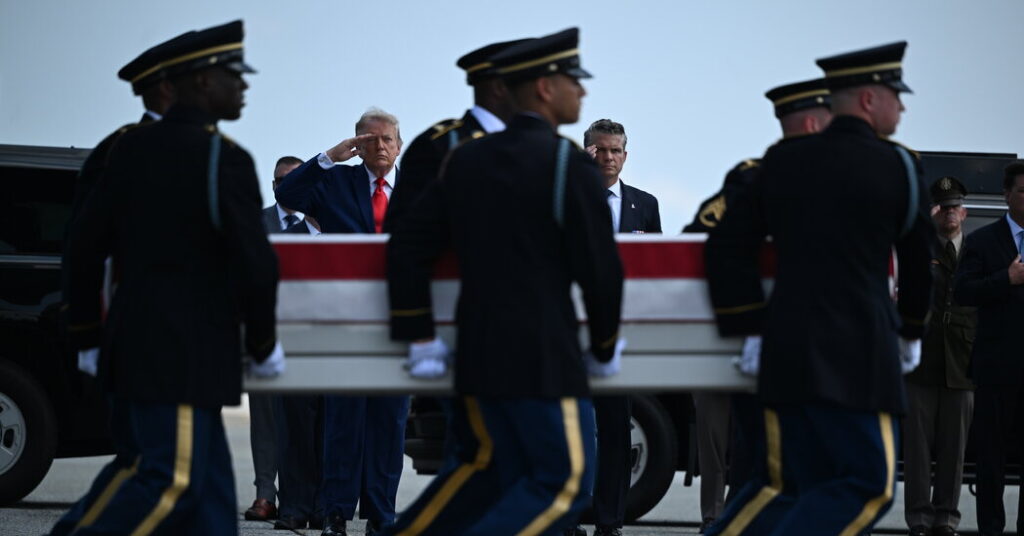
The U.S. has suffered 18 killed and 824 wounded in the war, according to a Pentagon casualty database.
Logistics issues
The destruction of the Navy’s main logistics hub in Bahrain forced the Pentagon to look for additional supply ships that were outfitted to transfer fuel and supplies to warships at sea, the report said.
The Navy’s move to use the British-owned island Diego Garcia — roughly 2,200 miles from the Arabian Sea — as its new logistics center means that supply ships have to spend two to two and a half weeks to travel to the island, take on goods and fuel, and return to the Navy’s main operating areas outside the Persian Gulf, according to the report.
Strain on other combatant commanders
Of all the Pentagon’s “combatant commands,” which are responsible for military operations in different parts of the globe, U.S. European Command, based in Germany, has provided the most support to the Iran war, according to the report.
It transferred “munitions, equipment, aircraft and personnel, and requisitioned and distributed fuel, food, and medical supplies” to Central Command, which oversees operations in the Middle East.
Mr. Hegseth ordered Pacific Command, which is based in Oahu, Hawaii, to pursue and board suspected Iranian merchant ships in the Indian Ocean — expanding the mission far outside the Middle East.
Pacific Command was also ordered to give up six warships for the Iran war. They included the aircraft carrier strike group centered around the U.S.S. Abraham Lincoln, which left San Diego on Nov. 21 and spent roughly nine months at sea without a port call for its crew to rest.
The ship is currently returning to its home port in Southern California.
The post Pentagon Inspector General Details U.S. Losses and Challenges in Iran War appeared first on New York Times.