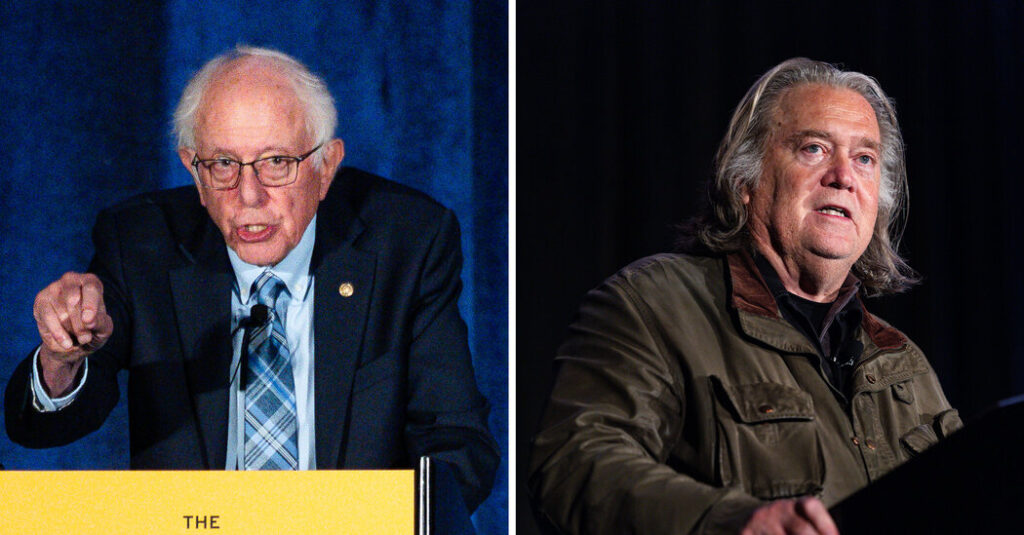
In thundering, back-to-back speeches, Senator Bernie Sanders and Stephen K. Bannon on Tuesday denounced the billionaires who run the country’s largest tech companies and urged Americans to demand tighter restrictions on artificial intelligence before its capabilities exceed human control.
The unusual public appearances by the country’s elder democratic socialist and a leading architect of the MAGA movement, at a conference in Washington, underscored the deep and rising anxiety over the potential destructive power of artificial intelligence. As calls to regulate the technology have grown louder, transcending political allegiances, there is little consensus from Congress or the White House about what a national policy would look like.
“When you are racing towards a cliff,” Mr. Sanders said, “you hit the brakes.” He added, “We are at a dangerous and unprecedented moment in world history. And it is imperative for all of us to stand up.”
Everyone attending the event, the Pro-Human Assembly, seemed in agreement about the threat that A.I. may someday wipe out humanity. But for a few hours, A.I. produced a less catastrophic outcome: It united the participants — Republican and Democratic politicians, evangelical Christian, Mormon and Catholic leaders, artists and others — in agreement that human beings, not machines, should control their own destinies.
The conference, which was hosted by the nonprofit Future of Life Institute, drew several hundred people who listened to hours of speeches about the deepening anxiety in Silicon Valley, Washington and beyond about the race to rein in A.I. before its computing power becomes unstoppable.
A slogan embroidered on hats being handed out to attendees captured the sentiment shared by most carbon-based life-forms in the room: “Keep the future human.”
Such concerns have intensified with surprising speed lately.
Last week, an Anthropic researcher who had previously worked at OpenAI went public with his decision to resign, saying that he believed both companies were acting irresponsibly.
In response, the chief executives of the A.I. start-ups Anthropic and OpenAI acknowledged their own fears that their technologies are advancing at an alarming pace.
Seven in 10 Americans said they are afraid A.I. will weaken human bonds, according to a poll released this week by Elon University, and about six in 10 say A.I.’s potential to take over most human tasks will undermine an individual’s sense of purpose. A separate poll from The New York Times found that 61 percent of voters oppose the construction of data centers, the massive warehouses that power A.I.
But there is little agreement in Washington about how to mandate a slower, more regulated approach to A.I. development. The White House and congressional leaders have sent conflicting signals. On Monday, President Trump dismissed calls for safety guardrails on A.I., calling fears of the technology as a “hoax.” He warned he could take criminal action against the heads of A.I. companies for any harms created by their technologies.
Anthropic declined to comment and OpenAI did not immediately respond to a request for comment.
(The New York Times has sued OpenAI and its partner, Microsoft, accusing them of copyright infringement of news content related to A.I. systems. OpenAI and Microsoft have denied those claims.)
At the conference, speakers pitched a wide array of regulatory proposals, without consensus on whether regulators should intervene to fully stop the development of A.I. Some leaders conceded they struggled to understand the technology.
Representative Greg Casar, for instance, proposed one solution the tech industry has resisted. “The answer is simple: We ban A.I. systems that are too powerful for humans to control,” said Mr. Casar, Democrat of Texas.
The speeches on Tuesday also conveyed, with a sense of disbelief from the speakers, about how such obvious, uncontroversial statements about human dignity needed to be said out loud.
“I can’t believe I have to say this,” said Representative Lori Trahan, Democrat of Massachusetts. “The future we all want is human. It’s nonnegotiable.”
“If we lose grip on this technology, we don’t lose grip as Republicans or Democrats,” Ms. Trahan continued, as she was interrupted by applause. “We lose it as human beings.”
A Catholic archbishop, an evangelical pastor and an elder from the Mormon Church voiced a wide variety of concerns.
Salvatore J. Cordileone, the archbishop of San Francisco, urged people to seize their agency while they still can. “We have to be the masters of A.I.,” he said.
His speech raised an unknown that weighed heavily on the minds of many at the conference: Is it already too late?
This heavy question and others were left largely unanswered.
Walter Kim, president of the National Association of Evangelicals, asked whether humans would be living without purpose in a world of “frictionless existence,” where he said A.I. is expected to solve most problems.
Ashley Judd, the actor and the chief negotiator for the union SAG-AFTRA, spoke for many in Hollywood about how A.I. has led to the spread of images of sexual abuse and disinformation.
Parents of teenagers who died by suicide after developing relationships with chatbots delivered tearful appeals for child safety regulation.
Representative Chip Roy, Republican of Texas, recalled encounters with constituents who described feeling powerless as data centers went up in their communities, with little consultation, and as their children became obsessed with technology they didn’t understand.
Technology, he said, should be a tool that people consciously decide to use, not the other way around. “We are not supposed to be tools for data collection and technology,” he said.
Both Mr. Sanders and Mr. Bannon decried the absence of any meaningful input into A.I. regulation by the tens of millions of working Americans whose lives they said would be most upended by A.I.
Mr. Sanders has introduced legislation to pause development of data centers and called for Mr. Trump to form an accord with the president of China, Xi Jinping, to ban superintelligent A.I.
Mr. Bannon said he doesn’t believe legislation will slow down A.I. because of Congress’ inaction. Instead, he called for presidential executive order to slow down development and ensure the biggest tech firms aren’t able to extend their power through their grip on the A.I. industry.
“American citizens are not going to be supplicants to the oligarchs anymore,” declared Mr. Bannon, who noted that despite the obvious areas of disagreement between him and Mr. Sanders, the high stakes of the moment demanded partisanship be set aside.
“We have to rise above it,” Mr. Bannon said. “This is a hinge in history.”
The post Steve Bannon and Bernie Sanders Demand Tighter Controls on A.I. appeared first on New York Times.