A federal judge ruled on Tuesday that the John F. Kennedy Center for the Performing Arts could not honor President Trump with an inscription on the institution’s exterior, blocking an effort by the center’s board to restore the president’s name to the building.
After the decision, Mr. Trump, who has been chairman of the center since early in his second term, posted a stark ultimatum to social media: If an appeals court does not agree to allow his name back on the building, he said, he would block a $257 million renovation of the center that he has been championing for more than a year.
“If the ruling is a negative one, which it should not be, and is not overturned by the U.S. Supreme Court,” he said in the post, “the Reconstruction and the Renovation of The Kennedy Center will not take place.”
Mr. Trump declared his position shortly after the center’s board voted — for the third time — to close the building for renovations, citing conditions that it deemed “hazardous.” In his social media post, Mr. Trump said the building would close “immediately,” a statement that was at odds with a court order blocking a closure.
The White House did not immediately respond to a request for comment.
In his order on Tuesday that barred the proposed inscription, Judge Christopher R. Cooper of the Federal District Court in Washington wrote that such an addition would violate his previous order that blocked the board from renaming the center after Mr. Trump.
“Simply put, defendants cannot install memorials for President Trump or anyone or anything else at the Kennedy Center without Congress’s blessing,” Judge Cooper wrote. “The board resolution bucks a federal court order and a statute Congress enacted.”
For weeks, Mr. Trump’s allies running the Kennedy Center have suggested that the president’s continued commitment to the institution was contingent on some conspicuous recognition on the building’s campus. Most recently, a draft resolution submitted to board members said the center was at risk of bankruptcy but could be saved by fund-raising by Mr. Trump — if he were to receive “appropriate recognition.”
Mr. Trump’s latest social media post made that quid pro quo even more clear. It said that $17 million raised by the president had been put into the center’s account “to keep it afloat.”
The post followed a day of rage directed at those blocking his agenda for the Kennedy Center. Shortly before the judge’s ruling was publicly released, Mr. Trump turned to social media to declare that the center was in a “virtual state of collapse.” The post called Judge Cooper “very hostile and conflicted” and went on to predict that the building was “destined to doom” unless it was allowed to close.
He continued those arguments during a virtual board meeting on Tuesday afternoon, where he got into a bitter argument with Representative Joyce Beatty, a Democratic ex officio board member whose lawsuit prompted the judge’s ruling, according to two people familiar with the meeting. They said that Mr. Trump and Ms. Beatty, who have been at odds in court for months, traded personal attacks: The president saying the congresswoman had “never built anything” in her life and Ms. Beatty called Trump “ignorant” and blamed him for the center’s financial problems.
The center first affixed the president’s name to the building in December after the board voted to recognize his role in securing $257 million from Congress for the sweeping renovation project.
In May, Judge Cooper ruled that the renaming as the Trump-Kennedy Center was unlawful and could only be decided by Congress, which had authorized the creation of the center and its dedication to President Kennedy. The judge ordered the letters spelling out the president’s name removed from the marble.
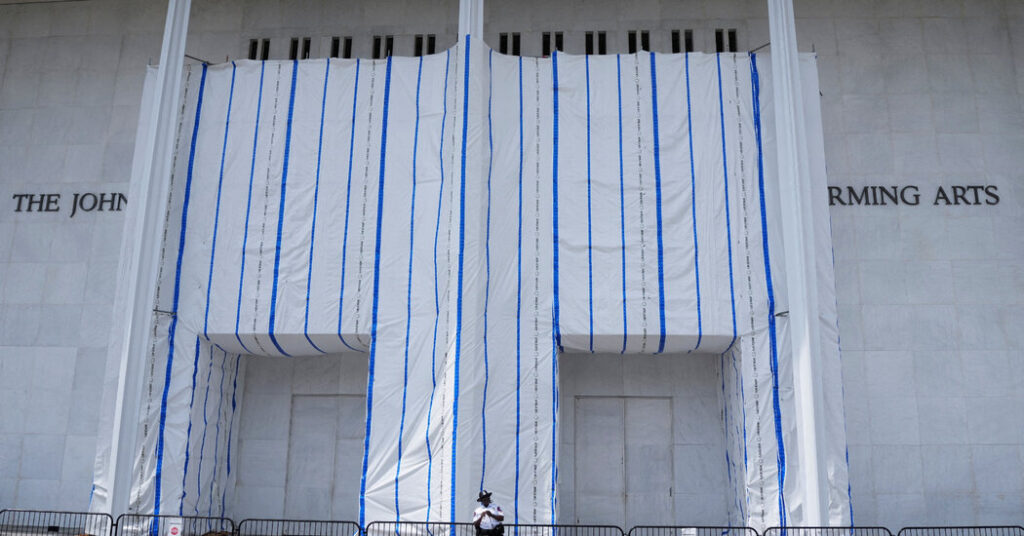
As it pursued an appeal, the center complied, installing a towering matrix of scaffolding covered in tarps that obscured much of the signage and is still up.
Last month its board voted to restore Mr. Trump’s name in a different form, aggressively testing the judge’s previous order. The resolution approved by the board proposed an inscription under the building’s main signage that would read “renovated and restored by President Donald J. Trump.”
Calling the decision “linguistic gymnastics,” the judge wrote that the new inscription would violate his previous order, as would a proposal to rename the center’s grounds the “President Donald J. Trump Plaza.”
He declined to rule on whether a different inscription — saying “endowed by The Trump Kennedy Center Fund” — would be allowed because the center said it would not pursue the addition until an endowment fund dedicated to the president raises $100 million. But he suggested that he was not likely to approve it, writing that such language would violate his previous order “just as plainly” as the first proposal.
The board’s attempt to inscribe Mr. Trump’s name was met with furious objections from Democratic lawmakers, including Ms. Beatty, whose lawyers called the effort a “breathtaking act of defiance” and asked the judge to block the center from adding the inscription.
“Legal sanity has once again prevailed over Trump’s vanity,” Ms. Beatty’s lawyers, Norm Eisen and Nathaniel Zelinsky, said in a statement following the order on Tuesday.
In recent weeks, Kennedy Center officials and Justice Department lawyers have presented the inscription as crucial to rehabilitating the center, which they have said is in financial disarray and physical disrepair.
“An order blocking the board from appropriately recognizing President Trump will cause donors to flee, financial contributions to dry up, and structural rehabilitation to stop,” Justice Department lawyers wrote in court papers filed in the case. “There will simply not be the expertise or funding necessary to rebuild and renovate this decimated structure.”
Lawyers for Ms. Beatty have characterized Mr. Trump’s position as effectively “taking the center hostage.” Since the president took control of the institution at the start of his second term, it has seen waves of cancellations by artists, plummeting attendance by audiences and withdrawal of support from some donors.
The board’s decision to recognize Mr. Trump with an inscription was an effort to find a workaround to a provision in the federal law governing the Kennedy Center that says “no additional memorials or plaques in the nature of memorials shall be designated or installed in the public areas.”
The U.S. Court of Appeals for the District of Columbia Circuit has yet to rule on whether Mr. Trump’s name can be restored to the center — a pending decision that Mr. Trump referenced on social media and could ultimately be appealed up to the Supreme Court.
At the center’s board meeting on Tuesday, trustees discussed an incident this month in which a five-foot-long section of plaster fell from the ceiling of the center’s Grand Foyer during a storm. A memo from the center’s executive director, Matt Floca, that was distributed to trustees attributed the incident to persistent problems with “water infiltration” in the building. The board resolution approved by members described the building “unsafe for continued occupancy.”
The court had temporarily blocked the center from carrying out its initial decision to close the building after finding that board members had been “derelict” in considering the president’s closure plan before approving it. Justice Department lawyers said they will formally ask Judge Cooper to lift that order so the center can close the building, but they have yet to do so.
The center plans to put on limited programming at a smaller addition to the center called the Reach, and to host marquee events, such as the Kennedy Center Honors, at a different location.
The center’s programming schedule has been largely bare since July, when it was initially slated to close, leaving a mostly empty building. The judge has ruled that by law, the center must be maintained as a living memorial to Kennedy, and officials have said that the Reach will also be adapted to serve that purpose.
At a court hearing ahead of the judge’s order on Tuesday, William S. Jankowski, a Justice Department lawyer, said it was possible that the center could end up approaching bankruptcy if it continued to operate with reduced revenue.
Judge Cooper asked if it was possible for a charitable trust to declare bankruptcy, but the Justice Department lawyers did not have an answer.
The post Trump Fights Back After Judge Says Name Must Stay Off Kennedy Center appeared first on New York Times.