The financial well-being of Americans held relatively steady last year, even as the cost of living continued to climb.
The poverty rate was 13.1 percent in 2025, the same as in 2024, according to data released on Tuesday by the Census Bureau. Poverty for children and people over age 65 did not change, while poverty among those without a high school degree rose. The share of Americans without health insurance stayed level.
Median household income improved last year to $87,460, the highest level on record, adjusted for inflation. But Americans remain highly anxious about their ability to pay for groceries, housing, child care, and other goods and services. Inflation remains elevated, eroding workers’ paychecks. Higher gas prices brought on by the war in Iran are further straining household budgets.
The poverty data does not capture many of the changes enacted in the sweeping Republican domestic policy bill passed in July 2025, including substantial cuts to Medicaid, the Supplemental Nutrition Assistance Program and other government aid. Analysts and advocates for those programs anticipate that the effect of reductions to the country’s social safety net will become more visible in the reports that cover 2026, 2027 and beyond.
“In many ways, 2025 represents a base line from which we’ll see bigger cuts in the years after,” said Gideon Lukens, a senior fellow and the director of research and data analysis at the Center on Budget and Policy Priorities. “It’s the calm before the storm.”
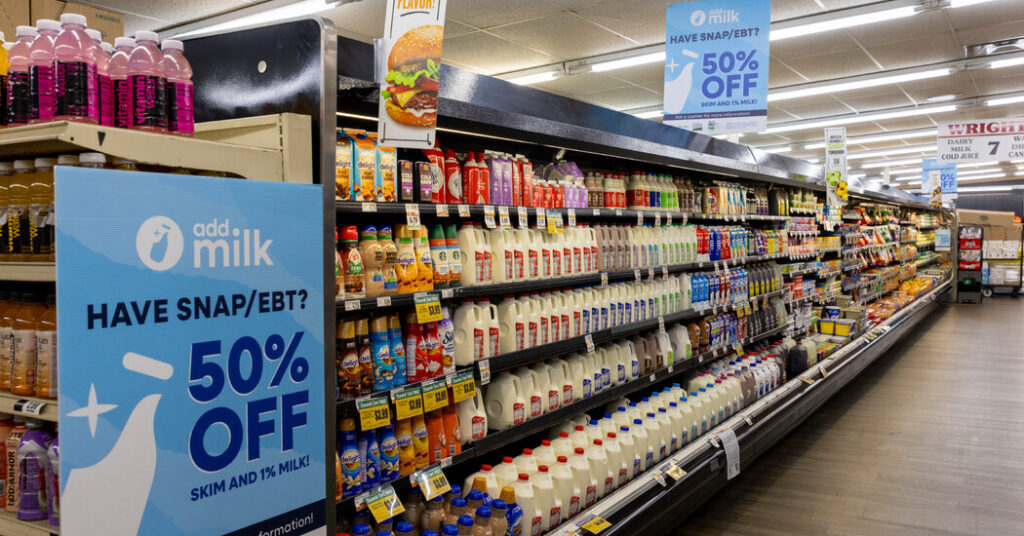
Many of the safety net programs that are facing steep cuts prevented people from falling into hardship last year. Refundable tax credits, including the earned-income tax credit and the child tax credit, shielded 6.1 million people from poverty in 2025. SNAP benefits lifted 3.1 million people out of poverty. On the flip side, medical expenses drove 7.7 million people into poverty, a number that could increase in the coming years because more Americans are expected to lose health coverage as a result of legislative changes.
For Alicia Quirk, 30, federal programs including Medicaid and food stamps have been instrumental in keeping her family afloat. She and her husband, who have three young children, used to make $100,000 a year as corrections officers at the county jail. But she stopped working three years ago to care for her son, who struggles to keep his oxygen levels up and has autism and epilepsy. Her husband, seeking a more predictable work schedule, now works in construction making $25 an hour.
His wages, along with her occasional stints delivering for DoorDash and Instacart, are generally enough for necessities and items for her children, though she sometimes forgoes paying rent or utility bills when things get tight. Still, she was dismayed and confused when she received a letter recently informing her that she was losing her food stamp benefits because her family’s income exceeded the eligibility limit. Her husband’s construction job is temporarily paused, so he is not bringing in any income.
“Everyone still has to eat, and everyone still needs all these things,” she said.
The Census reports are considered the most complete accounts of the nation’s rates of poverty and health insurance coverage, but the data lags. The reports for 2026 will not come out for another year.
The official poverty rate, which is considered to be an outdated measurement because it does not take into account many of the government’s anti-poverty programs, ticked down slightly to 10.2 from of the AI 10.7 in 2024.
The data reflected the low unemployment, solid wage growth and strong hiring in health care and related professions that characterized the job market last year.
Median earnings for women working full time increased 3.2 percent and stayed flat for men, which drove the ratio between female and male earnings up to 83.9 percent and reversed two years of declines.
Steven Durlauf, the director of the Stone Center for Research on Wealth Inequality and Mobility at the University of Chicago, said that divergence aligned with shifting dynamics in the labor market, including the decline in labor force participation for men.
“These numbers are reflecting the compositional changes in jobs that emerged over the last year,” he said.
The fairly stable headline numbers in the reports mask some concerning signs below the surface.
The supplemental poverty rate for people 65 and older, for instance, climbed to 15.4 percent last year from 9.4 percent in 2020.
The Ohio Association of Foodbanks has seen demand for its food services increase since the pandemic, partly because older Ohioans who often have set incomes are having more trouble adjusting to rising costs, said Joree Novotny, the organization’s executive director.
“Those fixed incomes aren’t able to stretch and keep up with much higher-than-average rates of increases of basic necessities,” she said.
She is worried that the Trump administration’s new rules restricting food stamp eligibility could make it even more difficult for Ohioans to feed themselves.
The data also revealed that income inequality persisted last year. The wealthiest households saw their income increase 1.7 percent, while the poorest households effectively experienced no change in their income.
“The people who are feeling the inflation impact are people who are lowest income,” said Wendy Chun-Hoon, the president of the left-leaning Center for Law and Social Policy.
Overall, the share of Americans who lack health insurance did not change much. The uninsured rate was 7.9 percent in 2025, similar to 2024. But the uninsured rate has very likely risen higher this year. The expiration of tax credits that helped many Americans buy health insurance in Obamacare marketplaces has driven a drop in enrollment by several million people.
Legislative changes to SNAP have also caused reductions in enrollment. Nationwide, enrollment in the food assistance program has fallen, with particularly drastic reductions in a handful of states.
The tax and domestic policy bill the Republican Congress passed last year will also bring changes to health care programs next year that are expected to further increase the uninsured population. The law added a new work requirement for childless adults in Medicaid and restrictions on coverage in several public programs for legal immigrants. The Congressional Budget Office estimates around 10 million more people will be uninsured in 2034 as a result of the legislation.
The post Poverty Rate Was Stable Before Trump’s Safety Net Cuts Gained Force appeared first on New York Times.