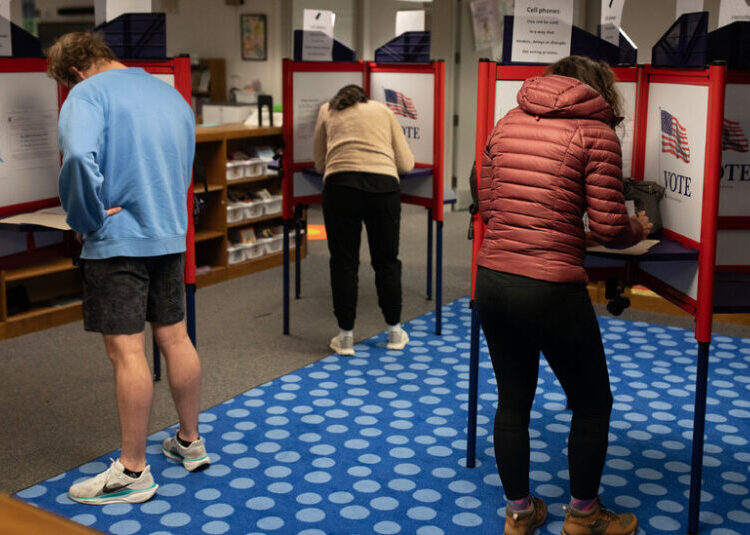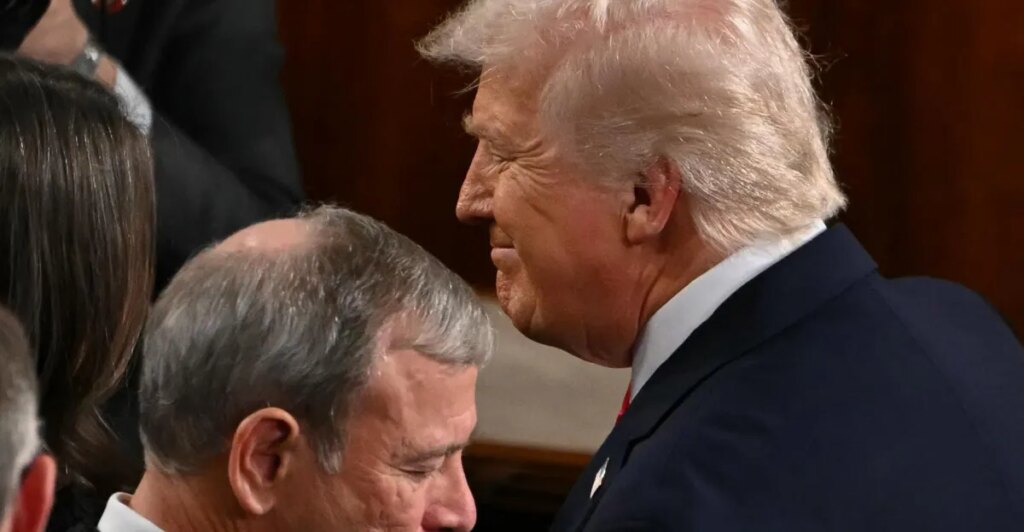
On Monday evening, the Supreme Court handed down its long-awaited decision in United States Postal Service v. California — the case involving President Donald Trump’s attempt to sabotage voting by mail in the United States.
If Trump’s attack on mailed ballots had succeeded, it would have given a significant advantage to Republicans in the upcoming midterms because Democrats were much more likely to vote by mail than Republicans in the last several US election cycles.
The decision is a rout. Trump didn’t just lose; the Court’s brief order slips in a line indicating that Trump exceeded his authority and cannot implement such an attack on voting by mail under any circumstances. Not one member of the Court, including the dissenting justices, argues that Trump had the power to shut down voting by mail in the way he attempted to. Trump, in other words, found a line that even this Supreme Court would not let him cross.
The decision in USPS is also the second Supreme Court decision in less than a week that shuts down a Republican Party effort to skew the 2026 midterms in its favor. Last week, the Court ruled that the state of Missouri must use the same congressional maps it used in 2024 (which elected two Democrats), instead of new maps that were expected to elect seven Republicans and only one Democrat.
All of this, from a Court where Republicans hold six of nine seats, and where that Republican majority is often unafraid to go out on a limb to benefit the GOP and its leaders. This is, after all, the same Court that held that Trump is allowed to use the powers of the presidency to commit crimes.
So what’s going on?
The short answer is that, as the Court moves rightward, the mix of cases that reaches the Supreme Court also changes. Liberals and Democrats — or, at least, savvy liberals and Democrats — stop bringing lawsuits that rest on legal theories that right-leaning judges are unlikely to accept. Republicans, meanwhile, grow more brazen and start bringing cases that would be summarily rejected by a less friendly bench. And red-state lawmakers decide to roll the dice on laws that would be immediately declared unconstitutional if the federal courts were less Republican.
As Dartmouth political scientist Brendan Nyhan wrote after the Court (despite its Republican majority) had an unusually liberal term in 2015, “the court’s recent decisions may reflect a change in the cases being considered by the court rather than a shift in the preferences of the justices.”
Eventually, however, lawyers and policymakers who raise dubious legal theories or who enact clearly illegal policies will do something that is so beyond the pale that the justices will start to push back, and that’s what happened in USPS. Republican lawyers and policymakers will undoubtedly make more attempts to skew the midterms in the coming weeks. At the very least, the USPS decision shows that there are some limits to what this Court will tolerate.
Trump lost, badly
Trump’s attack on voting by mail wasn’t just illegal; it also imposed such heavy burdens on state election officials so close to the 2026 election that it likely would have been impossible for many states to comply with Trump’s new policy.
USPS concerned a wide range of new restrictions on mailed ballots that the Trump administration announced in late August, just weeks before states needed to start mailing those ballots to voters. Among other things, the new rules required states to mail ballots in envelopes that include several federally mandated design features. These envelopes were to be preapproved by a federal official, and the Postal Service would refuse to deliver ballots that do not comply.
The new rules also required state officials to enter certain voter data into an online platform that doesn’t actually exist yet, but that the Trump administration has insisted will be available anytime now.
Many of the new rules appeared designed to make it impossible for states to distribute ballots by mail. One new requirement, for example, was that mail ballot envelopes must be individually scanned in a process that the Trump administration claimed will take “less than a minute per mailpiece.”
But, as several states that sued to block the rules pointed out in their complaint, the state of California alone needs to mail 23 million ballots to voters. So that adds up to as much as “23 million minutes…or more than 43 years” that state officials would need to spend just to comply with one small part of the new regulations.
Trump had claimed that vague statutes that permit the Postal Service to adopt rules governing the “collection, handling, transportation, delivery, forwarding, returning, and holding of mail” or to make rules “as may be necessary in the execution of its functions” allow him to effectively shut down voting by mail throughout the United States.
Broadly speaking, the Court could have blocked these new requirements in two ways. They could have either concluded, as several lower courts already have, that the Trump administration lacks the legal authority to issue the new rules. Alternatively, the Court could have concluded that it would not be “equitable” to allow the new rules to go into effect during the 2026 election, given the high likelihood that states could not comply with them.
A majority of the justices, however, decided to go with both options. Though the Court’s order is brief — only three sentences long — it states both that Trump is “unlikely to succeed on the merits” of his claim that the new rules are legal, and also that “the equitable factors applicable for obtaining emergency relief from this Court do not favor” Trump.
Translated from the legalese, that means that most of the justices concluded both that the new rules cannot be implemented in 2026, but also that they most likely cannot be used in any election because the Trump administration lacks the authority to implement them.
Justice Samuel Alito is the Court’s most reliable Republican Party partisan, and so he did write a dissent, joined by Justice Clarence Thomas, that would allow Trump’s attack on mailed ballots to take effect. But it’s notable that even Alito doesn’t try to argue that Trump’s rule is legal. Instead, Alito makes a convoluted procedural argument that, he claims, allows Trump to dodge judicial review of his new rules — at least for now.
Briefly, Alito argues that federal law makes it relatively easy for plaintiffs to challenge Postal Service rules governing “the mailability of matter,” but much harder to challenge rules that do not concern what can be mailed. He also claims that Trump’s new rules do not count as restrictions on “mailability,” even though those rules would forbid the Postal Service from delivering ballots that do not comply with a labyrinth of new restrictions.
Alito, in other words, is clearly much more willing to excuse weak arguments from the leader of his own political party than are many of his colleagues. But the biggest takeaway from the USPS decision is that not all of the Court’s Republicans are incapable of shame.
The Court’s Republican majority is extraordinarily tolerant of Trump’s antics. They gave him the right to commit crimes. They ruled that Trump may order the Justice Department to bring “sham” investigations and prosecutions against his perceived enemies. They’ve largely immunized ICE officers from the law, and blessed “Kavanaugh stops” that target suspected immigrants because of their race.
But there is apparently still a line that most of the Republican justices will not allow Trump to cross. And shutting down voting by mail a couple of months before an election crosses that line.
The post The Supreme Court has finally had it with Trump’s plan to steal the midterms appeared first on Vox.