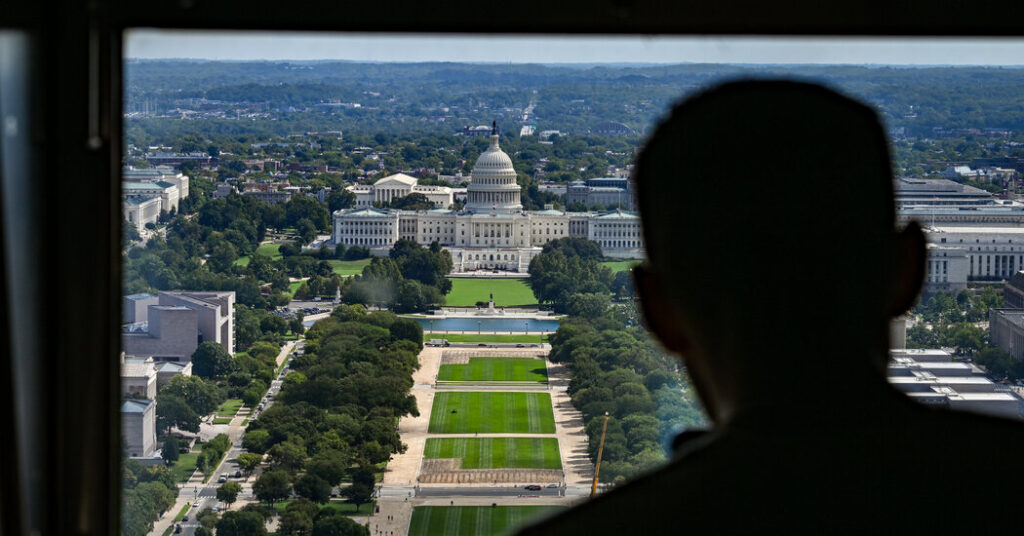
Even as some in Silicon Valley clamor for new regulation targeting artificial intelligence, their urgent warnings have failed to inspire action in Washington, where there are many ideas on Capitol Hill — yet seemingly little consensus to act on them.
Over the past two years, Democrats and Republicans in Congress have issued a battery of measures that would slow down A.I. development in response to safety concerns, limit access to the technology to address national security risks and tend to the potential economic fallout from mass automation.
But lawmakers have largely failed to enact any of the proposals, having been stymied by persistent partisan divisions and, in some cases, fierce lobbying by the tech industry.
The consequences of inaction have become starkly apparent, as top executives and engineers at Anthropic and OpenAI begin to call for a global slowdown in A.I. development to steel the U.S. economy against the safety risks. Those warnings include what some say is a threat to civilization itself, if rogue, autonomous A.I. agents gained the ability to bypass constraints imposed by its human makers, or if A.I. facilitated the creation of dangerous new cyberattacks or bioweapons.
“The conversation is not new,” said Representative Ted Lieu, Democrat of California, referring to the worries about artificial intelligence run amok. “What has happened is that the A.I. models have gotten far more advanced, far quicker than people had expected, and it’s moved that conversation up.”
But the slew of bills introduced in response seem to have been overlooked by Republicans in control of the House and Senate. President Trump has also opposed recent calls for new A.I. regulation, claiming that its potential for harm is a “hoax.” Members of his party are unlikely to advance significant legislation in the face of his objections.
As a result, Mr. Lieu said, “There is essentially zero federal laws on A.I.”
Addressing imminent safety risks
The most pressing A.I. debate in Congress concerns what role, if any, Washington should play in reviewing cutting-edge models before or after they are released to the public. The concern is that A.I. left unchecked could pose an imminent threat to American life.
While Mr. Trump signed an executive order in June creating a framework for government reviews, that system is voluntary, which has prompted a variety of legislative efforts for Washington to take a more active role in testing, reviewing or halting risky A.I. development
Many of the bills have been stalled.
The measures include the Frontier Act, a bill unveiled in July by Representatives Jay Obernolte, Republican of California, and Lori Trahan, Democrat of Massachusetts. It would require the largest A.I. companies to publish reports on their models, including any safety incidents. The companies would also have to undergo audits by independent organizations — an idea increasingly endorsed by A.I. companies — while the Commerce Department could suspend technologies if they posed imminent catastrophic risks.
In exchange, that bill would offer a boon to Silicon Valley: If passed, it would block states in many cases from issuing their own regulations. That pre-emption has proved contentious, given that many states believe Washington has taken too long to act.
Nevertheless, the Frontier Act is just one of a series of similar bills that try to enhance A.I. oversight, though the mechanisms differ: Some involve federal agencies, for example, while others create independent commissions akin to watchdogs for the financial industry. But each proposal shares a desire to ensure that Silicon Valley is not the sole arbiter of its own safety record.
One of the most closely watched proposals has not even been released: a bill by the Senate majority leader, John Thune, Republican of South Dakota, and Senator Amy Klobuchar, Democrat of Minnesota. The focus is expected to include “catastrophic risks involving biological or nuclear threats,” Senator Ted Cruz, Republican of Texas said on social media last week in describing his efforts to help draft the measure.
Mr. Cruz and Ms. Klobuchar share one of the few successful examples of A.I. regulation: Last year, they clinched a law meant to help stop the spread of nonconsensual, A.I.-generated imagery, known as “deepfakes,” addressing a major child safety issue.
But most other bills targeting the privacy, security and safety risks from A.I. remain stuck. That includes a bill by Mr. Lieu and Representative Nathaniel Moran, Republican of Texas, that would require that A.I. systems have a “kill switch,” which could allow the government to shut off or throttle an A.I. model that poses an imminent threat.
The idea of a kill switch has gained traction among lawmakers in both parties, including from Representative Anna Paulina Luna, Republican of Florida, who has recently called on the House to hold a special session on A.I. This week, she pointed to concerns about losing the A.I. race to China and a lack of technical fluency on Capitol Hill as reasons for stalled progress.
“If it’s your average older member, they are not necessarily tracking this to the magnitude that they should be,” Ms. Luna, 37, said of her colleagues.
Experts say enacting the proposal would be technically challenging, but the idea has still gained traction. Senator John Kennedy, a Louisiana Republican, said he planned to try to bring a kill switch bill to the Senate floor on Wednesday.
Protecting national security
Many in Washington are also troubled by the national security implications of A.I. — the way the technologies, and the computer chips that power them, may be weaponized.
To that end, some recent bills have sought to address the overlap among the industry, the Pentagon and U.S. intelligence agencies, along with restrictions on how adversaries, particularly China, can gain access to American know-how. These, too, have not seen final votes.
One bipartisan bill, the Advanced A.I. Security Readiness Act, would direct the National Security Agency to create a security plan to address vulnerabilities in data centers and the theft of sensitive technology from foreign adversaries. A second bipartisan offering, the A.I. Cyber Defense Act, seeks to help water and electric utilities protect themselves from cyberattacks by giving them free access to top-tier A.I. models.
Other legislation strives to limit A.I. in certain cases, such as a bill by Senator Kirsten Gillibrand, Democrat of New York, that restricts A.I. use in nuclear weapon deployment or for fully autonomous weapons. A similar proposal that recently passed a vote in the Senate Armed Services Committee as part of broader annual defense legislation would require human oversight before the military uses A.I.-enabled weapons.
Resolving severe economic disruptions
The rise of A.I. also carries great consequence for the U.S. economy: The technology could upend entire industries, perhaps leaving many Americans out of work. And it could have financial implications for families, given that the data centers powering A.I. rely on vast amounts of electricity and water, potentially causing utility prices to rise.
Those possible repercussions have attracted interest among Democrats and Republicans, reflecting a growing anxiety among their voters.
As soon as this week, the House is set to consider the Ratepayer Protection Act, which would nudge state regulators to prevent A.I. power demands from causing increases in electricity prices. But many consumer groups question the merits of the bill, essentially because they believe it is toothless and may not spare families from higher costs.
The potential for a great economic dislocation has also set off a nascent conversation in Washington about ways to retrain or protect affected workers — though these bills have not been successful to date.
One of the most prominent proposals, from Senator Bernie Sanders, independent of Vermont, would try to capture a share of the earnings generated by A.I. giants including OpenAI and Anthropic, which are set to go public. That money would be used to pay Americans and subsidize future federal support programs.
Lawmakers including Senators Josh Hawley, Republican of Missouri, and Mark Warner, Democrat of Virginia, have focused on tracking A.I.-related layoffs. In still another bill, Mr. Hawley and Senator Richard Blumenthal, Democrat of Connecticut, have aimed to make it easier for Americans to sue if A.I. companies train their models using copyrighted work that does not belong to them.
Increasingly, lawmakers are also troubled by the way in which tech companies have financed the breakneck pace of A.I. development. With the A.I. Bubble Transparency Act, for example, Senator Elizabeth Warren, Democrat of Massachusetts, has sought to amass more data so financial regulators can better prepare for the possibility of a bubble — one that, if it were to pop, could cause a catastrophic downturn in financial markets.
The post Congress Has Plenty of Ideas to Regulate A.I. Nearly All Are Stalled. appeared first on New York Times.