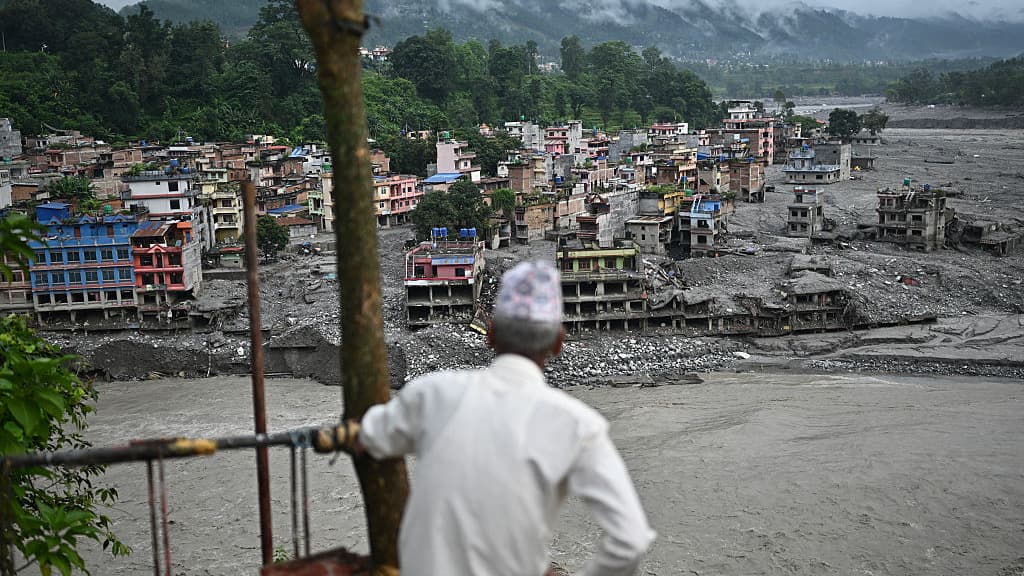
The floods in Nepal and Tibet have been terrifying: some 1,386 people have died, and around 5,000 remain unaccounted for. The flood destroyed bridges, hydropower projects and entire towns. The scale of the loss is immense but in Nepal and Tibet, the contours of such a disaster are grimly familiar.
The Himalayas have been regularly witnessing deadly flash floods. In July 2025, a flood originating in China crossed into Nepal through the Trishuli River basin and killed 19 people. Its dynamics were different, but also involved glacial meltwaters. A flood in the Indian state of Uttrakhand in 2021 killed more than 200 people, and another flood in the Indian state of Sikkim in 2023 killed 55 people. In 2022, the floods in Pakistan affected more than 33 million people, destroyed 1.7 million homes, and killed around 1,500.
How human choices multiply the flood damage
What is driving such recurring events? It would be easy to attribute the flood in Nepal and Tibet simply to climate breakdown. Nepal ranks sixth among the countries most vulnerable to climate risk, and Himalayan glaciers are melting faster as the planet warms. And climate change demonstrably contributed to other devastating events in the Hindu Kush Himalaya, including Pakistan’s 2022 floods.
The precise role of climate change in the Aug. 26 flood in Nepal and Tibet is not yet clear. The leading theory about the flood is that warming climate means permafrost might be thawing faster, and can cause landslides when it seeps into cracks between rocks. World Weather Attribution (WWA), an international group of scientists that models the role of human-induced climate change in extreme weather events, is yet to report on the flood in Nepal and Tibet.
Climate breakdown alone does not explain the scale of disasters in the Himalaya. Between June and August, India’s northeastern states of Assam, Nagaland, and Arunachal Pradesh experienced heavy rains and multiple flash floods. WWA found little evidence that these floods were a product of human-caused climate change. Instead, a host of other human choiceshelped create the conditions for disaster. Unplanned urbanization put more people in harm’s way. Deforestation left fewer trees to draw rainwater into the soil, and bare hillsides washed away more easily. Infrastructure disrupted natural drainage, leaving floodwaters nowhere to disperse.
The death and destruction caused by the flood in Nepal reflects a similar combination of factors. Keshab Kumar Sharma, a former secretary of Nepal’s infrastructure ministry, argued that unregulated industries, including riverbed mining and the dumping of excavated soil into rivers, had raised riverbeds and made the river channels more prone to flooding.
The worst devastation occurred in Nepal’s Rasuwa district, on the border with China. Yet Rasuwa has also been one of the country’s most rapidly developing regions, with new trade routes, border facilities, and Chinese-backed hydropower projects.
The interplay of water, infrastructure, and danger drives home the central lesson of disaster risk reduction: there is no such thing as a ‘natural’ disaster. A natural hazard becomes a disaster only when people are placed in its path. Had the floodwaters surged over uninhabited riverbanks where there were no people, roads, or farmland, the event would not have been called a disaster. For the damage to be so profound, the people in the flood’s path must also have been vulnerable: their homes, livelihoods, and sources of income exposed to destruction.
Then there is the question of tourism. The narrow valleys and mountain gorges around Rasuwa district, which are home to several hydropower projects, are also major tourist destinations. The disappearance of hundreds foreign tourists and pilgrims has brought greater attention to the disaster. Dependence on tourism also shapes a community’s capacity to recover. A tragedy of this scale cuts short the tourist season and leaves the people who rely on the trade in a precarious position.
There is no magic solution to this, because the other main economic option, agriculture, can be washed away just as thoroughly. Nepal’s National Disaster Risk Reduction and Management Agency estimates that the floods have damaged 1,806 hectares of agricultural land.
How to face the coming calamities
Rescue operations in Nepal are still under way. The need for emergency relief will persist for months, and recovery could take years. Floods will remain a clear and present danger, and they are likely to become more frequent and more destructive. The crucial question is: What must change to limit the devastation from future floods?
As they prepare for that future, Nepal and other places across the Himalayas would benefit from rethinking the type of tourism that they encourage. Nepal is currently a destination for low-cost, mass tourism. Last year, researchers at some of Nepal’s leading environmental NGOs and universities recommended curbing the environmental damage caused by mass tourism without sacrificing its economic benefits. They proposed a model of smaller-scale, higher-value tourism. Nepal needs fewer visitors who pay more. Bhutan has pursued such a model for decades, carefully controlling visitor numbers and managing tourism’s effects on the country’s environment and society. Costa Rica pursues a similar strategy.
Such a transition would not be easy for Nepal. Its infrastructure, businesses and reputation are all geared toward cheap mass tourism. Bhutan’s high-value tourism model benefits from a rarity value: foreign tourists with the exception of Indians have never had easy access to the country. Costa Rica has protected more than a quarter of its landmass in national parks, creating thousands of square miles of protected wilderness for tourists to visit. Other established mass-market destinations, like Thailand, are attempting a similar transition. Nepal could do so, too, but the shift would reduce exposure to disasters only if high-end hotels were built out of harm’s way and the infrastructure supporting them were made resilient.
There are also medium term measures that Nepal could adopt, some of them building on work already under way. Training people who live along river basins in evacuation procedures would help them make better use of existing early warning systems. Nepal has a well-established flood warning system, and, on Aug. 26, government authorities sent more than 600,000 early warning text messages to vulnerable communities in the flood’s path within a single minute.
A warning is only as useful as the response it evokes. Witnesses say that those who reacted immediately and ran to higher ground survived. Others, who hesitated briefly did not. A teacher who saved 900 students by quickly evacuating his school had answered calls from people he trusted, warning him about flood waters further upstream. In an interview with the BBC, he did not mention receiving an official text alert—a reminder that such warnings are effective only when people trust them and have practiced how to respond.
Flood-evacuation training could draw on Nepal’s experience with earthquake preparedness. After the Apr. 25, 2015 earthquake, which destroyed 50,000 classrooms but fortunately struck outside school hours, NGOs and the Nepal government collaborated on a program of drills and training for schoolchildren. That effort offers a potential model for flood preparedness in the mountains.
Floods in Nepal will keep coming. Glaciers will melt, rain will fall, and rivers will struggle to carry ever greater volumes of water. Disasters, though, are not inevitable. People will not abandon the Himalayas, and so the task is to find ways of living there more safely. Reducing disaster risk is difficult, but possible. Nepal has already laid much of the groundwork. Now it must build on it.
The post Nepal Cannot Stop the Floods. It Can Stop Them From Becoming Disasters. appeared first on TIME.