As the sound of drilling echoed around him, Mirlan Akzhigitov approached an architectural model of a 27-floor building with a toy helicopter perched on the roof. He turned around and beamed.
“The first skyscraper in Kyrgyzstan, in Kyrgyz history,” Mr. Akzhigitov joked, pointing out the penthouse he plans to call home once the building, the luxurious Royal Tower, is finished later this year.
The high-rise, in the Kyrgyz capital, Bishkek, is one of 24 simultaneous construction projects that Mr. Akzhigitov and his company, Royal, are developing. The new towers are part of a frenzied economic boom that is remaking Kyrgyzstan, a mountainous Central Asian nation of about seven million people.
One of the primary drivers of the upswing: Russia’s faraway war against Ukraine.
After sanctions and the departure of major international corporations isolated the Russian economy in the wake of the 2022 full-scale invasion, Kyrgyzstan became a key conduit for Chinese and Western goods that still flowed into Russia. Products like cars and electronics, and more sensitive equipment with both civilian and military uses, have transited through the former Soviet republic, as have the payments for goods.
Kyrgyzstan’s gross domestic product skyrocketed by 11 percent last year. The Asian Development Bank attributed 30 to 40 percent of the growth in the past four years to “re-export” activity. Goods exported from Kyrgyzstan to Russia do not face traditional duties because both countries belong to a customs union.
A surge in the price of gold, Kyrgyzstan’s top export, has also helped drive growth. So have a thriving crypto and finance sector and vast public spending on construction.
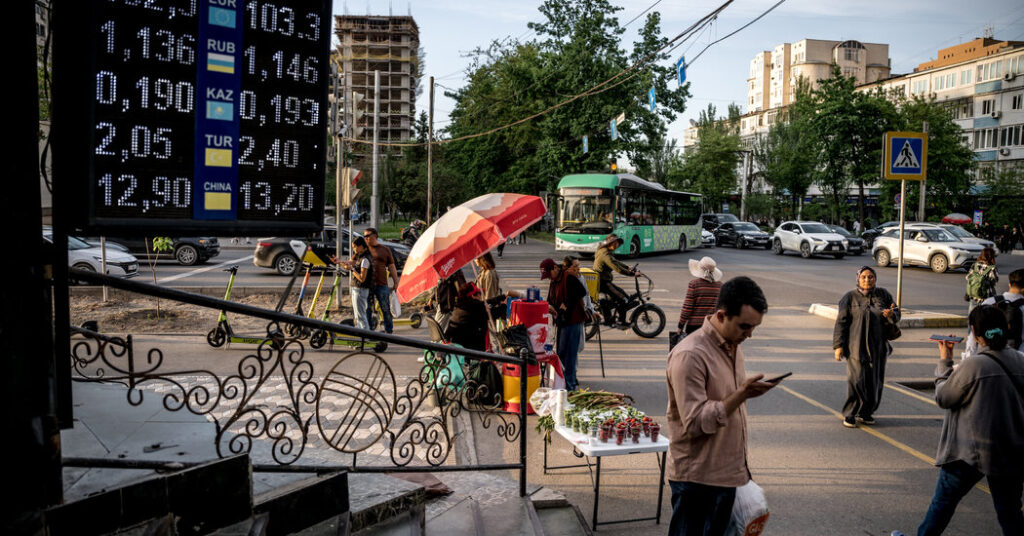
Today, Bishkek feels like a boomtown. The soundtrack is drilling. The skyline is a feast of cranes. Across the capital and the country, roads are being redone, airports are being constructed and big infrastructure projects, including stadiums and government complexes, are going up. South Asian workers have turned up as laborers on local construction sites, a marvel for many Kyrgyz, accustomed to years of working such jobs themselves abroad and sending money back home.
“There is a feeling that the economy has grown — it’s like a wave, and you want to ride it,” said Chyngyz Alkanov, a Kyrgyz entrepreneur who is building a huge logistics hub outside Bishkek to handle the trade flows.
The economic surge has bolstered the popularity of Kyrgyzstan’s leader, President Sadyr Japarov. Since rising to power in 2020, Mr. Japarov, a Kremlin ally, has consolidated his control with a crackdown on independent media, opposition politicians, demonstrations and civil society. That has ended Kyrgyzstan’s onetime aspirations to be a beacon of democracy in authoritarian Central Asia.
At the same time, Mr. Japarov pushed through technocratic changes to tax and customs collection that have spurred growth and allowed his nation to take fuller advantage of the economic surge. Since 2020, Kyrgyzstan’s tax revenues have jumped fourfold and customs duties sixfold, Mr. Japarov announced this year. Capital investments by the state have increased sixteenfold since 2021.
Higher-end Bishkek buyers have poured money into fancy new complexes with names like the Monte Carlo and the Brooklyn. The state mortgage company has extended hugely discounted loans to tens of thousands of public sector workers.
It’s a roaring economic crescendo, drowning out fears that the music will eventually stop.
“It will not keep going like this forever,” said Mr. Akzhigitov, the Royal Tower developer, who noted that apartment sales had begun slowing amid rising prices. “We are like on top of the mountain right now.”
An In-Between Nation
This spring, the Kyrgyz prime minister, Adylbek Kasymaliev, walked out onto the balcony of his country’s answer to the White House: a hulking gray-and-glass monolith that opened at the foot of the mountains in Bishkek in 2024.
A new government quarter was rising around him, with buildings for the tax service and the prosecutor’s office. More ministries will rise across the street.
“Right now, our only path is growth,” Mr. Kasymaliev said in an interview. “We plan to grow continuously over the next decade.”
He emphasized that it was not only “re-export” trade driving Kyrgyzstan’s rapid economic growth but also increased industrial output and the government’s success in collecting taxes.
Kyrgyzstan is constructing about 900 miles of roads a year and a railway connecting with China and Uzbekistan, Mr. Kasymaliev said, adding that 11 airports across the country were being renovated and scores of schools and day-care centers rebuilt.
But to some degree, the nation is now getting squeezed on both sides. Moscow is trying to crack down on things like gray-zone vehicle imports coming through Kyrgyzstan that have denied Russia much-needed wartime tax revenue. And Western countries have imposed sanctions on Kyrgyz entities for facilitating the Kremlin’s war.
About 80 percent of Kyrgyz people speak Russian, and more than 500,000 Kyrgyz citizens work in Russia, Mr. Kasymaliev added, though that number has dropped of late. Kyrgyzstan relies on Russia for oil, gas, iron, timber, fuel and lubricants, he noted.
“We are completely dependent on the Russian Federation,” Mr. Kasymaliev said. “Therefore, our economic relations will continue. We would like this not to be mixed with politics.”
He said that Kyrgyzstan had taken note of all sanctioned products specified by the European Union, the United States and Britain, “and these goods are very tightly controlled.” Companies that are singled out by the Western authorities are being shut down, he said.
Kyrgyzstan remains a significant, if waning, import node for wartime Russia. Exports from the European Union to Kyrgyzstan, for instance, amounted to about $2.5 billion last year, eight times more than in 2021, the year before the war. But they have fallen from a high of $3.1 billion in 2023, according to E.U. trade data.
Machinery, appliances and transport equipment accounted for about 45 percent of the European exports to Kyrgyzstan last year. Many exports are mundane European-brand consumer goods purchased by Russians who can no longer get them at home.
But some may have military applications. Kyrgyzstan, for example, imported nearly 15 times the amount of washing machines from the European Union in 2024 by value as it did in 2021, amid claims by the U.S. government that the Russian military was taking computer chips out of household appliances to fix equipment.
Mr. Kasymaliev said that suppliers sometimes said that goods were going to Kyrgyzstan on paper but that the products never touched Kyrgyz soil. He expressed frustration that the European authorities were penalizing Kyrgyzstan instead of controlling their own companies.
Sometimes, he said, “You get the sense that their main goal is to make the sale, and then blame Kyrgyzstan.”
‘New Rich People’
The rapid growth in Kyrgyzstan has caused anxiety about what’s next, with warnings from the International Monetary Fund that the economy is overheating. Russia’s closely linked economy is now struggling.
Kyrgyz inflation is hovering around 11 percent, meaning many have missed out on the recent economic juggernaut, particularly those with low incomes. Kyrgyz people without high-flying jobs wince at rising prices for food and rent. Some, even, are poorer now.
“All the growth and dividends are going to a fairly narrow group of people: those in finance, construction, logistics and people close to the state,” said Azamat Akeneev, a Kyrgyz economist. “New rich people have appeared in the country, those close to power.”
Many who have saved extra cash are putting their money into real estate, which is seen as a more reliable investment in the event of financial turbulence.
Mr. Akzhigitov said that buyers tended to put about 20 percent down for an apartment and aimed to pay the remainder over the next two to three years. His company can be flexible about the down payment, he said, sometimes taking a car in place of cash, for instance, or, in one case, a herd of cattle.
He expressed little worry about what comes next.
“We are living in this country,” he said. “We have been seeing all the ups and downs. I think it’s normal for us.”
Oleg Matsnev contributed to this report.
The post It’s Boom Time in Kyrgyzstan, Courtesy in Part of the War in Ukraine appeared first on New York Times.