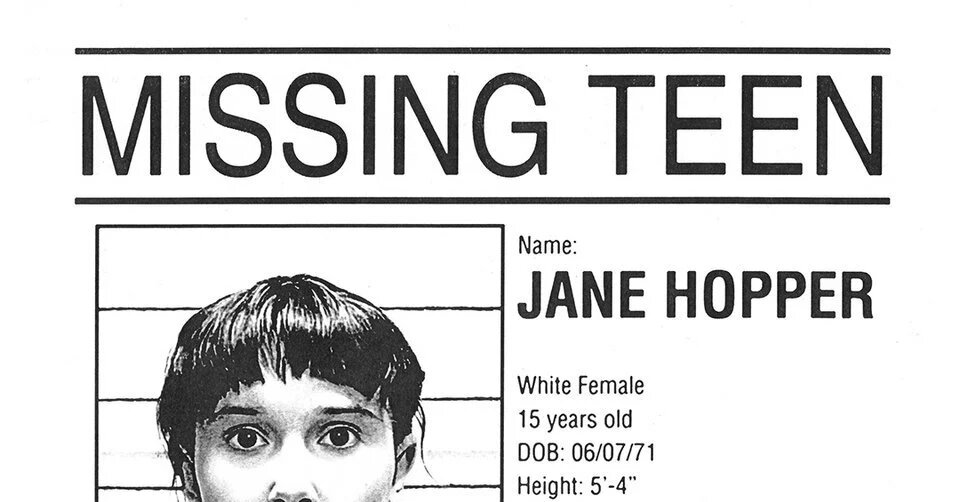
In the final season of the Netflix hit “Stranger Things,” which dropped last month, posters are put up around the fictional town of Hawkins, Ind., seeking the character Eleven (a.k.a. Jane Hopper, played by Millie Bobby Brown), along with a phone number to call.
If you’ve consumed even a few American movies or TV shows, you probably think you know how that phone number began. But this time, it was not the familiar 555 used by so many programs and films. Instead the number looked real: (765) 303-2020. The area code was even accurate: 765 is Central Indiana, the state where the show is set.
The authentic-looking number caused at least some fans to wonder, “What happens if I call it?”
The North American Numbering Plan Administrator, which regulates telephone numbers in the United States, officially reserves numbers for fictitious purposes — saving the average person from being inconvenienced, or worse, by constant requests to talk to Mark Scout or Homer Simpson.
But if you call (765) 303-2020, it really does sound like you have reached through time, space and the barrier between fiction and fact to arrive in the world of “Stranger Things.”
“Thank you for contacting the Hawkins Police Department,” a message on the other line says. “Due to the recent 7.4 magnitude earthquake, Hawkins is currently under lockdown to ensure the safety of our residents. The Hawkins Emergency Task Force is working closely with Hawkins P.D. to track down missing persons, of which Jane Hopper is a priority. We urge you, as a responsible citizen of Hawkins, to assist us in our search to locate her.” (At the end of season 4, a supernatural cataclysm occurs, thought by residents to be an earthquake. It’s that kind of show.)
While many shows still fall back on 555, “Stranger Things” is among the few that have used onscreen numbers for something different, offering Easter eggs for those with a little gumption or curiosity to punch in the fictional digits.
“Stranger Things” has done this before. In season 3, it revealed the home number of the conspiracy theorist character Murray Bauman. A call to the number gives a message saying, in part, “Mom, if this is you, please hang up and call me between the hours of 5 and 6 p.m. as previously discussed.” For strangers, it includes a brusque “never call here again; you are a parasite!”
You can also call the number for Saul Goodman, the titular character in AMC’s legal drama “Better Call Saul,” and get a cheery, “You’ve reached Saul Goodman!” The number of the brothers’ plumbing company in “The Super Mario Bros. Movie” connects to a recording of the actor Charlie Day as Luigi offering his services.
Trouble can arise, however, when filmmakers use numbers they haven’t locked up. The 2003 film “Bruce Almighty” made the mistake of providing a random phone number — worse, it was the phone number for God, which understandably prompted plenty of people to try it. A woman with the number in Florida, who was a non-deity, threatened suit, saying she was getting 20 calls an hour. (She had little luck, and was still receiving phone calls two years later, The Tampa Bay Times reported.)
When “Gilmore Girls” revealed the fictional phone number for the character Luke, it actually belonged to a guy named Matt. “My phone rings constantly, every single day,” he told Buzzfeed in 2016. He said he even answered his phone sometimes with, “Hello, this is Luke.”
That shouldn’t be a problem in Britain, where Ofcom, Britain’s broadcasting regulator, helpfully offers a website with thousands of numbers across many geographic areas that aren’t assigned to people and are available for use in television, films and plays.
And, if you’re of a certain age, all this talk of phone numbers might have a certain ’80s song running through your mind: “867-5309/Jenny” performed by Tommy Tutone, which hit the top 5 in 1982. Its extraordinarily catchy chorus repeated a number for “Jenny” again and again: “8-6-7-5-3-0-ny-ay-ay-ayn.”
No matter what their area code, telephone customers unlucky enough to be assigned that number began reporting getting calls, sometimes in the thousands. And the earworm is so strong, the calls have never stopped, with owners of the number reporting them continuing well into the 21st century.
So just to be clear, you can go ahead and call Hawkins P.D. if you must. But Jenny is definitely not there.
Victor Mather, who has been a reporter and editor at The Times for 25 years, covers sports and breaking news.
The post When the Phone Number in That TV Show Actually Connects Somewhere appeared first on New York Times.