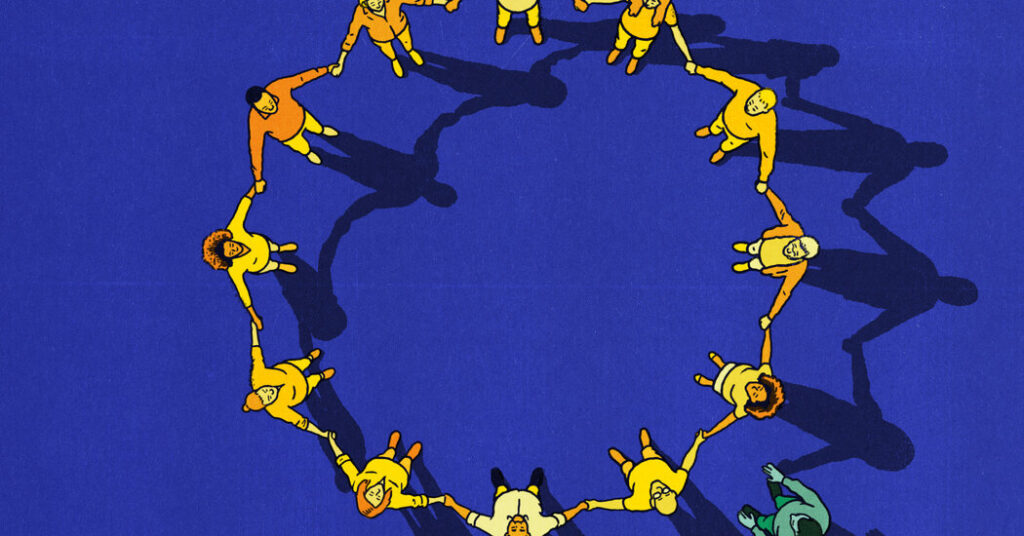
The historian Eric Hobsbawm was no friend of nationalism.
Growing up Jewish in the ruins of the German and Austro-Hungarian empires, he held an instinctual suspicion of all claims to national belonging. Yet as a phalanx of new nationalist parties entered European parliaments in the early 1990s, claiming that migration constituted a mortal threat to their communities, he offered a surprising interpretation. The appeal of anti-migrant politics, he speculated, lay less in a sense of national pride than in its ability to cover a hole at the heart of Europeans’ self-understanding. “There was no other way left to define group identity,” he wrote, “except by defining the outsiders who were not in it.”
The words carry a strange resonance for Europe today. More than six weeks after tens of thousands of migrants crossed into the Spanish enclave of Ceuta, hoping for passage to mainland Europe, immigration continues to dominate the continent’s conversation. Across European capitals, a common reaction has been to chastise Spain — whose relatively generous immigration policy is held responsible for the surge — and promise less permeable borders. With thousands still camping out in Ceuta and Prime Minister Pedro Sánchez of Spain struggling to contain the fallout, the subject seems unlikely to subside soon.
The furor clearly concerns more than migrants. Though polls indicate that European electorates care deeply about migration and want to see it addressed, such worries outstrip objective reality. Instead, the topic has become a prism through which all the continent’s ills are viewed, a convenient kaleidoscope of discontent. The problems of such a worldview are legion. Yet there is a deeper reason, beyond the continued arrival of migrants, for the continentwide obsession with outsiders: Europe doesn’t know what it is.
In European debates, migration is not simply presented as a problem to be managed. Rather, it is now held responsible for a gamut of problems, from poor social services to wage stagnation to crime. For the Dutch far-right politician Geert Wilders, the country’s housing crisis and debt levels are best explained by the influx of foreigners. Such thinking is no longer confined to the fringes. In Germany, for example, the coalition government of Chancellor Friedrich Merz has attributed the dilapidated condition of many of the country’s cities to newcomers.
Attempts to fact-check such claims — asserting that the effects of immigration are ambiguous, or warning that an aging continent needs new arrivals to sustain itself — miss the point. Research indicates that the far right’s surest footholds are in regions with comparatively few migrants, as in the German state of Saxony-Anhalt, where the Alternative for Germany party just scored a landslide victory. Europeans’ anxieties about migration increasingly appear to float freely, a heuristic through which they can make sense of the continent’s overlapping crises. This mode of thinking will continue to occupy the European mind for the foreseeable future.
The first reason is external. The consequences of global inequality were already glaringly obvious in Hobsbawm’s time. In the 1990s, he noted how Europe was “surrounded by poor countries with vast armies of the young, clamoring for the modest jobs in the rich world which make men and women rich by the standards of El Salvador or Morocco.” His conclusion was prescient: “These frictions will be a major factor in the politics, national or global, of the next decades.”
Indeed, these tensions have if anything deepened. Although global inequality technically fell in the past 30 years, that decline can largely be attributed to one country: China. Generally, the gap in living standards between the West and the rest remains dizzyingly large, a stubborn fact of global politics exacerbated by regional conflicts. It has also gained a jarring new visibility on the smartphone screens now widely available across the developing world.
The second reason is internal. Built as a common market before it came to resemble anything like a state, the European Union has always had difficulty articulating what it represented. In the late 1990s, the problem became manifest in the design of the bank notes that were to make up the union’s new currency. In the end, the euro was emblazoned with abstract shapes such as arches and aqueducts, rather than recognizable characters from Europe’s patrimony. To some scholars, this signaled that the union was above all a confederation of consumers.
In recent years, the union has embarked on a quest to define its “shared European home,” as Ursula von der Leyen, president of the European Commission, puts it. Along with chairs in E.U. studies, the bloc’s executive arm now finances initiatives aimed at raising Europeans’ sense of self. One was a well-publicized campaign by the commission called “Protect What Matters.” There, citizens were urged to appreciate the union’s founding principles, such as “free speech,” “free science” and “free press.” Even the bank notes are set to receive a makeover.
These efforts are undoubtedly attractive to some in the continent’s besieged borderlands, such as Ukraine and Georgia, where younger and more educated citizens still discern great promise in European affiliation. Yet it is unclear how much such campaigns can achieve. A succession of crises — chiefly economic, but also cultural and social — has made the argument for unity more challenging. At the same time, the transformation of many European countries into tourist-driven service economies has only worsened the disorientation.
This uncertainty about the continent’s character and future is strikingly — and perhaps ironically — perceptible on the far right. One of Mr. Wilders’s favorite spots in the Netherlands is the fairy-tale forest Efteling, located in the south of the country. The theme park, featuring gnomes, dragons and other figures from children’s tales, is not an example of local folklore but an imaginary world wholly outside of history. The far right’s fondness for “The Lord of the Rings” is suggestive of the same fantastical relationship with reality.
Perhaps political coherence should not be expected from a diverse set of 450 million people with no unitary state or single language. Yet nationalism at the member-state level is hardly less brittle, itself dependent on the boogeyman of migration. Unable to systemically unseat the power of Brussels, Europe’s far right clings to anti-migrant antics for an oppositional stance where there no longer is one. After all, the center and the far right have forged a consensus around stringent border enforcement and attempted deportations.
The result is something of a riddle. Migration is assailed from practically all sides as a threat to Europe’s identity. Yet in the 21st century, it is unclear what exactly that identity is. No longer the seat of globe-spanning empires, much less a world hegemon, the continent comes across as both prestigious and provincial: a cultural powerhouse suffering geopolitical marginalization. Civic Europeanism, for all the commission’s best efforts, will prove a feeble antidote to such ailments. Instead, it falls to migration to fill the void at the center of Europe’s self-image.
Anton Jäger is a contributing Opinion writer. He is a researcher at KU Leuven in Belgium and the author of “Hyperpolitics: Extreme Politicization Without Political Consequences.”
The Times is committed to publishing a diversity of letters to the editor. We’d like to hear what you think about this or any of our articles. Here are some tips. And here’s our email: [email protected].
Follow the New York Times Opinion section on Facebook, Instagram, TikTok, Bluesky, WhatsApp and Threads.
The post Europe Doesn’t Know What It Is appeared first on New York Times.