Wynton Marsalis thinks we’re going to get through this.
You can sense that in the conclusion of the wild and wildly affecting next-to-last movement of his hourlong Symphony No. 5, nicknamed “Liberty” and written for the 250th anniversary of the United States. After a feverish section that includes music for a bass-baritone, the programmatic music begins to tilt toward a sense of survival, even renewal.
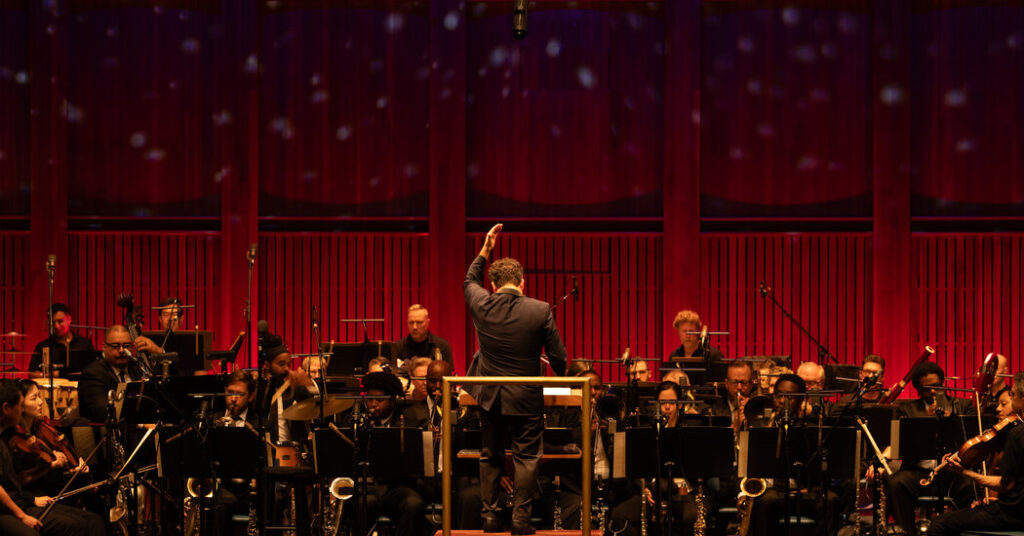
At this work’s world premiere in Virginia on Saturday — in a concert at Wolf Trap National Park for the Performing Arts by the National Symphony Orchestra and the Jazz at Lincoln Center Orchestra, conducted by James Gaffigan — a lot of people clapped after the movement’s conclusion. Some also stood, and some raised their hands in the air, as if following Marsalis’s score directions for a “sanctified” performance feel.
Not to suggest that Marsalis, the famed jazz trumpeter and composer, takes a uniformly blessed view of the American past and present in this symphony. Earlier in that same movement, he has a bass-baritone (sung on Saturday by the baritone Eric Greene) steadily repeat the movement’s title, “America My Home,” while observing widely varied instructions for how to express those words: “with warmth,” “flamboyantly,” “tenderly,” “with blues feeling,” “questioning” and so on.
Then Marsalis indulges his taste for Charles Ives-style chaos. In a section titled “Cacophony of Confederates,” biting attacks in the winds seem to prepare the brasses to play in an independent tempo; the jazz orchestra’s plunger-muted trumpets reach for grave “wa wa” exhalations. The singer is meant to “shout in terror” and to feel “anguished,” before “pleading” and, eventually, reaching a state of feeling “exasperated.” The orchestration tips into pandemonium for a couple of seconds before a blast of quiet, which is interrupted by a solitary, exposed moment for the percussion section.
After that, it’s back to the gospel- and blues-drenched motives and steady swinging feel that have anchored much of Marsalis’s music. The final score pages of “America My Home” contain subsections with titles including “Glory, glory,” “With grace” and “And peace remain.”
It’s one hell of a ride, and this year hasn’t yet produced any new art about the United States that hits harder than “Liberty.”
Two days earlier, Marsalis was rehearsing the symphony with the Jazz at Lincoln Center Orchestra in New York. This ensemble’s season begins on Thursday — with a concert of Marsalis’s big band arrangements of classic pieces by John Coltrane, Thelonious Monk and others — and it will be his last as the artistic director of the institution, which he has steered since 1987. (The question of who will take Marsalis’s place, after nearly four decades, is a topic of great speculation, and concern, in the jazz world.)
As the group locked into the 12/8 groove that follows the “Cacophony of Confederates” chaos, Marsalis shouted, “And we come up — returning from the dead!” During a pause in the playing, he talked to the musicians about the end of the movement, and the role they would need to play to bring out its meaning.
“It’s gotta have a belief in it, like old people in church,” he said. “They’re just sitting there, looking at you, like, ‘Yeah!’ We gotta have that effect when we start to play. Ultimate belief. With no cynicism at all.”
In an interview at his dressing room later, he further discussed this pivotal moment in the symphony. “It’s a part of why people say American music is optimistic,” he said, and added: “That’s what I am. With no evidence for it.”
The next day, the 15-member Jazz at Lincoln Center Orchestra folded itself into the substantially larger National Symphony Orchestra at the Kennedy Center in Washington. Gaffigan was tasked with blending the sound of the groups, and during a dinner break interview, he talked about his history with Marsalis’s music.
Gaffigan recalled leading the live premiere of Marsalis’s Violin Concerto; in August in Edinburgh, he conducted the First Symphony, “All Rise,” from 1999, and days later premiered Marsalis’s Concerto for Orchestra at the BBC Proms festival. Gaffigan said that although he initially had some doubts about the Violin Concerto, he now regards it as “a masterpiece.”
“I wish he wrote more, actually,” Gaffigan said of Marsalis. “And I think that’s his plan, now.”
Some fine details of this symphony were still being worked out in rehearsal. At the Kennedy Center, substantial time was given to the exposed percussion that follows the orchestral pandemonium and leads into the “Glory, glory” slow groove that Marsalis says holds “no cynicism at all.”
It’s not just any percussive thwack. In the score, Marsalis suggests the use of a ratchet and a desk bell to “simulate a cash register.” It’s a moment of sardonic humor about that old Marsalis enemy “Supercapitalism” (the name of a piece he recorded in 2006), situated between the “Cacophony of Confederates” and the old-people-in-church “absolute belief” that comes “back from the dead” in the movement’s ending.
At the Kennedy Center, the percussionists got the ratchet-and-bell, cash-register timing just right, and the musical staff members who were present in the Concert Hall burst out laughing. But at the Wolf Trap premiere, the ring didn’t come off at all — it sounded as if the desk bell had gone missing — so there was no laughter in the crowd, or any sense that people should have been laughing.
As with other granular details in this teeming symphony, there are sure to be future performances in which the moment shines. Perhaps it will work better in a traditional auditorium compared with the amplified, quasi-outdoor venue at Wolf Trap. (“Liberty” will travel to Cincinnati in October, before continuing to the other commissioning partners, including the St. Louis Symphony Orchestra and the Berlin Philharmonic next year.)
Yet there was a lot of delight and intrigue in Marsalis’s Fifth, thanks to some sterling playing from both ensembles. Of particular note was a sweetly singing, solo-then-duo passage for violin and cello, handled elegantly by the National Symphony’s associate concertmaster Ying Fu and the acting principal cello Raymond Tsai. Likewise dependable was the composite-Americana style Marsalis has honed across his orchestral catalog. (Think of Stravinsky in his American-inflected “Ebony Concerto” period, mixed with Ives and Bernstein — along with a lot of Ellington and Strayhorn, then the music of Marsalis’s native New Orleans.)
Asked, during the New York interview, about how he writes for a traditional orchestra and his own jazz ensemble, Marsalis said: “Complaint documents are interesting, right? The Declaration of Independence is a complaint document. ‘The Communist Manifesto’ is a complaint document. And they’re necessary.”
But, he added, it doesn’t make sense to bring together two ensembles to complain. “It’s better to come with solutions,” he said. “I have to find a solution for how our two trumpet sections are gonna play together. How is the oboe gonna be heard? How does this groove work, or what does this mean, and what does it mean to all of us? And if not, if we’re not searching for a common meaning, then we don’t need — all of us — to come together.”
The post A Wynton Marsalis Symphony Sees the Potential in America appeared first on New York Times.