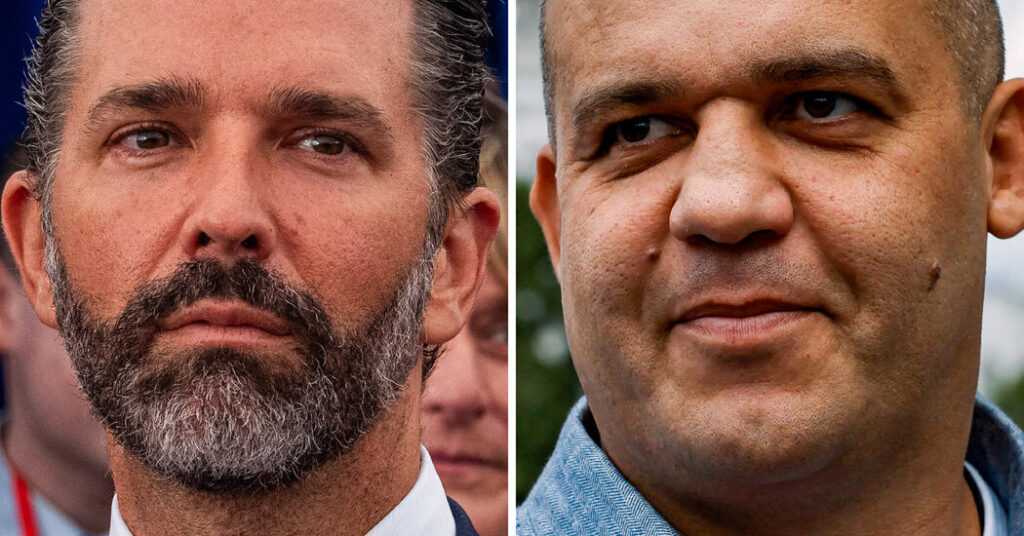
A Russian businessman with ties to the Kremlin paid hundreds of thousands of dollars to help finance Donald Trump Jr.’s wedding after-party in the Bahamas this year, according to two people with knowledge of the matter.
The payments represented an extraordinary flouting of ethical norms for an American president’s family.
To avoid foreign influence, a president’s family is generally expected to steer clear of these sorts of personal and pricey gifts, particularly from someone in a country like Russia, an adversary known to surreptitiously push its geopolitical agenda. The concern, ethics experts say, is that a foreign actor could ply a president’s family member with gifts and eventually expect something in return.
Mr. Trump, the president’s eldest son, accepted the gifts from Umar Kremlev, the president of the International Boxing Association, according to the people with knowledge of the matter. The payments, reported earlier by ProPublica, included the cost of renting a private island and a fireworks display.
Mr. Kremlev reportedly stood out at the after-party. Some of Mr. Trump’s guests questioned who he was and why he was there, according to one of the people with knowledge of the matter.
After ProPublica reported on Mr. Kremlev’s payments, Mr. Trump and his new wife, Bettina Trump, posted a statement to Instagram acknowledging the gifts.
They said that the trip to the island pertained to “an already planned weekend” with friends, not their wedding ceremony, though some ethics experts said that distinction was irrelevant. They also portrayed their relationship with Mr. Kremlev, who did not attend the wedding ceremony, as nothing more than a friendship.
“Our dear friend Umar very generously hosted two incredible nights of celebrations for us AFTER our wedding,” the statement said. “It was an extraordinarily generous wedding gift from a friend, and something for which we were and remain incredibly grateful.”
Mr. Trump and his wife added: “It’s unfortunate that something so personal and happy can be recast as something political or sinister simply because of who someone is or where they come from. Friendship doesn’t require a political motive. Generosity doesn’t automatically come with an agenda. And sometimes a wedding gift is simply a wedding gift.”
The statement did not address why Mr. Trump, 48, did not pay for the island stay and fireworks display himself. Forbes recently estimated his net worth to be around $300 million.
President Trump did not attend his son’s wedding or the after-party. He said at the time that his son would “like me to go, but it’s going to be just a small, little private affair.”
Asked on Monday whether the president knew that Mr. Kremlev helped pay for the after-party, the White House provided The New York Times a statement from the president, who said: “I have no idea who Umar is, never heard of him, and he didn’t pay for Don and Bettina’s wedding, which took place at a totally different location, and on a different day.”
The president added: “It was an ‘after-party’ given in their honor. Not a big deal!”
A spokeswoman for Donald Trump Jr.’s brother Eric Trump, who attended the wedding, said that “Eric has absolutely no clue who this person is.”
It is unclear how Mr. Trump and his wife met Mr. Kremlev, and then came to be so friendly.
A spokesman for Mr. Trump, who has a sprawling business operation with international ties, said they are not in business together. The two men met through a mutual friend, the spokesman said, adding that they bonded over their mutual enjoyment of boxing and hunting.
Mr. Kremlev’s boxing association, the sport’s longtime governing body, has drawn scrutiny over the years for various scandals and its reliance on Russian government support. The group is backed by Gazprom, Russia’s state-owned natural gas company.
Mr. Kremlev also has direct ties to President Vladimir V. Putin. In April, Mr. Putin honored Mr. Kremlev with a high-level state award, the Order of Friendship. And just days before Mr. Trump’s wedding in May, Mr. Putin and Mr. Kremlev were seen together in China.
A spokeswoman for Mr. Kremlev did not respond to requests for comment. But his press office told ProPublica that “Mr. Kremlev and Mr. Trump Jr. have a friendly relationship” and that they first met “a couple of years ago.”
According to ProPublica, the press office said that “Mr. Kremlev has never discussed political matters with any of his American friends and acquaintances,” including Mr. Trump.
Even so, his acceptance of a gift from a Kremlin-linked businessman showed a flagrant disregard for the optics of the situation, ethics experts say. And although the gift itself was not illegal, it raised concerns that Mr. Kremlev could seek something down the road from the Trump administration.
In an open letter to President Trump shortly after his second inauguration last year, Mr. Kremlev solicited the administration’s support in a dispute between the boxing association and the International Olympic Committee.
“A gift from such an unusual source puts a red flag on the matter,” said Kedric Payne, who leads the ethics program at the Campaign Legal Center. “It completely changed my whole measurement of how outrageous these ethics issues are getting.”
This is not Mr. Trump’s first brush with Russian controversy. In the thick of the 2016 presidential campaign, as Russia sought to sway the election in his father’s favor, Mr. Trump met with a Russian lawyer who purportedly claimed that he could provide the Trump campaign with dirt on Hillary Clinton.
In response to the offer of damaging information, Mr. Trump wrote, “If it’s what you say I love it.”
The meeting became a focus of the special counsel’s investigation into the Trump campaign’s ties to Russia. The special counsel, Robert S. Mueller III, never accused the president’s son of wrongdoing.
The post A Wedding Gift for the President’s Son Raises Ethical Concerns appeared first on New York Times.