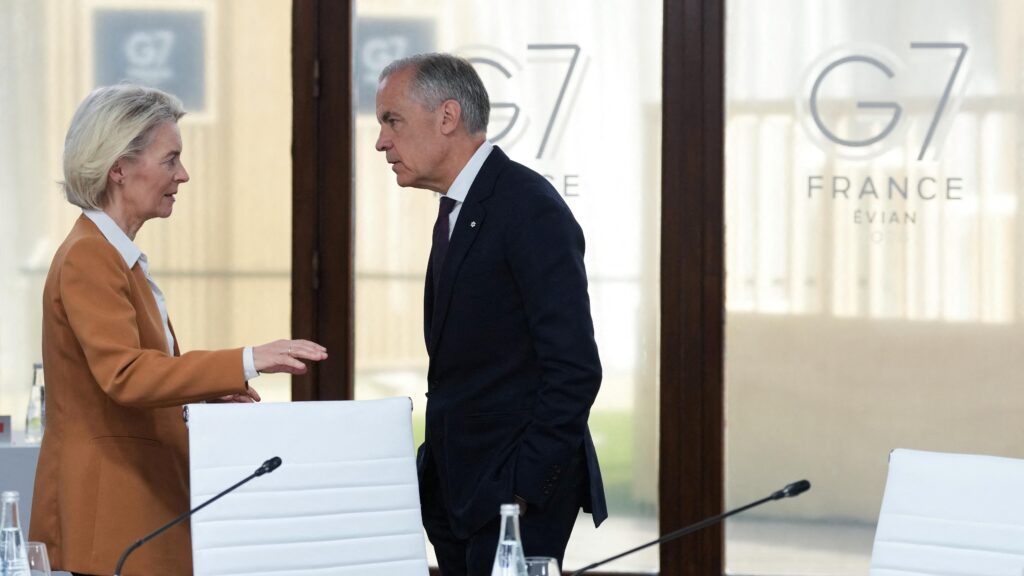
Canadian Prime Minister Mark Carney said Canada is seeking a “unique alliance” with the European Union as he aims to strengthen international ties amid a deepening trade war with the U.S.
“What we are looking, and will begin discussions for, [is] a unique alliance with the European Union,” Carney told reporters at the Toronto International Film Festival on Sunday. “We share the same values, we have the same priorities, and we have very complementary strengths.”
Canada’s European pivot has been months in the making, following growing tensions between Carney’s government and the Trump Administration. Canada’s retaliatory tariffs came into effect last week, matching the economic pressure imposed by the U.S. after negotiations collapsed last month. Carney has encouraged Canadians to take back economic power at the kitchen table, and many have embraced a boycott of U.S. products. Trump has also repeatedly threatened Canada’s sovereignty, speaking openly of his desire to annex the country and make it the “51st state.”
The U.S. accounted for 72.5% of Canadian merchandise exports in 2025, according to the country’s annual trade report, making it Canada’s largest trading partner. But Carney is keen to build an international support network that isn’t reliant on the U.S.
Over the past 18 months since Carney entered office, Canada has signed agreements that cover trade, defense, more with countries such as Indonesia, Japan, and Ecuador.
At the E.U.-Canada summit in June 2025, Canada established a new Security and Defense Partnership with the bloc. “Our partnership is grounded in the core values we share: democracy, human rights, the rule of law, and open, rules-based markets,” read a joint statement marking the occasion.
In January, Carney notably met with China’s President Xi Jinping to forge what he referred to as a “new strategic partnership” to end Canada’s economic reliance on the American market. Carney agreed to cut his country’s 100% tariff on Chinese electric cars in return for lower tariffs on Canadian farm products, including canola seeds, a major Canadian export.
Continuing with these efforts, Carney on Monday brought together executives and senior leaders from global investment firms to encourage them to invest in the country at the Canada Investment Summit in Toronto.
He’s heading for a three-day trip to Europe on Tuesday, where he’ll meet with various European leaders including British Prime Minister Andy Burnham. He’s also set to address the European Parliament in Strasbourg, France, on Thursday, in what could symbolize the mark of a new era between Canada and Europe.
Here’s a look at the alliance options on the table between Canada and the bloc, and what that could mean for U.S.-Canada relations.
Is Canada trying to join the E.U.?
Canada is not looking to join the E.U. as a member, Carney clarified amid questions over what a firmer relationship between his country and the 27-member bloc might look like.
“We’re not looking to become a member,” Carney said, emphasizing he’s instead keen to form an alliance. “We’re stronger together, and this is at a time where the world’s more dangerous and divided, and friends need to stick together in these times.”
Article 49 of the Treaty on European Union explicitly states that any “European State” can apply for membership, making Canada ineligible.
However, a report in the Wall Street Journal, quoting officials from both sides, said Carney is keen for Canada to become an “associate member” of the E.U.
When approached for comment, the European Commission directed TIME to remarks made during a Monday press briefing in Brussels.
“Canada is a strategically important partner for the European Union, and indeed a close friend,” the European Commission’s deputy chief spokesperson Olof Gill told reporters. “We deeply value this co-operation. You will recall that at our E.U.-Canada summit last year, we set a very high level of ambition for cooperation across the board, this year our ambition is even higher.”
When asked directly what discussions had taken place between Canadian and European officials, or what this “unique alliance” could look like, Gill declined to answer.
TIME has reached out to the Canadian Prime Minister’s office for comment.
Frank Schimmelfennig, a professor of European politics at ETH Zurich, predicts that Canada may wish to pursue deeper cooperation through additional trade agreements, or take inspiration from countries that have close relationships with the bloc without being E.U. members.
“Canada is already one of the most integrated non-European countries. It has the densest network of institutional relationships with the E.U.,” he tells TIME, referencing the Comprehensive Economic and Trade Agreement (CETA), a major free-trade deal between the E.U. and Canada, signed in 2016, and Horizon Europe, an initiative on collaborative research launched by European Union in 2021 and joined by Canada in 2024.
“Canada could have more of the same, which means additional sectoral agreements for sectors that haven’t been covered yet,” he says. “That would basically be a lateral extension of the current relationship. Anything more, would mean access to the internal market which would require an arrangement like the EEA.”
The European Economic Area (EEA) includes countries such as Iceland and Norway, which are not members of the E.U., and provides for the free movement of goods, services, and people within the E.U.’s member states, while enabling cooperation across multiple industries.
“The EEA countries have access to the E.U. internal market in return for adopting the relevant E.U. regulations and directives, so that would be a much denser legal integration than what Canada has now,” says Schimmelfennig.
Burgeoning E.U. relationship comes amid deepening U.S.-Canada trade rift
At the World Economic Forum in Davos in January, Carney declared a “rupture” in the international rules-based order. He said “great powers” were using tariffs and financial systems as instruments of coercion. He did not directly name Trump or the U.S.
The speech came at a moment of acute transatlantic tension over Trump’s push to annex the semi-autonomous Danish territory of Greenland and his short-lived threats to tariff European allies until Denmark relented.
Patrick Leblond, an associate professor at the University of Ottawa, says Carney’s movements now are in response to the world “seeing a United States that is becoming more protectionist, nationalist, and willing to use its leverage points to gain concessions, including on very close allies like Canada and Europeans.”
“For Canada, [the consensus is] we need to do more with partners who share our values based on liberal democracy, open markets, rule of law, international agreements, and the first port of call for Carney is the European Union,” Leblond tells TIME.
These trade efforts, he continues, may allow Carney to “build momentum, and hopefully bring other countries” into a broader coalition of what the Canadian leader has often called “middle powers.”
In July, Carney, in a joint op-ed with Finland’s President Alexander Stubb, urged the “middle powers of the world” to “unite.”
Championing middle power countries that possess significant economic power and diplomatic influence, but lack market or military power, the leaders implored: “In a rapidly changing world, we have the grit and the sisu to chart the path ahead—and we know that so have many others whom we invite to join us on this quest.”
Leblod explains that “ultimately trust has been eroded” with the U.S. and Canada must re-think its place in the wider global economy in the long-term.
“The first time we thought Trump was a blimp, but he’s not, and we’re looking at what’s happening in terms of democracy and political polarization, and a lot of Canadians think we can’t rely on the U.S.,” he says.
According to a poll by Nanos Research, conducted between Aug. 30 and Sept. 2, 74% of Canadians disagreed that “the U.S. is a trustworthy ally of Canada.” An earlier poll by Angus Reid Institute, conducted between July 10-14, found that 42% of respondents said they think the Canadian government should approach the U.S. as an enemy/potential threat.
The E.U. has also clashed with Trump over tariffs, his Greenland annexation threats, and the wider split between the U.S. President and several European leaders.
German Chancellor Friedrich Merz in February warned of “a deep rift”between Europe and the United States, arguing that the latter “will not be powerful enough to go it alone.” But relations have since soured further amid the fallout of the Iran war, particularly between Merz and Trump.
Carney to address European Parliament
Carney’s highly-anticipated speech at the European Parliament in Strasbourg this week stems from an invitation extended by European Parliament president Roberta Metsola.
Leblond predicts Carney will use the speech “to reiterate a lot of the things he mentioned at Davos,” but with a strong, intentional focus on the E.U.
“I would expect that he will use that address to call on the E.U. to work with Canada to push this idea of co-operation beyond the North Atlantic and include partners and allies in the Indo-Pacific,” he says.
The Canadian leader is also expected to be a guest at the State of the European Union debate, where European Commission president Ursula von der Leyen is due to deliver a speech outlining the Commission’s work and plans for the future.
Von der Leyen called E.U.–Canada ties “one of the closest partnerships in the world” when she celebrated 50 years of E.U. diplomatic presence in Canada in May. She declared the two sides were “closer than ever” as they confronted wars, an energy crisis and “new fractures in old alliances.”
Schimmelfennig says Canada inching closer to the E.U. is a strong display of “how both partners are affected by the deteriorating transatlantic relationship” with the U.S. “They feel that they need to move together because the world is getting more dangerous, and more difficult for both [parties],” he says.
The post Canada Seeks ‘Unique Alliance’ With E.U. Amid U.S. Trade War. Here’s What It Could Look Like appeared first on TIME.