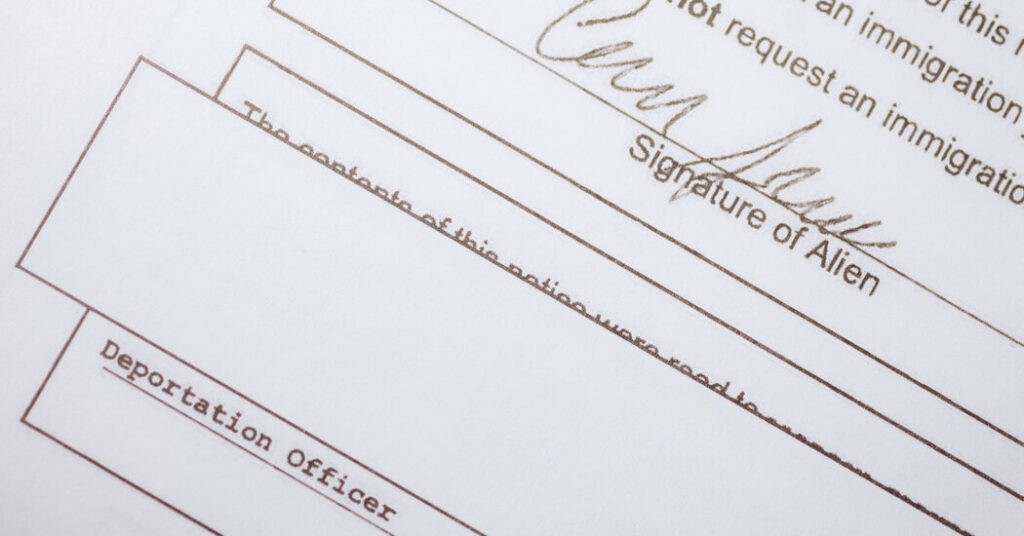
Immigrants seeking documents from the government to prove that they are in the country legally are being rebuffed or provided paperwork that is heavily redacted, according to dozens of immigration lawyers, who say the refusals put their clients at risk of deportation.
In the past, federal agencies routinely turned over documents immigrants requested — for instance, when international adoptees sought proof of their parents’ U.S. citizenship, or noncitizens wanted copies of petitions or interview transcripts for amnesty programs. These records requests, filed by hundreds of thousands of immigrants each year, are often the only way for them to secure documents that detail their full immigration history.
But the Trump administration has been redacting and withholding documents at a strikingly high rate, according to nearly three dozen immigration lawyers interviewed by The New York Times. The government has sometimes asserted that it could not find even documents that immigrants and their lawyers know exist, such as an expired passport or parts of prior applications. In other cases, officials have provided documents, but critical information is struck out, the lawyers said.
“Delays and redactions pile on to the many other intentional ways immigrants are being deprived of due process in immigration court,” said Kelly Rojas, a lawyer who provides pro bono services to asylum seekers and crime victims at Amica Center for Immigrant Rights.
The experiences align with claims by Timothy Turner, a former senior official at U.S. Citizenship and Immigration Services’s internal record-keeping office. Mr. Turner alleged in a whistle-blower complaint last year that the agency improperly enacted policies early in the second Trump administration to make it harder for immigrants to get documents to which they are legally entitled.
For instance, he said in his complaint to Congress, the agency in May 2025 ordered staff to withhold all documents in languages other than English. Staff members were also told to hold back marriage certificates, joint bank statements, tax forms, portions of immigration court hearing transcripts and other documents, citing privacy laws.
And the agency used discrepancies in names — for instance, if a person had a hyphenated last name in official records, but submitted only one of the two names in the document request — to deny requests, even if relevant records were located, he said.
Federal law entitles people to their immigration paperwork, which they may request under the Freedom of Information Act. A 2020 court order requires the government to respond within 30 business days.
The Justice Department, which oversees the immigration court system, declined to comment. The White House did not respond to The Times’s specific questions about the redactions and withholding of documents, but Lauren Bis, a spokeswoman, said that “all illegal aliens receive full due process and have their claims heard.”
The Department of Homeland Security did not address Mr. Turner’s claims but said its public-records officials provide documents in a timely manner and tell immigrants the reasons for no-records responses.
U.S. Citizenship and Immigration Services “receives over 2,000 Freedom of Information Act requests a day. Almost all of the requests are for individual immigration files and records,” the department said in a statement. “Many people who request records have similar names, birth dates and countries of birth. To ensure we comply with privacy laws and send the records to the right person, U.S.C.I.S. carefully checks the identity of each requester. If we can’t definitively identify persons, we let them know why and allow them to correct and resubmit their requests.”
Andrew R. Arthur, a former immigration judge and a fellow at the Center for Immigration Studies, an organization that backs tougher immigration policies, acknowledged problems in the FOIA system but defended the Trump administration’s policies as legally required efforts to protect privacy of those mentioned in immigrants’ files.
He also dismissed concerns that the redactions and denials violated immigrants’ rights, noting that people can sue the government if they think their requests were improperly rejected. Pro bono representation is available to immigrants, and if they prevail in courts, the government would compensate legal costs, he said.
“There is a lot of due process built into this system,” Mr. Arthur said.
But the denials have hampered some immigrants’ efforts to secure legal residency in the United States, their lawyers say. And many without the means to sue are giving up, risking deportation despite plausible pathways for stable immigration status.
In his August testimony to a federal judge, Mr. Turner said the agency closed, without providing documents, more than 35 percent of all requests from immigrants facing deportation between September 2025 and March 2026, compared with around 8 percent between March and September 2025.
When Mr. Turner raised objections, his director told him that it “doesn’t cost” immigrants anything to file another records request. But he said the delay from refiling costs immigrants what they often need the most: time.
“Now imagine being the one who has to refile: in detention, your hearing three weeks away, your defense potentially sitting in a file the government has and you don’t,” he said in a statement to The Times. “From there, the cost looks very different.”
The circumstances of immigrants affected by the government’s responses run the gamut. But their lawyers all reported Kafkaesque ordeals as immigration agencies denied queries for records that, in many cases, those immigrants themselves had provided to the government.
In February, Cipriano Alarcon-Galvez, 54, a Mexican national, asked citizenship services for a copy of the green-card petition filed in 1993 by his mother, a naturalized U.S. citizen, on his behalf. That 33-year-old petition may make Mr. Alarcon-Galvez eligible for permanent residency and amnesty for coming to the United States without permission as a child.
But more than half of the records he received were fully redacted, according to the government responses reviewed by The Times. Another request filed by his mother yielded copies of green-card petitions, but all of her children’s information was redacted. A Freedom of International Act official at the citizenship services agency confirmed in an email to his lawyer that the petition existed, but said Mr. Alarcon-Galvez should file a request with the State Department instead.
He is now facing deportation; his court hearing is scheduled for December. The government says his FOIA appeal will be processed by May 2027. Mr. Alarcon-Galvez has four U.S.-citizen daughters and has lived in Oceanside, Calif., for decades.
“It’s almost like a joke,” said Caroline Matthews, his lawyer, adding that Mr. Alarcon-Galvez “has a constitutional right” to his documents.
Zachary A. Kohn, an immigration lawyer in Washington, D.C., recently sued the government for records for the first time in his 10-year career.
His client, a Salvadoran national, is the mother of an adult U.S. citizen who sponsored her to become a legal permanent resident in 2022. But the government denied the petition because of a 25-year-old dormant deportation order against the client that she had not known about, Mr. Kohn said. Mr. Kohn then filed FOIA requests to obtain records to contest the order.
But federal officials responded that they did not have records, according to documents Mr. Kohn submitted to a federal judge that were reviewed by The Times.
Once he sued, however, the government provided records Mr. Kohn had sought with one condition: withdraw the lawsuit. Now his client has a chance in courts, after paying thousands of dollars in legal fees and a delay of almost a year. Mr. Kohn declined to provide his client’s name, citing fears of a potential effect on the case.
Gregory Luce, the founder of Adoptee Rights Law Center, represents international adoptees who came to the United States as children. Mr. Luce has long relied on FOIA requests to try to demonstrate his adoptee clients are Americans.
But around April 2025, those requests started yielding heavily redacted or entirely withheld documents, forcing him to try to find the paperwork another way. Some of his clients’ cases are stalled after those alternative ways turned out to be dead ends.
In July, he sued the government for records, on behalf of around two dozen adoptees.
According to data Mr. Luce compiled and submitted to the court, U.S. Citizenship and Immigration Services redacted or withheld more than 80 percent of documents since April 17, 2025, for Mr. Luce’s clients. Redactions and withholdings had averaged just 10 percent between May 2024 and April 2025.
The government’s FOIA practice “is to hide the ball,” said Patricia M. Corrales, an immigration lawyer in the Los Angeles area who served as an ICE prosecutor. “If you hide the information from immigrants and you have lousy lawyers filing documentation for them, they’re going to be deported.”
Madeleine Ngo contributed reporting.
The post As Immigrants Seek Legal Status, Redacted Documents Doom Their Chances appeared first on New York Times.