Many people have never heard of Eckhaus Latta. Many shoppers, especially the ones who don’t live in Bushwick or the cutting edge of Chinatown and NoHo, probably haven’t.
Founded by Mike Eckhaus and Zoe Latta in 2011, the label has been around almost 15 years, treading the fine line between fashion and art. It draws a power crowd of hipsters and hautesters at New York Fashion Week and has exhibited at the Whitney Museum of American Art and the Hammer Museum in Los Angeles, but it has been mostly relegated to that box known as “niche” or “downtown arty” or “indie.”
It’s a box a lot of New York designers have shared (Miguel Adrover comes to mind, as does Todd Oldham), and few have escaped, especially as the gap between art and commerce gets ever wider.
This week, however, Eckhaus Latta busted out.
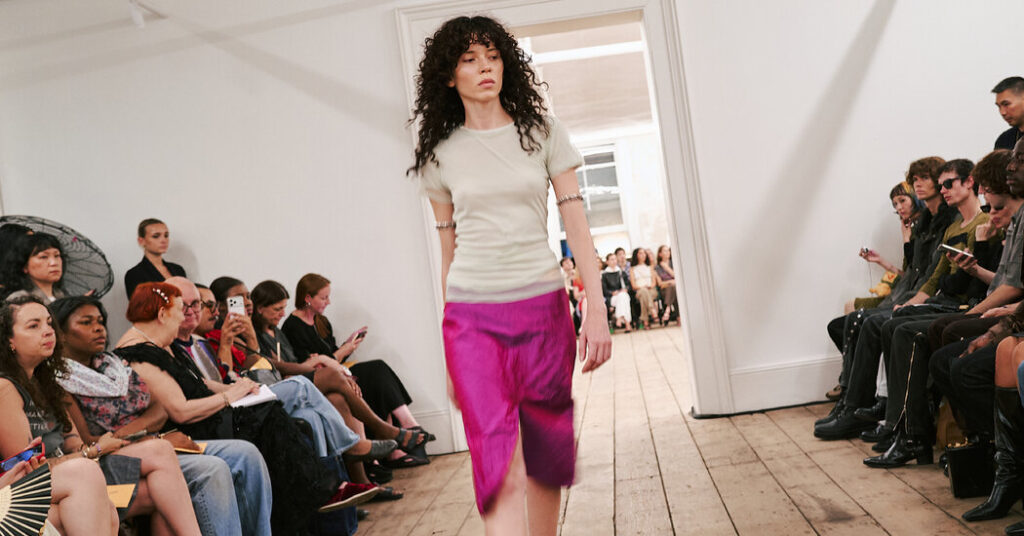
The designers did it with clothes that offered their patented mix of libido, D.I.Y. and the everyday, subverting the familiar in startling ways that make you look — and think — twice. Sportswear is the foundation on which American fashion was built, but more than any other brand in the city, Eckhaus Latta seems to be reinventing it for the 21st century. They’re taking its defining values of practicality and functionality (the kind of words that are well-meaning but at this point make you yawn) and infusing them with kink and cool. If Helmut Lang and Claire McCardell had a knitting circle, this is what might come out.
T-shirts were cut on the curve so they twisted around the body and then were layered under or over tulle for contrast. Satin pencil skirts were hammered and crinkled into shape. Jeans had a paper bag waist that unzipped into a V at the front, as if to say, Don’t you want to keep going? Sweater sets were reconceived as skirt suits that unbuttoned up one leg and down the front. Fishnet pants for guys came under slouchy knits.
The Eckhaus Latta collections have always been crafty, in all senses of that word, but whereas they used to have a whiff of the kitchen table, they have become increasingly refined. (Eckhaus and Latta once had a show in deepest Brooklyn that involved kids banging on pots and plastic pails as their soundtrack.) Now, rather than blowing a raspberry at Seventh Avenue and its traditions, they seem to be casually arching a brow and one-upping them.
The whole thing was a bit like a very knowing game of peekaboo. It was hard not to want to play. Especially because before that, it had been a fairly lackluster fashion week — with a few bright spots.
Tory Burch combined midcentury trompe l’oeil opulence (all that encrustation was knitted chenille) with military silhouettes for a new kind of soft power femininity. Rachel Scott, in her second collection for Proenza Schouler, took a step forward with abstract animal stripes and airy balloon dresses that captured the urbane place between earth and sky. Michael Kors did modernism at MoMA with color blocking, geometry and some really great accessories. But overall, there was a lack of new ideas. Or any ideas, really. It was hard to engage.
Which is also why Eckhaus Latta was so effective. When attendees arrived at their show space, a walk-up warren of white-walled rooms on the edge of NoHo and Chinatown, they found a manila envelope on every seat with the instruction: “Do Not Open. Wait for Laughter.”
The envelopes turned out to be full of confetti, which the audience could throw at the models in the show’s final section, making everyone complicit in the celebration. That turned out to offer its own big reveal: a 27-piece J. Crew collaboration filled with slightly twisted preppy classics. Seems Eckhaus and Latta made a roll-neck sweater for J. Crew back in February that sold out so fast that it made the bigger brand sit up and start planning. In case anyone was wondering if the darlings of the downtown spirit could do mass too.
“We’re not interested in remaining tiny,” Latta said backstage after the show. They shouldn’t be.
The post The Breakthrough Show of New York Fashion Week appeared first on New York Times.