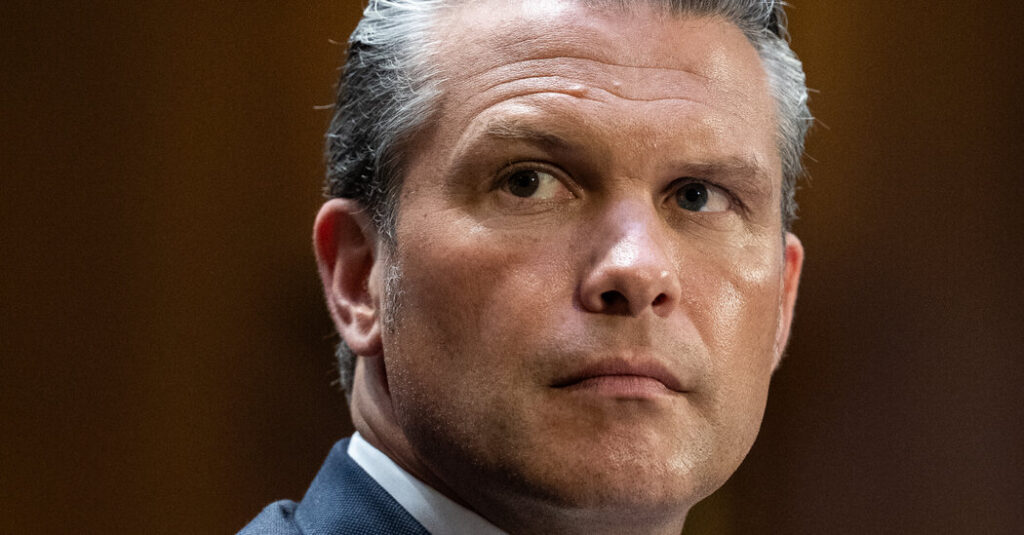
For decades, secretaries of defense have largely sought to insulate the military from the country’s divisive culture wars.
Pete Hegseth, more than any of his predecessors, has taken the opposite approach, bringing those fights directly into the Pentagon.
There have been purges of senior military officers on a scale unlike anything in the modern history of the department. There have been new restrictions on where officers can study and what thoughts they can express in academic papers. There have been widespread polygraphs aimed at ferreting out leakers or intimidating those tempted to share sensitive information.
The turmoil comes at a moment when the extended war with Iran has caused a series of cascading strains on the force. Long deployments have sapped the morale of sailors. Shortfalls of critical missile interceptors have raised troubling questions about the military’s ability to outlast Iran and fight a conflict in another part of the world.
Many of these problems are rooted in decisions made by previous administrations and a war in Iran that has gone on far longer than President Trump or the Pentagon expected.
Current and former military officials describe Mr. Hegseth’s tumultuous tenure as a persistent distraction that has pulled top leaders away from focusing on these priorities and fed a climate of mistrust in the top ranks. The officers spoke on the condition of anonymity to avoid retribution.
Senior officers have also raised doubts about Gen. Dan Caine, who as the chairman of the Joint Chiefs of Staff is the primary military adviser to Mr. Hegseth and Mr. Trump. General Caine has been guarded in discussing the advice he has given Mr. Hegseth, particularly on sensitive personnel matters.
A question asked by officers up to and including four-star generals is whether the chairman has been unwilling or unable to protect the force from the culture war Mr. Hegseth is waging. A spokesman for the chairman declined to comment on General Caine’s advice.
As an Army National Guard officer, Mr. Hegseth fought in Iraq and Afghanistan. He left the Army in 2021 after he was singled out for tattoos that the service deemed extremist.
“I separated from an Army that didn’t want me anymore,” he wrote in 2024. “The feeling was mutual. I didn’t want this Army anymore either.”
He arrived at the Pentagon determined to raise standards and liberate the military from what he cast as a divisive, left-wing agenda that was shackling troops on the battlefield and feeding dissension in the ranks. A year ago, he laid out his vision in a speech to hundreds of generals and admirals from around the world.
“You are hereby liberated to be apolitical, hard-charging, no-nonsense, constitutional leaders,” he said.
Mr. Hegseth’s aim has been to restore a “warrior ethos” that was “buried under bureaucratic process, quotas and institutional self-preservation,” said Kingsley Wilson, the Pentagon’s press secretary.
But many current and former military leaders said Mr. Hegseth has instead targeted the military’s most combat-tested leaders, hollowing out an institution at war.
He has fired or blocked the promotions of as many as 80 generals and admirals. Officers have seen trusted mentors with decades-long careers purged without any sense of what they might have done wrong. Key leadership positions have gone unfilled for months. The chaos and uncertainty have spurred quiet conversations among career officers about whether it is worth accepting promotions and continuing to serve.
“Stop fighting this rear guard against phantoms,” H.R. McMaster, a retired Army general who served as the national security adviser in the first Trump administration, said on a recent podcast. “What you don’t want to do is create a climate in which everything’s a loyalty test.”
Even as Mr. Hegseth has pushed the military to adapt to a battlefield dominated by drones and artificial intelligence, he has pressed its leaders to return to the standards of what he views as an earlier, tougher era. In speeches, he has praised officers like Gen. H. Norman Schwarzkopf, who commanded troops in the 1991 Persian Gulf War, and World War II leaders like General George S. Patton Jr. Both officers led forces that were far less educated than today’s military on battlefields dominated by big, heavy-armored divisions.
Underlying many of Mr. Hegseth’s questions to senior military leaders is an assumption that the Army has in recent decades grown weaker and worse. Earlier this year, he challenged the Army to explain why it had eliminated ruck march requirements — timed hikes carrying a heavy backpack and combat gear — from officer training courses. Senior Army leaders replied with an analysis comparing 2025 benchmarks with those from 1990.
In every instance, the marches had not been eliminated, and the standards had increased in rigor, the Army reported.
Mr. Hegseth has brought a similar skepticism to officer education, which he has often described as a conduit for corrupting, liberal ideas. Earlier this year, he blocked midcareer officers from attending graduate school programs at top universities like Harvard, Princeton, Columbia and Yale. “They’ve taken our best and brightest, the men and women who pledged their lives to this nation, and subjected them to a curriculum of contempt,” Mr. Hegseth said earlier this year.
The heavy scrutiny has extended to master’s theses. At least two Army officers, selected by a board of senior leaders for promotion to one-star generals, were blocked after officials in Mr. Hegseth’s office raised objections to their graduate school papers. Fewer than 5 percent of eligible Army colonels are selected for one-star rank, making it the most competitive promotion in the military.
One of the officers, who is Black, wrote a paper on why Black officers have historically opted for support jobs over frontline combat positions, military officials said. The second officer explored the effect political polarization was having on the military’s ability to recruit and retain talent.
The heavy focus on academic papers, which were never intended for publication, has had a chilling effect on a force that for years had said it valued a culture of curiosity, questioning and innovation.
Some senior officers said that they were reluctant to raise ideas associated with the fired generals and admirals, or that they had censored themselves when discussing topics that Mr. Hegseth could view as contentious.
“Here is the question that I hope Secretary Hegseth and his team are wrestling with,” said Peter Feaver, a frequent adviser to the military who directs Duke University’s American Grand Strategy program. “Do they want a cohort of military leaders who are told: You do not need to learn how to think for yourself, you just need to know what we think are the correct answers?”
Gen. Charles Q. Brown, the former chairman of the Joint Chiefs of Staff who was fired by Mr. Hegseth last year, recently echoed those concerns.
“You don’t want to punish military members for saluting smartly and actually executing,” he said earlier this summer at a discussion hosted by the Aspen Institute on civil-military relations. He said that some officers were being singled out for doing their duty or were being used as “pawns in the culture wars.”
Inside the Pentagon, Mr. Hegseth’s supporters — some of them active-duty military officers — have defended his moves and attacked those who have questioned whether he has gone too far. Earlier this month, Army Col. Kevin T. Black praised Mr. Hegseth in a social media post for taking on a “protected class” of officers and a promotion process that he said had become disconnected from the military’s true mission: fighting and winning wars.
“If that stings, it is because it landed on the people who needed to hear it,” he wrote.
As the top military adviser to Mr. Trump and Mr. Hegseth, General Caine sits at the center of the strained relationship between Mr. Hegseth and the force. General Caine, a former fighter pilot, came to the Pentagon determined to build trust with Mr. Trump and Mr. Hegseth, both of whom had a dim view of his predecessors. To that end, he has defined his role more narrowly than previous chairmen.
In a recent commencement speech at the National Defense University, he said it was his job to tell the president whether the military could execute a mission, and to lay out the risks. But he warned against wading into internal debates over whether the president should take a particular military action.
“We don’t do that in our business,” he said.
It was a break from the recent past, when senior military officers like Gen. Mark A. Milley, a previous chairman, voiced opposition to former president Joseph R. Biden Jr.’s decision to withdraw all U.S. troops from Afghanistan. Despite their concerns and desire to maintain a residual force, the generals carried out the president’s orders.
In the same speech, General Caine revealed the difficult balancing act he faced as the military’s top officer. He urged the graduates — many of whom will work for senior commanders at the Pentagon and around the world — to keep reading and studying.
“The complex environment that we’re facing requires you to be and remain relentlessly curious,” he told them.
He cited the example of Brent Scowcroft, who graduated from the National Defense University and earned a doctorate while serving in the Air Force, then rose through the ranks to become President George H.W. Bush’s national security adviser.
General Caine did not mention that General Scowcroft had earned his doctorate at Columbia, a school that the officers were no longer permitted to attend.
The post In Hegseth’s Pentagon, Top Leaders Battle Turmoil appeared first on New York Times.