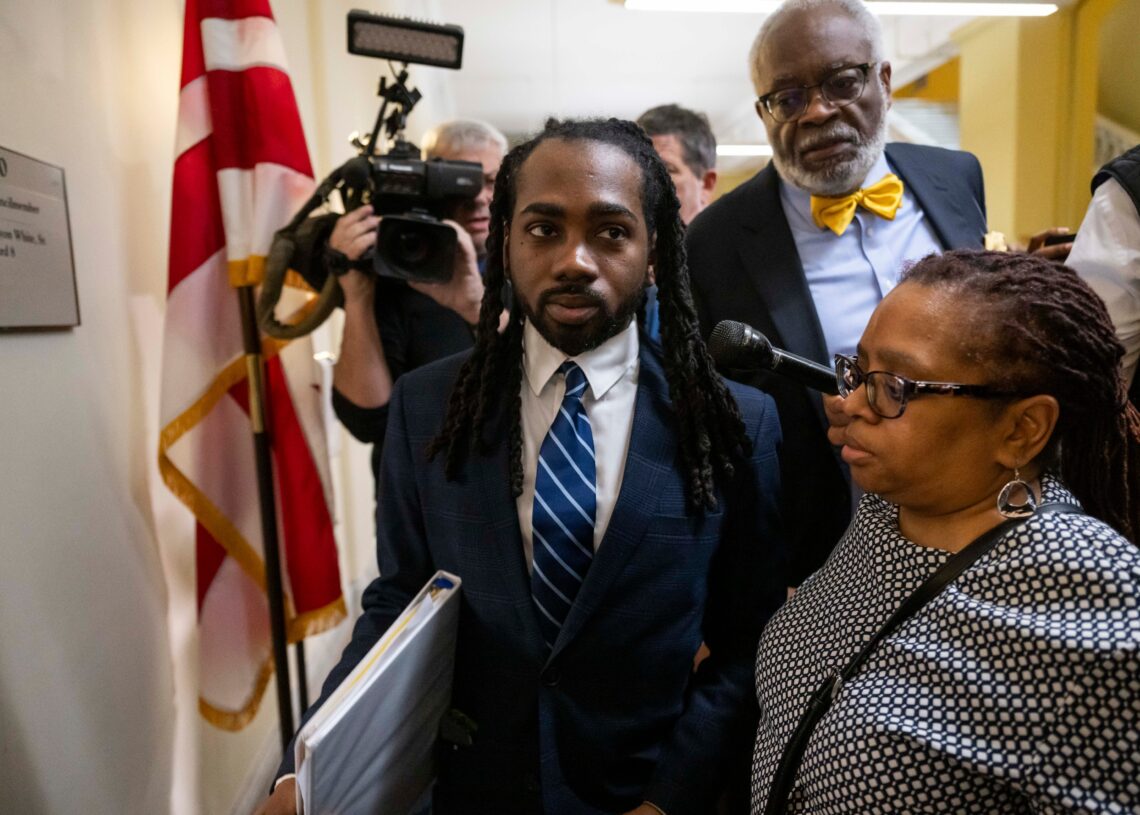
In the decade he has spent on D.C.’s political stage, council member Trayon White Sr. (D-Ward 8) has faced a multitude of reckonings, whether on Election Day or because of an ill-advised statement or allegations of wrongdoing.
The reckoning White now faces could land him in prison and cost him his livelihood — the legislative seat he has held since 2016, representing more than 85,000 residents in Southeast Washington.
A federal trial is slated to begin this week that will determine whether the D.C. Council member, as prosecutors allege, took $35,000 in cash bribes from a government contractor who has known White for years and was working as an FBI informant.
Now in his third term representing the city’s poorest ward, White, 42, has long styled himself as a protégé of the late D.C. mayor Marion Barry and is known more for showing up at crime scenes and community gatherings than for crafting legislation.
Prosecutors contend that White, in exchange for accepting the bribes, agreed to use his council office to lobby D.C. agencies to grant the government contractor additional work quelling violence in crime-addled neighborhoods.
White, who has denied the charge, won reelection after his well-publicized arrest two years ago, then captured a special election to reclaim his seat months later after the D.C. Council took the extraordinary step of voting 12-0 to expel him because of the allegations.
White returned to the council dais, though his influence was diminished. By then, Council Chair Phil Mendelson (D) had removed him as chair of the Recreation, Libraries and Youth Affairs Committee, a punishment that left constituents in Ward 8 concerned that their council member’s capacity to advocate on their behalf had been compromised.
“We have been without representation in local government, and, basically, the residents in the ward are suffering,” said Stuart Anderson, a Democratic organizer in Southeast Washington and White’s former campaign manager. “Anybody who is in a position of having to fight a criminal case could not conceivably be doing their job.”
White’s trial evokes reminders of past D.C. corruption scandals and is sure to generate another round of unwelcome attention for a city already the focus of barbs from President Donald Trump and congressional Republicans who have sought to encroach on its limited self-governance.
“We’re about to go through another round of negative headlines for Ward 8,” said Tom Donohue, an advisory neighborhood commissioner in Southeast Washington. “It’s a lose-lose situation for the ward. We will gain nothing.”
White declined to comment on his case when a reporter approached him as he spoke to constituents during a recent Ward 8 community meeting hosted by Janeese Lewis George, a council member who is the Democratic nominee seeking to succeed Mayor Muriel E. Bowser (D).
In a recent Instagram video, White told his 87,500 followers that he feels “really good and encouraged about my trial” and that “I trust my legal team.”
“I’m in good spirits,” White said in the Sept. 1 video.
He also addressed his legal predicament in that video and in an earlier post, urging his constituents, a preponderance of whom are Black Washingtonians, to attend his trial and to answer jury summonses if they receive them to help him get a “fair shake.”
“We have to ensure I have a fair trial, so if you see letters in the mail, make sure you get those,” White said in a video posted to his Instagram account Aug. 19. “I want to thank you all for your love and support, I still need it. It’s not over with yet.”
Prosecutors objected to the videos, filing a motion asking U.S. District Judge Rudolph Contreras to admonish White for what they claimed was improperly seeking to sway potential jurors by making “disparaging” and “inflammatory” remarks in the lead-up to the trial. U.S. Attorney Jeanine Pirro requested that the judge order White to remove one post.
Although his defense team argued that the First Amendment protected his right to make his remarks, White last Tuesday removed the video he had posted Sept. 1. His Aug. 19 post, which included a similar plea to his constituents about answering the jury summonses and to attend the trial, remained on his Instagram page.
To win a conviction, prosecutors need to persuade all 12 jurors that the $35,000 in cash payments made by Allieu Kamara, the contractor who was working as an FBI informant, constituted a bribe. Prosecutors allege that the payments were part of a broader agreement the two men reached in which Kamara would pay White a total of $156,000.
The indictment alleges that Kamara also paid White $20,000 around 2020 in exchange for the council member’s promise to help the businessman reach a favorable settlement of his appeal to D.C. officials after a contract he had was terminated because he falsified background checks.
In a court filing, White’s legal team has asserted that the council member acknowledges accepting cash payments from Kamara on four different dates. In return for White’s admission, prosecutors agreed to not introduce evidence pertaining to the council member’s “gambling expenditures.” However, prosecutors also asserted that they could break the agreement if White “attempts to undercut” or question the claim that he took the money.
The strength of the prosecutors’ case rests in video recordings agents obtained of Kamara handing White envelopes purportedly filled with cash during meetings the men had in the contractor’s car during the summer of 2024. Prosecutors also included in their 37 page complaint photos of text messages that White and Kamara exchanged.
“They have compelling evidence,” said Paul Butler, a Georgetown University law professor and former federal prosecutor who focused on corruption cases. “In a case with evidence like that, it’s not typically difficult to get a conviction.”
Yet the path to a conviction could be complicated by a number of factors, including that White’s attempts to pressure city agencies did not lead to contract extensions for Kamara’s nonprofit, Life Deeds. To prove bribery, prosecutors need to demonstrate that White, in exchange for the payments, intended to use his position to help Kamara.
White’s defense team is likely to seek to damage Kamara’s credibility. The contractor, a former Army captain who has traveled with White, agreed to become a confidential informant as part of a plea bargain in which he admitted to conspiracy to commit bank fraud and bribing another D.C. government official.
Butler said White’s defense team would probably seek to persuade the jurors to render a verdict in the council member’s favor “because they think the prosecution is unfair or they’re sympathetic to the accused” despite believing he is guilty. With prosecutors needing a unanimous verdict, White’s defense team needs only one dissenting juror to derail the prosecution.
That strategy, said Butler, worked for Barry when the mayor faced federal drug and perjury charges in 1990 after an FBI sting operation caught him on videotape smoking crack cocaine in a downtown Washington hotel. The jury, which included 10 Black and two White members, convicted Barry of a misdemeanor count of cocaine possession but was deadlocked on a raft of other charges. The judge called a mistrial.
“There’s always a race dynamic but the city is quite different now, and it’s not nearly as pronounced as it was then,” Butler said. “The jury is likely to have way more White people on it.”
That said, Butler added: “We have a city where race and class and the criminal legal system is still a fraught combination, and that gives even more credence to the notion that you never know what a jury is going to do.”
Under federal sentencing guidelines, White would not be eligible for the maximum 15-year sentence if convicted, because he would be a first-time offender.
The prosecutors’ list of witnesses includes Kamara; Matthew Gano, the lead FBI agent on the investigation; Lindsey Appiah, Bowser’s deputy mayor for public safety and justice; and Kwelli Sneed, director of the D.C. Office of Neighborhood Safety and Engagement, the city agency that managed the contracts obtained by Kamara’s nonprofit.
White’s defense team has listed as its potential character witnesses Wanda Lockridge, the council member’s former chief of staff; Charles Moreland, a former D.C. shadow representative; and the Rev. Donald Isaac, the pastor at a Ward 8 church.
Over the two years since White’s arrest, his allies have voiced skepticism about the U.S. attorney’s case against him.
“This was total entrapment,” said Jauhar Abraham, a longtime associate of White’s who plans to attend the trial. Referring to Kamara, he said, “The government sent this guy in because he was a friend, in a wired up truck, to embarrass the councilman. If 12 Washingtonians hear all the facts, I can’t believe that 12 people will believe the government’s case.”
White’s arrest in August 2024 was a stunning turn for a council member whose victory eight years earlier, over a Bowser-backed incumbent, inspired celebrations among those familiar with his hardscrabble background growing up poor in Southeast Washington.
White’s current legal trouble is not the first time he has found himself the focus of unflattering attention. In 2018, two years after his election, he provoked international news coverage after posting a video on social media in which he expressed support for an antisemitic conspiracy theory that a Jewish banking family controls the weather.
White apologized for the video and won reelection in 2020. But he continued to draw scrutiny. The D.C. Office of Campaign Finance in 2024 fined him and his campaign treasurer $20,000 for several infractions, including failing to submit reports and refund excessive contributions. The city’s ethics board earlier this year fined him for failing to file several financial disclosure statements.
Since his 2024 bribery arrest, the council member has existed in a legal limbo. His constituents — opponents and supporters, alike — are eager for the trial to begin.
“You want to see this situation resolved,” said Phil Pannell, a longtime organizer in Ward 8. “You never want to see your leaders with a cloud over their head.”
The post As his federal bribery trial begins, Trayon White Sr. faces another reckoning appeared first on Washington Post.