
What’s your story? The story that you live by, that your cells are geared to, even or especially when you’re not thinking about it? Do we create our own meaning, or should we be trying to discover the meaning that created us? Is it the tractor beams of heavenly love that hold us here, like God’s guy ropes, or are we adrift?
When George Lucas, a long time ago in a galaxy far, far away, began writing the screenplay for Star Wars, he had a copy of Joseph Campbell’s The Hero With a Thousand Faces clamped, so to speak, between his teeth. For Campbell, a professor with a popular touch, life was nothing more or less than a summons to greatness. Across cultures, and across the history of the human imagination, he had discerned it, “the one, shape-shifting yet marvelously constant story”: the hero’s journey. Departure, initiation, return. Living is a heroic business, Campbell insisted. Stacked with trials, sure, and frightful reversals, but with the grail floating always ahead of us, calling us onward. Use the Force, Luke. Let go!
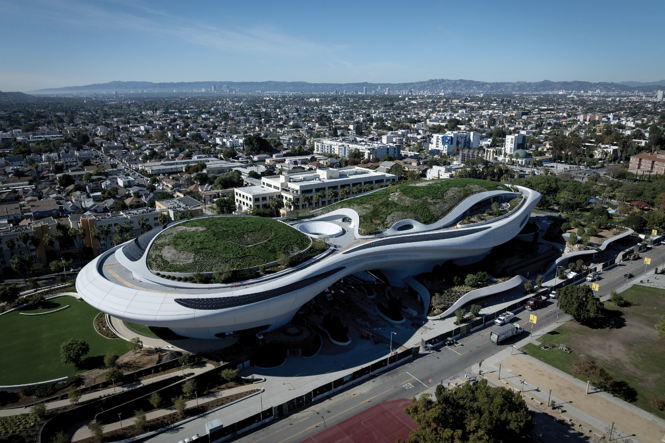
And now Lucas has built a temple to story. The Lucas Museum of Narrative Art, which opens this month in Exposition Park, just south of downtown Los Angeles, is a swooping, brain-beggaring, super-sexy, twin-bodied leviathan of a megastructure, white as the gown of Princess Leia, half spaceship, half cetacean, all curves, Shangri-la for skateboarders if they could ever get inside. Co-founded by Lucas and his wife, Mellody Hobson, it hoists itself into twinkling California emptiness on an 11-acre site (formerly two parking lots) next to the Natural History Museum and the L.A. Memorial Coliseum. Walking toward it, you think: Jesus. Eighth wonder? Squillion-dollar folly? Architectural embodiment of some impulse from spiritus mundi? Entering it, you stop thinking altogether. As I passed from the dreamy light of the covered forecourt, a single lens-like portal in its ceiling (for maximum diffraction of heavenly tractor beams), and into the space-gobbling atrium, I was conscious only of a delighted vertigo. Like, awe. Like, wow.
It was an old-school encounter with the sublime, not unlike the one I’d had as a 9-year-old, in 1977, in a cinema in Cambridge, England, watching the first scene of Star Wars. You remember the first scene of Star Wars. A tiny fleeing Rebel ship zips past us into the star-pricked abyss, laser bolts pinging around it, and then, and then, Darth Vader’s Star Destroyer drones overhead, shears off the top of the screen, the viewer’s eye hauled powerless and silently wow-ing for what feels like miles along the faceted grayness of its Imperial underbelly. Agog in my cinema seat, I was a tiny, grubby Shelley, and before me was Mont Blanc.
Lucas and Hobson thought about building their museum in San Francisco; there were prolonged negotiations to build it in Chicago; but it’s landed in the right place: fictive L.A., the Kingdom of Story, where even now, in coffee shops and one-room apartments across the city, on laptops sweating with hope, at least 400 screenplays are being written in accordance with the immemorial template mapped out by Campbell and industrialized by Lucas. Look around: Everyone here is on their hero’s journey.
So in Exposition Park it sublimely squats, the Lucas Museum, flaring its contours into the L.A. void. Why is it so bloody enormous? Because it has to be. Because larger and grander and deeper than the campus itself—with its library, two movie theaters, 100,000 square feet of gallery space, and sculpted stretch of public parkland—is the wobbling master-idea of Lucas himself: a museum of narrative art. Of images that tell or contain or project or smell like a story.
Which means … pretty much everything in the history of art that isn’t abstract. Which means the story of art itself, from the hovering aurochs and Paleolithic handprints of the cave paintings of Altamira (presented here in a glowing full-size reproduction) to the gods-and-monsters heavy-metal dream time of Paul Raymond Gregory. Which means comics, murals, film, Conan the Barbarian and Frida Kahlo, Andrea Solario’s Salome With the Head of John the Baptist and Robert Crumb’s Book of Genesis. (First frame: God holding a big old hairy ball of Chaos in his hands.) Which means Richard Ansdell’s The Death of Sir William Lambton at the Battle of Marston Moor next to a reproduction of Gustave Courbet’s A Burial at Ornans. Both paintings are frieze-like in structure: In the former, the body of an expired or expiring nobleman is conveyed through a turmoil of cattle, dogs, sheep, and milling cavalry; in the latter, a gang of grim-faced locals assembles round an open grave, down at the village cemetery. In both paintings, death is a kind of antimatter, churning the scene.
Am I making it sound random? It’s not random. Some of the galleries are organized around the foundational myths of American culture—work, family, sports—while others are dedicated to a single artist (Maxfield Parrish, for example). It is, however, wildly democratic. Star Wars, as movie geeks know, is a brilliant hodgepodge of influences: Buck Rogers, Kurosawa, The Dam Busters, high culture, trash culture, the lot. At the Lucas Museum, this is part of the character of the collection—everything that tweaked, tickled, or ran its buzzing lightsaber through the imagination of young George Lucas is represented here.
The galleries dedicated to comics and cartoons have a particular energy, pulp art exploding off the walls. Downstairs, meanwhile, on giant screens, are giddyingly depthful high-res photographic re-creations of the Sistine Chapel and, nearby, the Hagia Sophia. The effect is slightly Vegas, that throb of alien vividness, that feeling of signs coming loose from their moorings, the Sphinx gazing blandly across Las Vegas Boulevard—but I love Vegas, and America has taught me to love that feeling. Lucas is also a major collector of that singular populist and freakish master of compacted visual storytelling, Norman Rockwell. I was delighted to be able to stand in front of The Connoisseur—which features a well-dressed older gentleman, seen from the rear (Rockwell loved his rears), his body somewhat torqued with interior tension, standing in front of a large Jackson Pollock–style cosmic splatter. Doing so, I participated, as it were, in its sight gag: a man looking at a painting of a man looking at a painting. Very Rockwellian.
The amplitude of all of this is not for everybody. Writing in the Los Angeles Times in 2017, after it had been announced that the museum was coming to L.A., the critic Christopher Knight protested that narrative art was a “made-up category.” He scorned the definition then on the museum’s website—“Narrative art is visual art that tells a story”—as a “perfect tautology.” Linguistically, he was quite correct, but then again, I’m not sure how you could fail to have a good time at the Lucas Museum, splashing through the gorgeous spaces, bouncing from Diego Rivera to Frank Frazetta. More than that, the conceptual bagginess and ambition and all-gatheringness of the collection is its own statement, as American as it gets. Consciousness is so squeezed right now (close your eyes for two seconds and you’ll feel it) and thieves work the levers of the world, but you leave this museum with a sensation that rumbles in the body for hours—a sensation of art as the most illustrious kind of counterprogramming, art as the vehicle for the real story, which is imagination and connection, which is life.
“The effect of the successful adventure of the hero is the unlocking and release again of the flow of life into the body of the world,” Campbell wrote. Is this what he’s done, 82-year-old Lucas? Streamed the Force right into Exposition Park? Dinged by his Rockwells, donged by his replica Michelangelo, I’m going to say yes. It’s been 21 years since Revenge of the Sith, but this is tremendous storytelling—a killer final act. The hero kneels and opens his hands, and look what comes out: a great and crazy museum, flexing its fins, firing its lasers, swimming like an amphibian through time.
* Lead image sources: Cindy Ord / Getty; FlixPix / Alamy; LMPC / Getty; Rob Kim / Everett Collection; SOPA Images / Getty; Universal History Archive / Getty
This article appears in the October 2026 print edition with the headline “That’s No Moon.”
The post George Lucas’s Last Great Epic Is an Art Museum appeared first on The Atlantic.