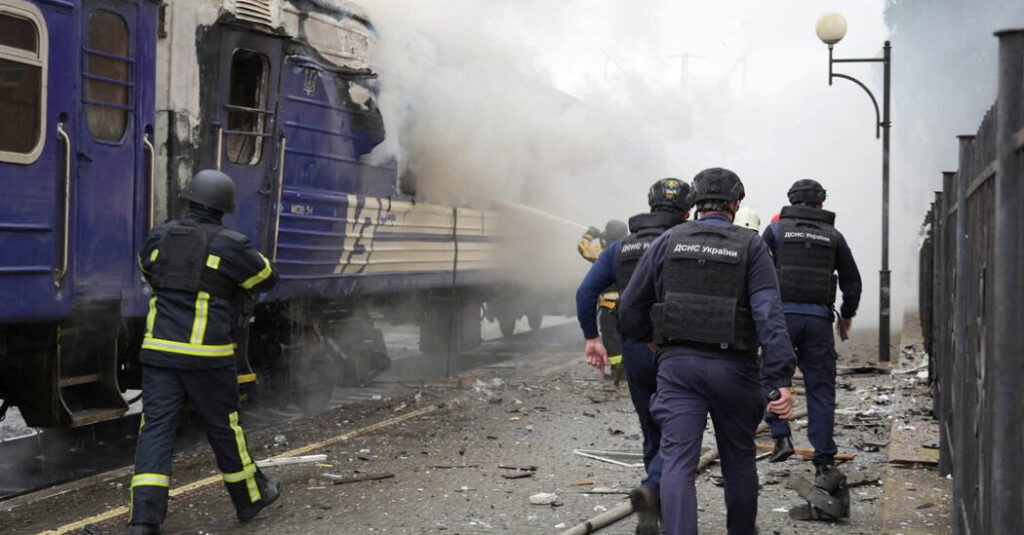
Ukraine’s rail network is a physical and symbolic link to the West. European officials say Russia’s weekend strike on a station near Poland was an attack on those ties.
The drone strike, near the Ukraine-Poland border, hit a train close to one ridden by the former C.I.A. director David Petraeus and came shortly after the departure of another, carrying the former British prime minister Boris Johnson and other European politicians and diplomats.
It was not immediately clear whether Moscow intended to target the foreign visitors. Attacks on infrastructure are common, and the Russian Defense Ministry said that the military was taking aim at railways “used to transport military cargo,” according to the Russian news agency TASS.
European leaders called the attack an attempt at intimidation.
“It is clearly meant to scare Western countries from supporting Ukraine, from going to Ukraine to show support,” Kaja Kallas, the European Union’s top diplomat, said on Monday. “The question for us is, ‘What do we take from that message?’”
European officials and analysts said on Monday that they saw the strike as part of an escalating Russian campaign to sow fear and confusion in Europe and to weaken the Western alliance backing Ukraine.
Governments and researchers have accused Russia in recent years of sabotage and hybrid attacks aimed at Ukraine’s allies. A drone containing an explosive device was found in the freight terminal of an airport in Leipzig, eastern Germany, last month, an incident that Berlin blamed on Moscow. Misinformation and election interference by Russia have become common. So has GPS jamming, which can disrupt communication and navigation.
Ukraine’s rail lines are a significant target. The air war over the country has stopped civil and commercial flights, so the network has become an essential mode of transport. Trains crawl toward the border with Poland day and night, moving foreign dignitaries as well as ordinary Ukrainians to and from the Ukrainian capital, Kyiv.
Philip Bednarczyk, the Warsaw office director at the German Marshall Fund, a think tank, said that Russia’s attacks served to test “over and over again” whether NATO allies were committed to defending one another.
Mr. Bednarczyk pointed out that while incidents so far had been isolated, many in Poland were bracing for further escalation this winter, perhaps even into something coordinated. Mr. Bednarczyk said that he already knew friends who had begun to avoid taking the train into Kyiv from Warsaw, opting to drive instead.
“It’s an important artery” he said of the rail link to Poland.
Prime Minister Donald Tusk of Poland said that Russia’s escalation was “becoming a reality” and that he would review plans to protect his country’s railways and industries.
He added that the most recent strikes showed that Russia was more willing than ever to deploy longer-range, high-precision, jet-power drones to threaten NATO.
“We do not want to give in to nervousness — emotions are the last thing needed here,” Mr. Tusk said. “But there is no doubt that we, together with our allies, must be prepared for a joint response should the need arise.”
Russia’s latest strike comes at a moment when European nations are considering how they can best support Ukraine as the war becomes ever more costly and the fighting shows no sign of ending soon.
The European Union finalized a support package of 90 billion euros, about $100 billion, for Ukraine this year. But Kyiv’s financial needs are growing under a barrage of Russian attacks, reviving a conversation among European nations about how to continue the financial backing.
Some countries are again contemplating whether it might make sense to use Russian sovereign assets frozen in Europe to support Ukraine — an idea that was considered last year, but ultimately rejected.
Petteri Orpo, the prime minister of Finland, said on Monday that the train station attack was an attempt to break European unity, adding that Moscow was wrong to think such efforts would succeed.
“This is a very dangerous game they are playing now,” Mr. Orpo noted.
Anatol Magdziarz contributed reporting.
The post Russian Strike on Train Station Near Poland Seen as Warning to Kyiv’s Allies appeared first on New York Times.