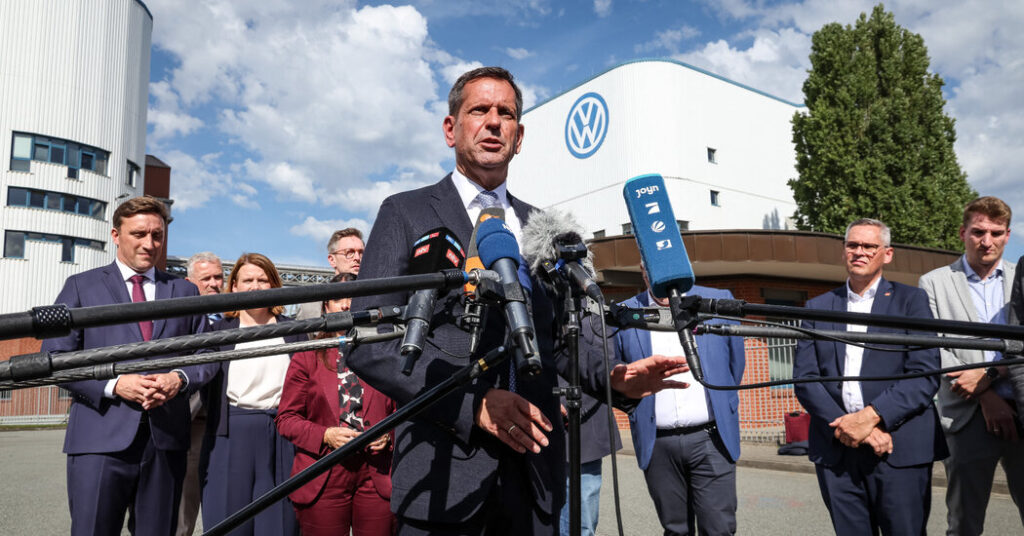
For more than a century, the German city of Osnabrück has built cars ranging from Beetle convertibles to Porsche Boxsters. In the future, the city may be better known for air defense, not autos.
Volkswagen’s agreement with an Israeli investment firm and the German state of Lower Saxony, announced last week, is expected to turn its fading factory in Osnabrück into a defense manufacturing hub, potentially rescuing more than 1,200 jobs. It may also provide a road map for European industrial companies struggling to adapt to mounting Chinese competition, punishing U.S. tariffs and rising energy costs.
Employees who had been bracing for the plant to shut down next year now face a very different prospect: building air defense systems and parts for European militaries.
The plant “is far more than an industrial facility — it is part of our civic DNA,” Osnabrück’s mayor, Katharina Pötter, said in an email. “This marks the painful end of an era of civilian car production. On the other hand, it represents an act of industrial resilience.”
A pivot to military work is seen as a way to help ease the strain for manufacturers and their employees and strengthen European security as the continent ramps up spending to counter the threat from Russia and reduce reliance on the United States. But it is unlikely to make up for the auto industry’s losses, with Volkswagen alone planning to cut about 100,000 jobs by 2030. Overall, the auto sector in the European Union supports an estimated 14 million jobs and accounts for about 7 percent of its economic output.
“Defense will not be the sole lifeline for the auto industry,” said Max Becker, a policy fellow and security and defense specialist at the German Council on Foreign Relations. “That much is clear.”
German automakers produce large volumes and employ hundreds of thousands of skilled workers. How many will be able to shift smoothly into manufacturing complex weapons systems and other technologies remains unclear, he said. Mr. Becker recently visited a European factory producing fuses for warheads, work he said that is so specialized it is like assembling Swiss watches.
Some German employees will be reluctant to go from making “family vans to tanks,” he said, while those who do make the leap may need to gain a government security clearance for some projects, which can take a year or more. Companies expanding in defense also have to clear regulatory hurdles, he added.
The two sectors have business models that “are as different as ready-to-wear fashion and haute couture,” according to a report in May by Paul Taylor, a senior visiting fellow at the European Policy Centre. While automakers focus on mass production in highly competitive consumer markets, the defense industry operates with long-term, low-volume contracts, usually for a single government or small number of national militaries.
Still, the pivot is already underway. Mercedes-Benz is collaborating with Tytan Technologies to develop counter-drone vehicles based on its Sprinter vans and military versions of its G-Class sport utility vehicles that would intercept threats to critical infrastructure. Renault, the French carmaker, has agreed to produce military drones with defense technology firms Thales and Turgis Gaillard.
Auto industry workers, albeit a small number, are starting to move into defense. Tytan, based in Munich, is fielding a significant number of applications from auto workers, many of them with engineering backgrounds, as it prepares to open a new factory to make interceptor drones, the company said. Tytan plans to expand its staff to 250 employees by next year from just 35 at the start of 2026.
Hensoldt, a German sensor and radar maker, said it has hired auto workers numbering in the “low triple digits” as part of a wider recruitment campaign this year. The company is forming partnerships with companies including the auto suppliers Bosch and Continental to bring on some of their employees.
In Osnabrück, known for hosting the talks that led to the Peace of Westphalia, the 1648 treaty that ended the Thirty Years’ War, the proposed transition has set off debate, said Ms. Pötter, the city’s mayor. Some residents, she said, hold “deeply rooted” pacifist convictions. But the project is in line with a City Council resolution passed this year emphasizing the importance of protecting democracy, freedom and the community, she said.
“The focus at the site is not on producing offensive munitions,” she said. Instead, the factory is expected to make “air-defense systems designed specifically to intercept missiles and drones, thereby shielding civilians. Many workers and residents recognize that active protection and defensive readiness are necessary preconditions for preserving peace in Europe today.”
The city won’t be the last to have this discussion.
Volkswagen may try to find a defense company to take over another struggling plant, possibly in Hanover or Emden, as the company evaluates alternatives in a range of sectors, including robotics and energy storage, said Stuart Pearson, who leads auto research at Oxcap Analytics in London. Stellantis, the maker of Peugeots, Opels and other cars, could look at a similar move at a factory in Germany or France, he said.
The works council that represents Volkswagen employees doesn’t consider “new business opportunities in other industrial sectors as a means of replacing existing commitments,” its spokesman, Heiko Lossie, wrote in an email. Still, he said, “should such opportunities arise — whether within the group or with external partners — the employee representatives will examine them with an open mind.”
The sale of the Osnabrück plant to Aurelius Capital, based in Tel Aviv, and Lower Saxony, the home state of Volkswagen, would represent a “small step” for the automaker but signals that companies, unions, regional governments and shareholders can work together to revive underused factories, Mr. Pearson said.
“It’s symbolic, but significant,” he said.
The preliminary accord calls for Aurelius, Lower Saxony and Rafael Advanced Defense Systems, a company behind Israel’s Iron Dome antimissile system, to transform the site into an air defense center. Aurelius would be the majority owner, with Rafael providing expertise. Additional partnerships may follow.
It’s just one part of Volkswagen’s strategy following a breakthrough deal reached earlier this month with unions to carry out the biggest overhaul in the automaker’s 89-year history. Recognizing that the new facility at Osnabrück probably won’t require all of the factory’s 1,800 employees, worker representatives said they are seeking to secure employment for the hundreds who wouldn’t have roles.
Many questions about the site remain. “What is already clear, however, is that the work force in Osnabrück possesses a very high level of industrial expertise,” Jan Mentrup, a spokesman for the union IG Metall, said in an email. “That expertise is an asset to be developed, not a cost to be written off.”
The defense sector has a long history of leaning on carmakers.
During World War II, Volkswagen produced weapons and military equipment at its factory in Wolfsburg, relying on forced labor. After American troops liberated the plant in 1945, the company shifted to civilian production. In the United States, Ford Motor’s Willow Run project produced a B-24 Liberator airplane every 63 minutes as part of a huge mobilization.
More than eight decades later, Ford is aiming to play a military role once again. Senior executives met earlier this year with Pentagon officials to gauge whether the industry can help the military in producing parts. In Europe, the company said it is competing to develop vehicles for the British Army and seeking to expand sales of its Ranger trucks for NATO forces.
With Europe aiming to retrain 600,000 people for defense, and carmakers potentially cutting hundreds of thousands of additional jobs, the two industries are converging again. Substantial idle capacities in the auto sector, along with the machinery, fabricated metals and chemicals industries, could be repurposed for defense manufacturing to address the region’s industrial decline, according to a European Commission report in March.
“This is a case of, we have too much head count, and defense has too little. How can we find a way to meet in the middle?” Mr. Pearson of Oxcap said.
“It won’t be that simple because some of the skill sets won’t match, and some of the geographic locations of those workers won’t match,” he said. But “defense can partially help solve the auto industry’s head count problem.”
The post Defense Hiring Will Ease, Not End, Pain in European Car Industry appeared first on New York Times.