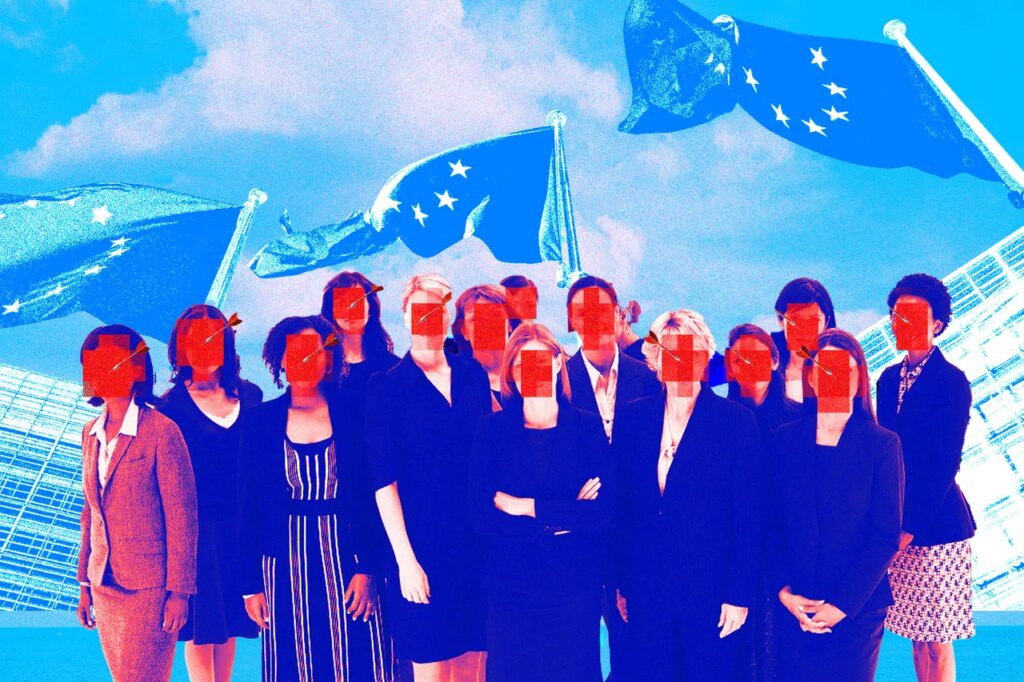
Almost 150 politicians across Europe have been included on harmful deepfake pornography websites over the last few years, according to new research seen by WIRED. Some of the politicians, who are overwhelmingly women, have had their likeness included in explicit videos, while others have names and photos listed in disturbing database-like entries that can link to deepfake creation tools.
Analysis of around 160 domains that host deepfake abuse and other nonconsensual sexual content, by researcher Benjamin Shultz, has found that at least 138 women members of parliament (MPs) from 22 European Union countries have appeared or been mentioned on the sites. In contrast, only nine male MPs were referenced in any way. By Shultz’s calculations, it is 33 times more likely for women MPs to be targeted by deepfake ecosystems.
“Deepfake porn is part of a much bigger trend of online hate and intimidation against women and female politicians,” says Suzanne Kröger, a Dutch member of parliament with the Progressive Netherlands group, who was impacted. Kröger, who expressed anger at what the research uncovered, says the findings are “really deeply disturbing” and help to reveal the scale of abuse. “We are politicians, we have a platform and speak out,” Kröger says. “But meanwhile, there are millions of women victims of these criminal acts.”
The research, which has been published by German digital democracy think tank Agora Digitale Transformation, focuses on national members of parliament from all 27 countries in the European Union. Shultz, a fellow at Agora and the lead researcher at the American Sunlight Project, compiled the details of more than 5,800 members of parliaments across Europe in July and then used custom search engines to find where they appeared across the deepfake websites. (The research does not include members of the European Parliament).
Politicians from Germany, the Netherlands, Italy, and France appeared on the websites the most, according to the findings, and the more senior a politician is, the more likely they were to be targeted. Shultz alerted all of the MPs individually and provided guidance on how the content may be removed. The websites also include depictions of celebrities, journalists, and other public figures, he says. WIRED is not naming the websites in order to not drive further attention to the abusive images.
Multiple researchers and lawmakers say that while politicians have been targeted with deepfakes for years, it can damage democratic practices and create chilling effects that may stop women and girls from becoming public figures. “This discourages women from taking office in the first place and also crowds these women out of public life,” Shultz says. “There’s so much evidence to support that this does real psychological damage. This also does reputational damage for the future if they want to fade out of politics and have another career.”
“Deepfake videos are used to intimidate politicians but also to belittle women,” says Sarah Dobbe, a Dutch Socialist Party MP, who was impacted. “It is very important that if a woman or girl is victimized in this way, she can get direct support if needed, and that the content is removed quickly.”
Across the sites he monitored, Shultz categorized multiple categories of abusive content or behavior. His results include instances where MPs appeared in content that was actively being hosted by the sites, indexed results where content had been removed, and also a number of profiles and “gateways” where potentially new content could be created.
Multiple websites hosted pages that include the names of MPs, official photos, and in some cases their social media profiles or personal information. Some included sections “rating” the women’s bodies, Shultz’s report says. Often next to these MP biographies were links to so-called nudifier apps or the websites’ own tools that claimed to digitally undress people. “It has all the images, all the information, and a direct link to the tool, and in three clicks you can generate,” Shultz says. “That’s just as bad as actually hosting the content.”
Since AI-created deepfakes first emerged at the end of 2017, the underlying technology to produce them has become much more accessible, and the output of the tools has become more realistic. Over time, millions of nonconsensual AI images and videos have been created, mostly by men and boys, and are often used to harass, intimidate, or blackmail women and girls, including at almost 100 schools around the world.
“These platforms are designed to run like businesses,” says Henry Ajder, an AI adviser and deepfake expert who has been tracking the ecosystem since 2018. He says that while it is not surprising that politicians are being targeted in this way, the findings are helpful for officials in Europe to understand the severity of the issue. “The whole infrastructure is set up to do this at scale with ease,” he says.
In general, lawmakers have been slow to introduce legislation to tackle the growing array of harms caused by deepfakes. However, in recent months, some laws have started to be introduced. Both the UK and EU are planning bans on nudify services, while under the US Take It Down Act, at least two major deepfake websites publishing thousands of images and videos of celebrities have been taken offline. Reporting by journalists unmasking those behind the websites has also led to major sites being taken offline. Ahead of this story being published, WIRED found that at least half a dozen of the domains that appear in the research have recently been removed from the web—reducing the total number of depictions of the European MPs.
Shultz, who is also researching the number of depictions of UK and US politicians, previously analyzed how many US senators and members of Congress appeared on deepfake sites in 2024. After the websites were taken down, Shultz says, there has been a “significant decrease” in the number of depictions of those American politicians that appeared on the websites two years ago.
“It’s a priority to ensure that these images are taken down, but that also there’s strong regulation on this type of technology,” says Kröger.
The post Sexually Explicit Deepfake Sites Target 100-Plus Politicians in Europe appeared first on Wired.