The most ambitious part of the 2015 Paris climate agreement, to limit global warming to 1.5 degrees Celsius, only came about because of a campaign by some of the world’s poorest and most defenseless countries.
Caribbean participants tacked up posters saying “1.5 to stay alive,” and the prime minister of Tuvalu said any temperature rise beyond that mark would “spell the total demise” of his and other low-lying island nations. In the final stage of negotiations, some were chanting, “1.5.”
The acknowledgment last week from the United Nations that the planet is going to breach that limit was not a surprise to anyone tracking global temperatures, which keep rising.
But it nonetheless formalized a dire outcome: Amid scant progress from global powers to cut pollution from fossil fuels, vulnerable countries will now spend decades, or perhaps centuries, confronting the very climate scenario they’d once said would be untenable.
And though that puts them face-to-face with the concerns they’d held in Paris, about rising sea levels and intensifying disasters, they also face new risks few could have imagined a decade ago. Cutbacks in aid from wealthy nations, including the United States, have reduced the humanitarian safety net. The United States, the world’s largest historical emitter, has also withdrawn from the Paris Agreement, as well as from funds meant to help developing countries deal with climate change.
Poorer nations say these changes threaten to make the 1.5 Celsius breach even rockier, leaving them fewer resources to deal with disasters while widening global inequities.
“We risk creating a world in which climate change continually pushes poorer countries backward,” said Mohamed Adow, the director of the Nairobi-based climate and energy think tank Power Shift, who attended the Paris talks in 2015. “This is precisely why vulnerable countries fought for 1.5 Celsius. They understood that climate risk is not distributed equally.”
The fault line between wealthy, industrialized nations and poor, developing nations has long been a defining feature of international climate talks. But the U.N. report on the “overshoot” of 1.5 Celsius, issued on Sept. 2, figures to create extra tensions when countries meet for the annual climate summit, set this year in November in Antalya, Turkey.
A negotiating bloc representing 44 nations known as the Least Developed Countries this month raised the idea of a tribunal to assess potential climate “reparations.” That term has long been a nonstarter with wealthier, polluting nations that would be on the hook.
Those least-developed countries said that overshooting the target of 1.5 degrees Celsius, or 2.7 degrees Fahrenheit, means “mounting irreversible loss and damage.”
In the long-term, temperatures could theoretically be brought down if carbon dioxide could be pulled out of the atmosphere on a massive scale. The Alliance of Small Island States, another negotiating coalition, said that the 1.5 degree goal shouldn’t be abandoned, and that governments should try to minimize overshoot “and return global temperatures to below 1.5°C as rapidly as possible.”
The 1.5 degrees target doesn’t reflect a magical planetary threshold, where everything is different on either side. Scientists emphasize that every fractional temperature increase ratchets up the likelihood of dangerous heat, floods, drought, fire and other extreme weather. But negotiators embraced that temperature mark as a way to avoid the most damaging consequences.
The United Nations said it will be surpassed “in the next few years.”
In the long-term, temperatures could theoretically be brought down if carbon dioxide can be pulled out of the atmosphere on a huge scale. The Alliance of Small Island States, another negotiating coalition, said that the 1.5 degree goal shouldn’t be abandoned, and that governments should try to minimize overshoot “and return global temperatures to below 1.5 degrees Celsius as rapidly as possible.”
In part because of how leaders talked about existential risks in Paris, one image looms largest in the public imagination: the notion of rising seas rendering island nations uninhabitable. But as warming edges toward 1.5 Celsius, the problems go well beyond that, involving both sudden disasters, like the glacial collapse in Nepal last month, and slower-burning events that often escape attention. Droughts in southern Angola that devastate agriculture and send people fleeing without documents into neighboring Namibia, according to Amnesty International. Stagnant floodwaters in South Sudan that upend grazing patterns and feed into conflicts. Marine heat waves that bleach coral and ruin economically crucial tourist destinations.
“It’s very scary,” said James Fletcher, a negotiator from the Caribbean nation of Saint Lucia who helped lead a committee in Paris on the 1.5 Celsius target. “There are species that will go extinct. There will be lives that are lost. We had an opportunity to make sure we would not get to this point, and we still let it happen.”
At the time of the Paris Agreement, the world had already warmed about 1 degree Celsius, or 1.8 degrees Fahrenheit, since the start of the industrial age, when humans began burning oil, gas and coal on a larger scale.
In the run-up to those talks, most big countries seemed content for a deal that would aim to cap future warming below 2 degrees Celsius, or 3.6 degrees Fahrenheit. But vulnerable nations managed to alter the usual power balance of talks, persuading larger countries, including the United States, to get on board. President Barack Obama, who was born in Hawaii and called himself an “island boy,” said any agreement should serve the “interests of the most vulnerable.”
Projections at the time showed a vanishingly narrow path to hit that mark, which would have required rapid societal changes and cuts in greenhouse gas emissions. Even then, some scientists said the best-case scenario might involve a tiny overshoot.
But a decade later, emissions are about 10 percent higher, despite major price decreases in solar technology and advancements in battery storage and electric vehicles.
And now, in the best-case scenario, the overshoot won’t be so tiny. Even if every nation hits every climate pledge as well as net-zero targets, warming would peak at roughly 1.8 Celsius, the United Nations says. The likelier scenario, experts say, is that warming will sail above 2 degrees Celsius.
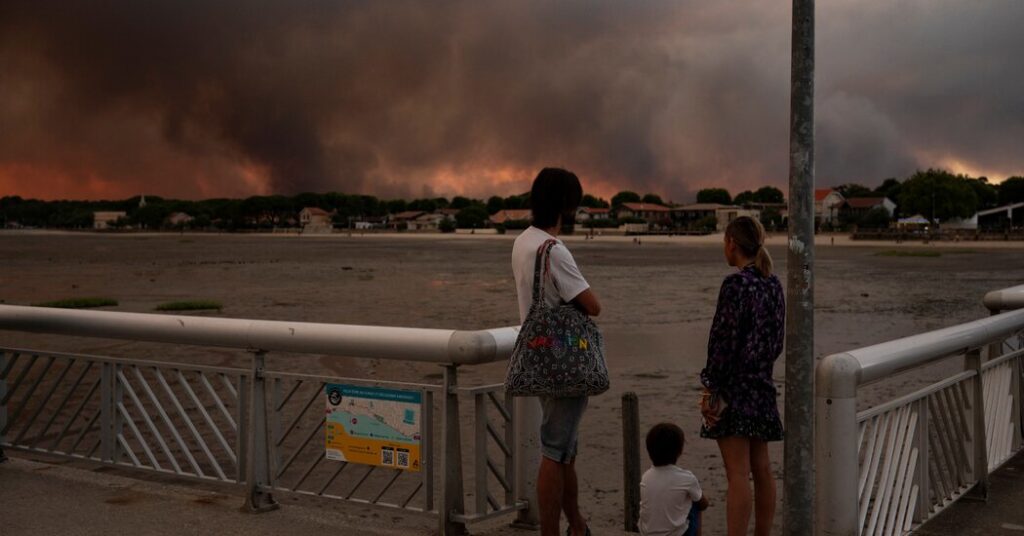
That may sound modest. But every fraction of warming translates into more extreme weather. The world’s current warming level, just below 1.5 Celsius, is hardly the picture of a stable climate — with deadly heat waves in Europe, mounting water shortages and smoke from Canadian wildfires carrying across North America. Bill Hare, the chief executive of Climate Analytics, a climate science and policy institute based in Berlin, said that “the impacts at 1.5 are higher than we thought they’d be a decade ago.”
Joeri Rogelj, a lead author of the annual U.N. reports on emissions, said that in general a decade of science has shown the planet is more sensitive than expected. “When we discover new things, we overwhelmingly get bad news,” he said. “Ecosystems are more vulnerable to the stress and warming that are coming from climate change.”
The most obvious example of that fragility came recently in Tibet and Nepal, after a section of the Himalayas collapsed along with a glacier above it. That triggered mass-scale flooding in the valley below, submerging towns, killing more than 1,000, and leaving Nepal with a recovery requiring $5 billion. Nepal’s minister for agriculture, forest and environment, Gita Chaudhary, noted that even as the country seeks funds to reconstruct, it is bracing for other disasters stemming from thawing permafrost and high-altitude glacial lakes.
“This kind of disaster, it is not the last one,” Ms. Chaudhary said.
The post As the Fight for a Key Climate Goal Falters, Some Begin a Fight for Survival appeared first on New York Times.