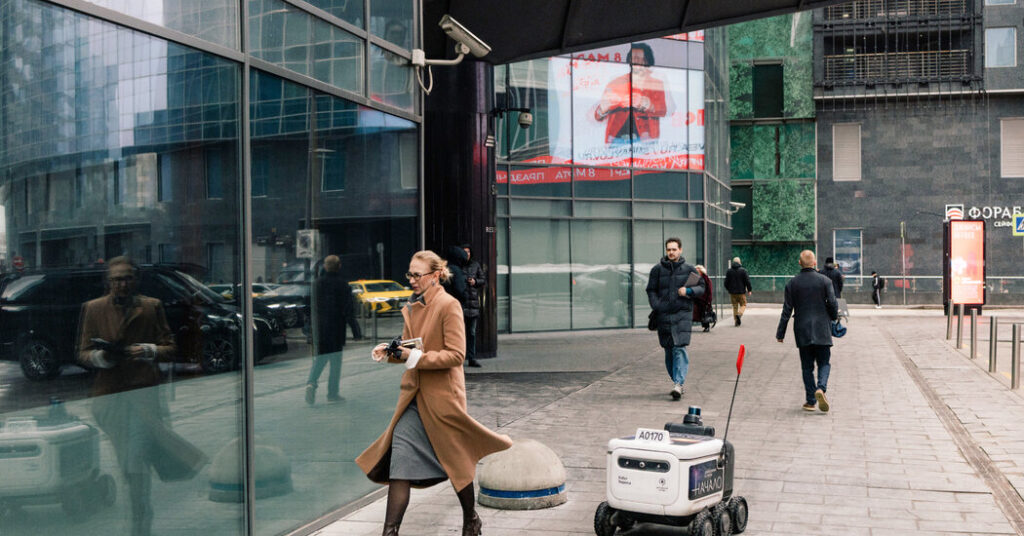
On the surface, today’s Moscow is a technological wonderland. You can use your face to pay for almost anything, like subway fares, or even to finalize the purchase of an apartment. Robots scurry across sidewalks making 15-minute grocery deliveries, and driverless taxis are set to begin commercial service this year.
Underpinning many of the modern amenities is a robust digital infrastructure developed by the city government that has made life not only easier, but also safer. Policing aided by digital tools has helped cement Moscow’s transformation from the raw, unforgiving place it was 25 years ago, plagued by home burglaries, street muggings and murders.
But there is a cost to the convenience and security: an expanding surveillance state.
Moscow’s roughly 300,000 CCTV cameras make it one of the most heavily watched cities in the world. It is impossible to avoid a lens while simply walking through the city. The same cameras that whisk subway passengers through turnstiles are also used to monitor and flag people.
In April, a Russian rock musician was detained by the police at a railway terminal in St. Petersburg after surveillance cameras mistook him for a similar-looking Ukrainian public figure wanted by the state. After checking his face and pulling at his hair to ensure it was not a wig, they let him go.
The CCTV network is linked to biometric databases. Submission of biometric data is voluntary in Russia, but it is encouraged in widespread advertisements, and citizens cannot take full advantage of digital services without complying.
These databases help the authorities target political dissent in addition to crime. Biometric feeds can be used to hunt down critics of the government after they hold gatherings. The days when outspoken Russians could flee to remote towns to avoid the authorities, as they did during Stalin’s purges, are largely over.
As of July, around 10 million Russians were using biometrics-driven applications in some form, and the Kremlin wants to increase that number, pushing citizens to adopt the tools for identification not only at train stations, but also at airports. This year, Moscow City Hall announced that a biometric system would recognize passengers on buses and trams, automatically deducting their fare once they confirmed the transaction in an app.
Other major European cities also have large CCTV networks, most notably London. Moscow’s, however, is more centralized and uses biometrics to identify people spotted by cameras with fewer restrictions.
With Russia’s war in Ukraine, the stakes behind the growing surveillance have become higher.
Rumors of a new wave of military conscription, the first major mobilization since the early months of the war, have swept through Russia. While in the recent past it was relatively simple to evade a draft because enlistment offices were buried under paper files, artificial intelligence-enhanced digitized systems make that almost impossible now. The authorities introduced electronic summonses that carry the full legal weight of paper notices after thousands of Russians fled the draft in 2022.
In March, Vlad, 28, an art and fashion photographer, received a summons to appear at a military enlistment office for a mandatory medical examination. Through the State Services app — a centralized portal for government services, medical care and identity verification — he learned that he had been barred from leaving the country until he complied.
Vlad, who asked that his last name be withheld for fear of repercussions, said he now lived “in fear” as he defied the summons, which he believes could be a prelude to being sent off to war.
“There is total control because you give up so much data that your every step can be traced,” he said. He has stopped using the subway, terrified of the cameras.
Kremlin-aligned analysts argue that the government is using convenient apps and data collection to build a system that is more responsive to people’s needs than what can be provided by Western democracies, which struggle to plan long term because of changes in government and, in some cases, limit digital services because of privacy concerns.
Russia remains steps away from China’s “social credit” system, which rates people on their behavior in financial, legal and other matters and limits the freedom of offenders. But Russian technocrats clearly view Beijing’s digital architecture as a blueprint.
Gleb Kuznetsov, a political analyst who previously worked for a major Kremlin-aligned think tank, pointed to Moscow under its longtime mayor, Sergei Sobyanin, and to Shenzhen, the Chinese high-tech megacity, as urban models superior to Western capitals.
“Sobyanin’s approval rating is high not because ‘the elections lack competition,’” Mr. Kuznetsov said in response to written questions, “but because the city government genuinely works in the interest of its residents.”
The Russian authorities, however, can be quick to pull the plug on the networks undergirding these digital amenities when they perceive a security threat, highlighting a tension between technocratic agencies and the security services.
In March, for instance, mobile internet services were abruptly shut down for more than two weeks across much of central Moscow, including in the subway system, temporarily rendering many of the city’s prized digital services useless.
Residents were left stunned by the blackout, which some analysts speculated was a result of intense state paranoia after the assassination of Ayatollah Ali Khamenei in Iran.
“Russia is going to go back to a situation 25 years ago where you have ‘patchwork globalization,’” said Jeremy Morris, a historian of Russia and one of the few Western academics who continue to conduct fieldwork in the country.
“You could go into one place and it would be super, super cybernetic and technological,” he added, “and then you walk out of the zone of coverage and you’re back to a basic economy.”
According to a Russian official involved in developing digital infrastructure, who spoke on the condition of anonymity because he was not authorized to speak publicly, a quiet war is being waged within the state.
Technocratic agencies like the Ministry of Digital Development, he said, are colliding with the Federal Security Service, or F.S.B. — specifically its notorious political-policing department. While it has access to digital tools, the F.S.B. was not involved in creating them. It favors old-school analog methods of monitoring and controlling society, the official said, even if that means breaking the technology that the technocrats spent billions building.
The F.S.B.’s stance is partly driven by institutional self-preservation, as A.I. threatens to erode the justification for its sprawling apparatus of human agents, the official said.
Ultimately, both the digital and security agencies are competing for the ear and mind of one man: President Vladimir V. Putin, who has demanded that the government develop A.I. while insulating it from Western influence.
In April, speaking at a high-profile Kremlin meeting on A.I., Mr. Putin framed the stakes in existential terms. “The sovereignty of the Russian state in the near future — and, without exaggeration, its very existence — depends on our ability to perform well in A.I., along with digital platforms and autonomous systems,” he said.
Yet for all of its ambitions, Russia lacks the infrastructure and hardware to develop the technology in isolation from China and the United States. Western sanctions related to the invasion of Ukraine have limited Russia’s access to cutting-edge chips, and many of its top technical minds have left the country since the war began in 2022.
Russia’s two flagship A.I. models — one developed by the country’s largest state-owned bank and the other by its leading domestic tech company — were “inspired” by or heavily rely on Chinese open-source architectures.
In the end, said Ilya Grashchenkov, a Moscow-based political analyst, Russia is likely to be defined by what he called an attempt to “combine the seemingly incompatible.” That, he said, involves building an “external digital perimeter” to close the country off from the world, while accelerating digitization within Russia.
Vlad, the photographer who received the military summons, said he would gladly do away with the frictionless, high-tech conveniences if it meant getting back the freedom that was truly missing.
Life in Russia, he said, now resembles “living in an oxygen mask.”
The post The New Moscow: A Digital Utopia Doubling as a Surveillance Trap appeared first on New York Times.