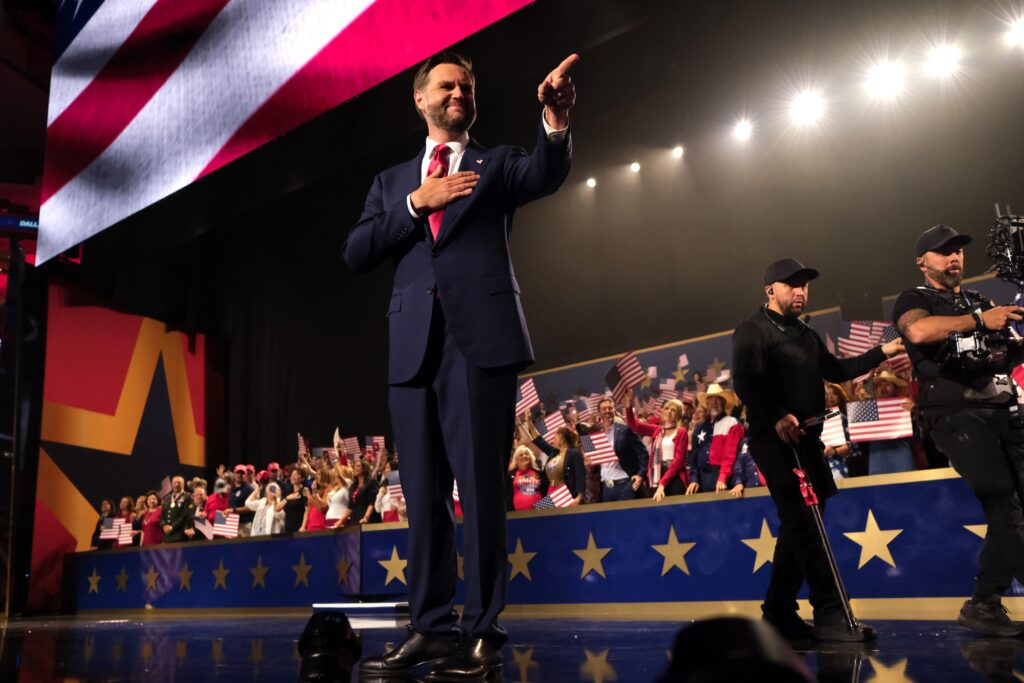
Fresh off basking in the praise of adoring supporters at the GOP midterm convention, President Donald Trump and Vice President JD Vance kick off their first swing of midterm campaigning in earnest this week, with trips that betray how much trouble their party could be in.
Trump, returning from a weekend retreat to his Ireland golf course, is scheduled on Wednesday to visit North Carolina, where his handpicked Senate candidate, former Republican National Committee chairman Michael Whatley, trails former governor Roy Cooper (D) by seven points in a recent high-quality poll.
Vance, meanwhile, plans to travel to Kansas on Monday to campaign for GOP Sen. Roger Marshall, whose reelection race appears too close for comfort for Republicans.
The visits reflect how much the political environment has shifted against Republicans since 2024. Trump won North Carolina by three points in 2024, and Republicans haven’t lost a Senate race in Kansas since 1932.
Both Trump and Vance intend to increase the pace of their campaign travel as the midterm election nears, White House advisers with knowledge of their schedules said.
Trump’s political team has consulted closely with Whatley’s campaign about where and how to hold a rally that would have the most positive “impact” on the race, according to an adviser with knowledge of those discussions. The adviser, like others interviewed for this article, spoke on the condition of anonymity to discuss internal deliberations.
North Carolina’s early timeline for sending mail-in ballots was an impetus for starting Trump’s fall campaign swing there, the person said. On Sept. 4, North Carolina began mailing absentee ballots to those who had requested them, making it the first state to do so. Only a small percentage of voters there cast ballots by mail, but even narrow margins could matter as the race is expected to tighten.
The president in recent weeks has increasingly expressed a commitment to campaigning in person for vulnerable midterm candidates, saying both in private and public that he is willing to do so. Aides have drafted a travel schedule for him for the coming weeks, but it’s unclear how closely he will hold to it, the adviser said. The cadence will be determined in part by what noncampaign business arises.
“I know I’ve got to get out there,” Trump has remarked, the adviser said.
And Trump over the past couple weeks finally began approving campaign spending from his aligned super PACs, after leaving vulnerable Republican candidates wondering when he would open the coffers — and frustrating some on his own political team who had hoped to begin spending earlier.
Vance will hold an event with Trump’s super PAC in Kansas. The vice president’s campaign stop coincides with an anti-fraud news conference he is holding just over the state line at a law enforcement facility in Kansas City, Missouri. But Vance decided to visit the region and campaign for Marshall based on his personal affinity for the senator, according to three people briefed on the plans.
Republicans have quietly raised alarms about Kansas for two months, after internal polls showed Marshall up by just several points — a closer-than-comfort margin for a Republican incumbent in a state Trump won by 16 percentage points in 2024. Marshall won by an 11-point margin in his 2020 race. Strategists from both parties say the race is closer than expected.
Vance’s visit is the first action by the Trump team that signals they believe Marshall could use reinforcements. A person with knowledge of the planning of Vance’s Kansas trip maintained, however, that Republicans have “strong” confidence Marshall will win.
In addition to the problems Republicans face nationally — persistent inflation, the war in Iran and Trump’s unpopularity — Marshall, an obstetrician, faces criticism over past lawsuits to collect debts from patients.
Local TV news has been airing interviews with patients whom Marshall’s office took to court for failing to pay their bills, sometimes resulting in arrests. During a debate with his Democratic opponent Saturday at the Kansas State Fair, Marshall faced chants of “shame on you” from the crowd when he explained he followed “common business practices.”
Despite the cheerful showing in Dallas, Republicans enter the peak campaign season with a pile-on of discouraging signs. Democrats have gained an average 8-point lead on the generic congressional ballot, according to polling analyst Nate Silver, and Trump’s approval is still around record lows. Surveys also suggest that much of Trump’s support is soft and that Democrats have greater enthusiasm about voting.
Inflation stayed at a 3.4 percent annual rate in August and crude oil climbed above $100 a barrel as fighting once again escalated in the unpopular Iran war.
In most of the closest races, Democratic candidates have raised more money than their Republican opponents. Republicans are counting on Trump’s war chest to come to the rescue on that front. Since Labor Day, a super PAC run by his allies has pumped more than $74 million into Senate and House battlegrounds.
Most of the House races where Trump is spending are toss-ups or seats where the party hopes to go on offense. The exceptions are two open seats, Kentucky’s 6th district and Texas’s 35th district, where the group bought ads despite a “likely Republican” rating from the Cook Political Report.
In Kansas, frustration with Trump’s policies has been brewing for months among farmers, a Republican operative with knowledge of the state’s dynamics told The Washington Post this summer.
Sorghum farmers were already hurting from reduced Chinese purchases resulting from Trump’s trade war, and then ranchers objected to the administration’s plans to ease beef prices through imports. Jobs are also at risk from Trump’s threat to ban planes from Canadian jet-maker Bombardier, whose U.S. headquarters is in Wichita.
Glenn Brunkow, president of the state’s Farm Bureau who has long supported Trump, said after the beef decision that Trump was “selling out American farmers and ranchers to buy votes in November,” and he urged him to reconsider the plan, which Brunkow called “anti-American in nature.”
Gov. Laura Kelly, a Democrat who is term limited and retiring, told reporters last week that “Kansas has come a very long way wherein we’re included in the swing states.” She predicted the state would elect another Democrat to succeed her and send the party’s nominee, Adam Hamilton, a United Methodist megachurch pastor, to the Senate.
The post Trump, Vance open midterm campaign tour as GOP troubles deepen appeared first on Washington Post.