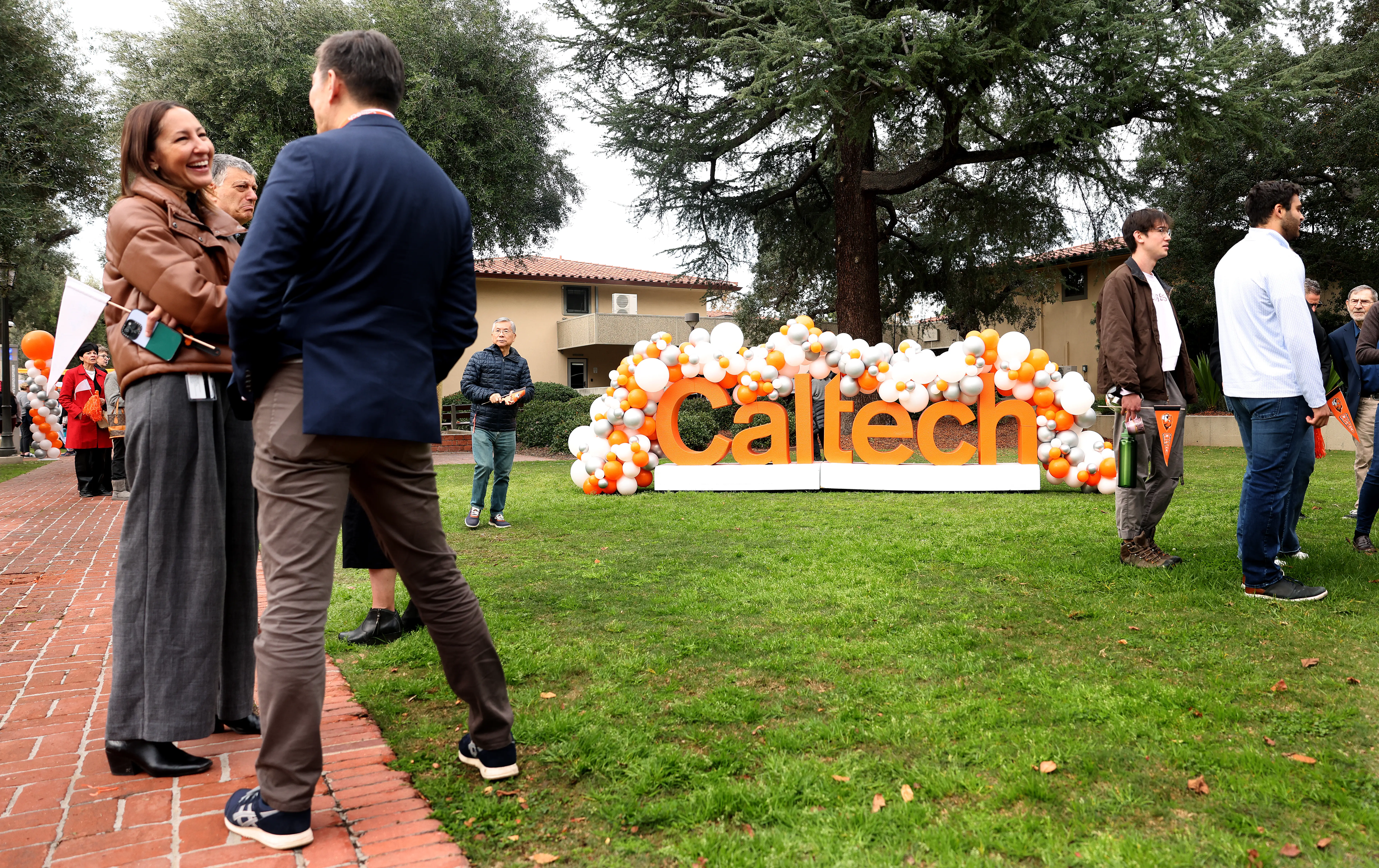
Caiman Moreno-Earle, a math major at Caltech, was wary after watching AI companies rapidly solve mathematical theorems that had stumped his professors for years.
“It got kind of demoralizing,” he told Business Insider.
So the 19-year-old sophomore decided to bring together other students and hold a “mathathon,” where participants could use AI to solve some of the world’s hardest theoretical problems in a single multi-day session.
About a month later, Moreno-Earle’s idea became a nationwide flash point after more than 700 academics and students signed an open letter denouncing the event as promoting AI “slop,” prompting OpenAI, one of its sponsors, to back out.
Though the event is set to continue, with some slight alterations, Moreno-Earle and other organizers said they never intended to cause a stir. In their view, they’re only trying to ensure that humans remain relevant in a field AI is rapidly uprooting.
“As young mathematicians, we don’t necessarily have some of the same luxuries that these older mathematicians do,” Moreno-Earle said. “We look to the future, and we don’t even know if there’s going to be grad school open positions by the time we get to Ph.D.”
The split between pioneering undergraduates and tenured professors over the use of AI is not limited to the math field, but the Caltech clash is especially relevant as American academia wrestles with technology that threatens to put them out of work.
Math professors, for their part, told Business Insider that despite the alluring headlines, AI’s work in math is often quick and dirty and requires hours of human–led research to make sense of the solutions.
“If the machine understands something new, then there is no progress,” said Álvaro Lozano-Robledo, a professor at the University of Connecticut. “The actual progress is when human knowledge advances.”
The mathathon
Armed with their idea, Moreno-Earle and another undergraduate organizer shopped it around to various AI companies. They needed massive amounts of computing power to launch AI agents into the problems, and they didn’t have a lot of capital themselves.
So with typical undergraduate bluster, Moreno-Earle asked Anthropic representatives in a Zoom meeting for $1 million.
“We were like, OK, look, we’re gonna pitch some absurdly high number,” he recalled. “We’ll be happy when they give us like 50k.”
To his surprise, however, the Anthropic reps said yes. The frontier AI company would give the undergrads $1 million in computing power for their event. Soon after, OpenAI agreed to provide another $1 million.
With $2 million suddenly in the coffers, the stakes got a lot higher for the undergrads.
“This was no longer something that was just a fun little experiment,” Moreno-Earle said. “We now had a responsibility to the math community.”
Recognizing that weight, the organizers sought advice from professors at Caltech, whom they had asked to judge the event, as well as others in the field. They worked with these luminaries to develop a responsible framework for the use of AI, they said.
Nevertheless, when the event flyer went live on September 4, not everyone was happy.
A controversy erupts
Moreno-Earle said some of the people the organizers had been privately consulting about responsible AI use soon went public with an open letter calling for the event to be canceled.
In the letter, which eventually garnered more than 700 signatures, signatories said the event, as sponsored by Anthropic and OpenAI, “is likely to have destructive impacts for the mathematical community.”
The open letter details several grievances. First, signatories objected to language used by the organizers, principally a line that read: “What is the role of a mathematician when AI can solve conjectures faster?”
“The claim that AI can solve conjectures faster than human mathematicians appears both motivated and empirically dubious,” the letter reads.
Fault lines between mathematicians and AI companies exploded into the open last week after OpenAI said it solved a particularly thorny problem — one so difficult that a math institute was offering a standing $1 million prize for whoever had the solution.
Other objections in the open letter calling for the mathathon’s cancellation include fears that AI companies intended to use the event as a garish marketing opportunity and that, as structured, the event would incentivize rushed, poorly understood AI-generated work.
In the face of such backlash, OpenAI withdrew its support for the event and took back its $1 million in tokens. “We recognize that the rapid progress of AI in mathematics is disruptive,” Dan Roberts, OpenAI’s research lead, said on X.
The organizers took the concerns seriously. One of the organizers, Alvan Arulandu, put it this way: “These are all questions that are very important.” Arulandu, though, said they decided not to cancel.
“This is much larger than about the mathathon,” he said.
‘A problem we will have to face’
Organizers didn’t necessarily expect to be thrust into the center of a nationwide debate, but they weren’t surprised by it.
Arulandu said the controversy reflects a larger question confronting mathematics: how to preserve the human side of the discipline while adapting to increasingly capable AI systems.
“This is a problem we will have to face,” he said. “It is not something that we should run away from.”
To the organizers, canceling the event would do little to answer that question. In fact, part of the reason they decided to partner with OpenAI and Anthropic was to “critically engage” with the companies that have set the math world aflame.
A common critique from professors is that AI companies are racing ahead without meaningfully involving mathematicians. Organizers said, essentially, here’s a chance to form those connections.
To Moreno-Earle, that aspect makes the mathathon less a stunt than a necessity. AI is already reshaping the field, he said, and students entering mathematics can no longer afford to wait for senior academics or AI companies to decide what the rules should be.
“We don’t have the luxury of waiting around to find out,” Moreno-Earle said.
The event is set to begin on October 30, and Moreno-Earle said organizers are in talks with other AI companies to replace the tokens that OpenAI voided.
Read the original article on Business Insider
The post Inside the generational clash over AI in math: ‘We don’t have the luxury of waiting’ appeared first on Business Insider.