Scandal was the political theme of the summer.
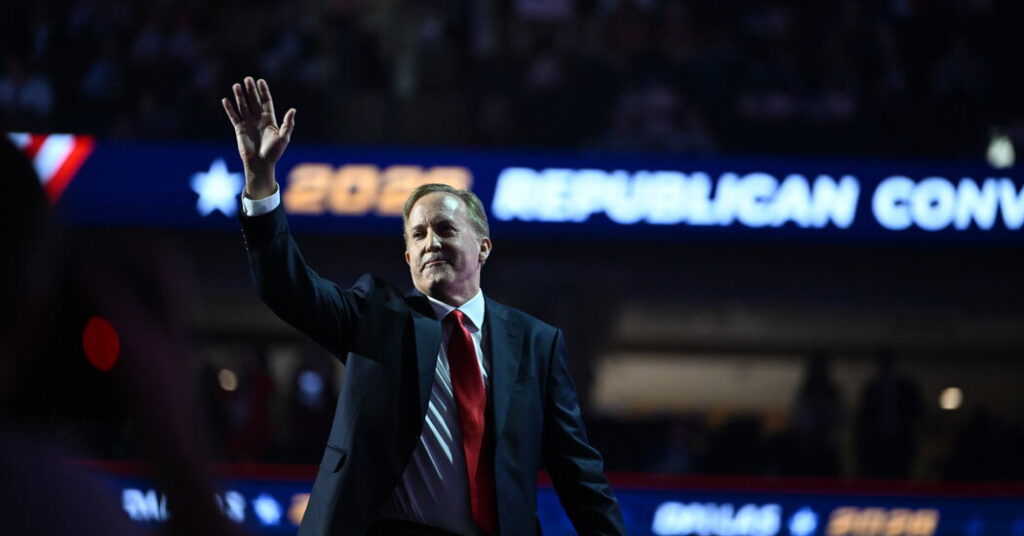
Max Miller, a Republican member of Congress, was accused by his ex-wife of physically assaulting her and their toddler daughter. Ken Paxton, the Texas attorney general and Republican candidate for Senate, had previously been indicted on felony charges of securities fraud and impeached for a list of allegations including bribery, dereliction of duty, obstruction of justice and abuse of the public trust. Graham Platner, a Democratic candidate for Senate in Maine, was dogged for months by an escalating series of accusations of past misconduct, culminating in a former girlfriend’s coming forward to say he raped her several years ago. (All have denied the allegations against them. Mr. Paxton’s impeachment trial ended in acquittal, and he struck a deal to avoid criminal trial in which he paid $300,000 without admitting wrongdoing.)
Of these politicians, Mr. Platner stands out. He is the only one who suffered significant political consequences: abandoning his campaign. Mr. Miller continues his campaign for re-election. Mr. Paxton won his recent primary, unseating John Cornyn, a longtime senator who is decidedly less scandal-plagued.
Scandals, it seems, are losing their power.
Looking at this litany of outrages, you might be tempted to wring your hands over the death of shame in American life. In 2015, Ezra Klein called Donald Trump’s shamelessness his “superpower,” because he refused to give an inch when confronted with examples of his politically incorrect statements. Although Mr. Trump has not tested his stated theory that he “could stand in the middle of Fifth Avenue and shoot somebody” without losing any voters, his political fortunes have remained buoyant even after he was impeached twice, was found civilly liable for sexual abuse and enriched himself by billions of dollars in office.
But while plenty of ink has been spilled on the subject of shamelessness during the Trump era, this is a global phenomenon, not just an American one. It’s difficult to see how American shamelessness could be responsible for, say, Spain’s Socialist prime minister’s continuation in office despite a wave of scandals that has hit his administration and his family.
In fact, political science research suggests that the problem isn’t the death of shame, nor anything unique to America. Around the world, studies show partisan polarization is causing a breakdown in the chain reaction by which misconduct used to lead to consequences.
The political scientist Theodore Lowi defines scandal as “corruption revealed” — a breach of moral or legal codes, exposed for public condemnation. In the past, scandals always carried the threat that the revelation of the misconduct would lead to a public backlash, which in turn would generate some kind of punishment. But now the link between revelation and reaction often seems to have been severed.
That has serious implications for accountability. That chain reaction was traditionally one of the ways that norms and rules were enforced in democracies. If the power of scandal goes away, then we’re left with a vicious cycle in which moral or legal wrongdoing doesn’t lead to consequences, which undermines trust in the government and public institutions, which in turn widens polarization and allows more corruption, abuse and lawbreaking. This cycle is hard to break.
The New Playbook
Typically, the expectation is that news of scandalous wrongdoing will create outrage among voters. That, in turn, incentivizes political elites: The opposition will try to weaponize the scandal to win an advantage, while the wrongdoer’s party will try to distance itself from the scandal and its perpetrator. If public interest in the scandal stays high, both parties have an incentive to push for the wrongdoer to resign, and perhaps to impose other punishments as well.
Today’s landscape looks very different. “There’s a playbook now that didn’t exist before,” said Brandon Rottinghaus, a political scientist at the University of Houston who studies U.S. political scandals. “The reason politicians hang on instead of resigning is that, increasingly, that’s working in a polarized system.”
In the United States and many other countries, the ideological — and, in many cases, cultural — distance between left and right has grown. Numerous studies have found that political beliefs are becoming the basis for a complete personal identity, with everything from what you wear to what you eat associated with your political positions. And “affective polarization,” where people feel warmly toward members of their own camp but intense hostility toward their opponents, can turn disagreements into deep emotional divides.
That polarization, experts say, is undoing the power of scandal. Today, voters are less likely to become outraged by what politicians on their own side do, and less likely to abandon them if doing so might hand an advantage to their enemies. Without the threat of voter backlash, political elites have little incentive to force resignations, impeachments or other consequences. Although scandals do sometimes lead to punishments, that has become rarer, and the threshold much higher.
One reason is that when politics is polarized, the media tends to be, too, researchers say. Partisan media outlets often downplay allegations of misconduct about ideologically aligned politicians and may treat them as conspiracies by the opposition.
“In a parallel media system with propaganda-like partisan outlets, it becomes very unlikely that voters receive clear and credible information about either their own side’s politicians (where nonreporting is the most likely pattern) or the other side (where overinterpretation of small incidents, and sometimes unfounded charges, become possible),” Veronika Patkos, a senior researcher at the Center for Social Sciences in Budapest who studies polarization in Europe, said via email.
Spain has a multiparty political system, but polarization between the left and the right rose sharply over recent decades, said Mariano Torcal, a Spanish political scientist and the author of “From Voters to Hooligans: Political Polarization in Spain.” Today, he said, voters behave like hardcore sports fans, supporting their side through thick and thin. “They tend to exonerate the responsibility of the leaders and say, ‘This is a campaign of manipulation, orchestrated by the media,’” Mr. Torcal said.
There is often a grain of truth in that, he noted. Partisan outlets have an incentive to treat even minor misbehavior by the other side as a major scandal, which can create a “cry wolf” effect as voters assume that all scandals are just partisan media narratives.
In fact, in highly polarized media environments, scandals can even help politicians. “It gives them eyeballs,” Mr. Rottinghaus said. “It gives them a chance to be able to push back against the ‘powers that be’ and say that they’re the ones who are under fire from these mystery opponents.”
He pointed to Mr. Paxton’s successful primary campaign in Texas. “He’s used these scandals that have been leveled against him, or that have resulted from his ethical issues, by saying this is just this partisan witch hunt, and that every attack on him is an attack on what he stands for.”
Prime Minister Pedro Sánchez of Spain has similarly seized on a corruption case against his wife, Begoña Gómez. Mr. Sánchez has portrayed the accusations as a right-wing witch hunt, and his supporters hope the perceived overreach by a politically motivated judge will mobilize left-wing voters whose enthusiasm has been dampened by damaging scandals connected to top officials in his Socialist party. He has branded media outlets that cover his wife’s scandals as “enemies of democracy” and implied that they are part of a shadowy conspiracy.
Far-right populists, who base their careers on appealing to one extreme of a polarized electorate, have been particularly adept at using that playbook. The French far-right leader Marine Le Pen, who was convicted of embezzlement and barred from running for office for five years, called the charges against her a “witch hunt” and claimed that a “system” of deep-state judges and politicians were plotting against her and her followers. Recent opinion polls suggest that she could win the next presidential election despite the conviction.
And Nigel Farage, the leader of the British right-wing populist party Reform U.K., has claimed that allegations of financial wrongdoing against him and his party are an “establishment plot” designed to prevent him from becoming prime minister. The defense seems to have resonated with voters: A poll last month showed his party likely to win the next election by a slim margin.
When a nation is deeply split, it is easier for voters to forgive the transgressions of individual politicians for the sake of maintaining political supremacy, said Tamar Hermann, a public opinion researcher at the Israel Democracy Institute. Even if voters “are very angry about this scandal or that scandal,” that can pale in comparison to their concerns about allowing the other side to take power, she said.
In Israel, Prime Minister Benjamin Netanyahu has been on trial for over five years on charges of bribery, fraud and breach of trust. He has argued that the criminal case against him was politically motivated, and that he alone can take on Israel’s enemies and prevent a Palestinian state. As polarization deepened the distance — and distrust — between political camps, voters became convinced that the political stakes were too high to oust Mr. Netanyahu, said Iddo Porat, a professor at the College of Law and Business in Ramat Gan, Israel, who studies partisan polarization.
A Downward Spiral for Democracy
When the link between scandals and consequences starts to break down, the implications for democracy can be serious.
Under normal circumstances, scandals are an essential lever of accountability, and even renewal. “As a forest fire germinates and renews a field, political scandals may help the public and the media enhance accountability, renew trust in government and focus on key issues of concern,” Mr. Rottinghaus wrote in “Scandal: Why Politicians Survive Controversy in a Partisan Era.” In the United States, he points out, Watergate “corrected the system in multiple ways,” spurring the passage of laws reining in presidential power and expanding congressional oversight.
But when the logic of polarization takes over, that lever no longer works. A study on which Ms. Patkos was a co-author found that in 28 European countries, democratic accountability weakened as polarization grew. The effect seems to be particularly strong when it comes to incidents that seem minor or somewhat ambiguous, she said.
“One partisan camp starts to feel ‘I have always known these people aren’t trustworthy,’ while the other thinks, ‘Come on, this is nothing, no reason to withdraw trust,’” she said.
That may encourage more misconduct.
In a 2014 paper, Andrew Eggers, a political scientist at the University of Chicago, found that British members of Parliament were more likely to commit financial misconduct in highly partisan and contested districts — suggesting they knew voters would care more about their party’s winning than about punishing the misuse of public funds.
Allowing wrongdoers to keep power encourages more misconduct, which further erodes voter trust and widens polarization, as a partisan news media draws attention to the opposing party’s getting away with scandalous behavior.
That widening polarization makes it even more difficult to impose consequences for new scandals. It’s a devastating feedback cycle.
And with every round, the system grows weaker.
The post Why Scandals Don’t Bring Down Politicians Anymore appeared first on New York Times.