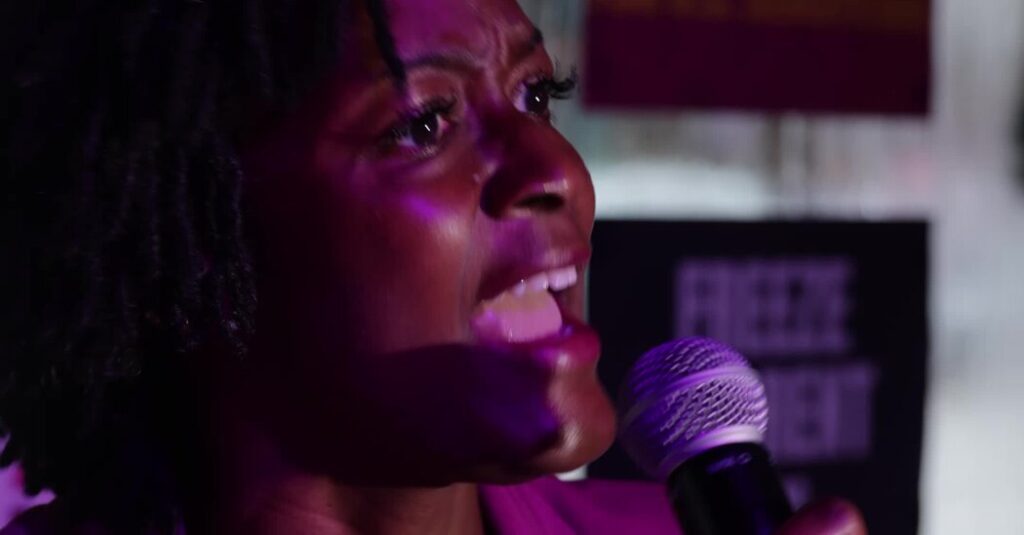
Angie Nixon is tough to silence.
The first time she protested gerrymandering in Florida, Republican state lawmakers cut the video feed of her sit-in. The second time she showed up with a bullhorn. The third time, she was arrested.
“When they go low,” she says, putting a twist on Michelle Obama’s decade-old dictum, “we get loud.”
Ms. Nixon’s high-volume tactics as a state representative have made her one of the most outspoken critics of Florida’s Republican governor, Ron DeSantis. She has also at times rankled fellow Democrats. Some political veterans dismissed her campaign for the U.S. Senate as progressive whimsy — until her decisive primary victory against a more moderate opponent last month. It catapulted her onto the national stage and jolted an otherwise sleepy Democratic Party in a Republican-leaning state.
She has spent the weeks since hoarse, appearing nearly everywhere as she tries to make the case that a Black woman with a Southern drawl — who identifies as a progressive but also joined the Democratic Socialists of America in June — can win in a state President Trump has taken three times. If elected, Ms. Nixon would become Florida’s first Black senator.
National Democrats have all but written off Florida. Republicans believe the nomination of Ms. Nixon, whom they have branded a “socialist,” has only made it easier for Senator Ashley Moody, the Republican incumbent Mr. DeSantis appointed last year to replace Marco Rubio, to win in November.
But Ms. Nixon the Senate nominee, much like Ms. Nixon the state legislator, is difficult to ignore. She leans fiery while Ms. Moody leans restrained. She engages with the media and curious crowds drawn to her, while Ms. Moody mostly sticks to Fox News and friendly supporters.
The forces working against Republicans nationally — the high cost of living, some Hispanic voters who lean away from Mr. Trump — are also present in Florida. And Florida Democrats have historically turned out more voters with a Black candidate leading the ticket.
“What up, Nassau County!” Ms. Nixon, 42, told a full house of supporters recently in Yulee, a deep-red community in northeastern Florida, near Georgia. She later joked that they probably had never seen so many Democrats here.
The establishment Ms. Nixon is not. Her primary win so shocked some Democratic leaders that a unity rally, planned on the assumption that her rival would win, was scrapped. Some Jewish Democrats were upset by a resolution she filed in 2023 in Tallahassee calling for a cease-fire “in the State of Israel and occupied Palestine,” which failed with a vote of 104-2. She has since mended some fences and been quick to condemn antisemitic incidents.
She also does not quite fit the mold of other democratic socialists running this year. A longtime union and community organizer, she has been rooted in campaigns to restore felon voting rights, expand Medicaid and unionize adjunct college professors. She also owns a book-and-coffee shop named Cafe Resistance. In 2020, she received the endorsement of the chamber of commerce in Jacksonville, her hometown, and then ousted a conservative Democratic incumbent.
Her vocal opposition to Mr. DeSantis has become her calling card. At every turn of his administration’s “war on woke” — changing how slavery was taught in schools, restricting diversity initiatives, removing books from school libraries — Ms. Nixon was there, calling the policies racist and the governor a bully. Her shop showcases banned books.
When Mr. DeSantis was booed at a vigil in 2023 for Black victims killed in a racially motivated shooting in a Jacksonville Dollar General store, she stood nearby, arms at her hips, glowering at him.
This spring, she parked herself in the governor’s office and demanded a meeting over his administration’s gerrymandered congressional map. She refused to leave, leading to her arrest. She is awaiting trial next month on trespassing charges.
“I’m the biggest pain in Ron DeSantis’s ass,” she recently told donors at a fund-raiser in Miami, casting herself as the fighter voters want and saying she would be the “biggest pain” for Mr. Trump, too. For his part, the president called her a “card-carrying member” of the D.S.A. at his Republican midterm convention last week.
Some Democrats dislike her style and politics, but Ms. Nixon comes off as authentic, something Florida Democrats have struggled with, said Joe Garcia, a former Miami congressman, who co-hosted the fund-raiser.
“You may not like what she’s saying, but you know it’s what she feels,” he said. “It’s very powerful.”
Daniel Henry, the first vice chairman of the Florida Democratic Party, who has worked closely with Ms. Nixon, said her skeptics dismissed her passion and organizing skills at their peril.
“The people that usually underestimate her,” he said, “end up losing.”
‘We have to be out there.’
Ms. Nixon was raised in Jacksonville’s historically Black Montcrief neighborhood. Her mother worked two jobs to support her and her brother.
At 13, Ms. Nixon said in her hometown newspaper, The Florida Times-Union, that she would call a movie based on her life “Outspoken,” “because I like to tell how I feel inside and not just leave things bottled up.”
She graduated from Stanton College Preparatory, a public magnet high school, and from the University of Florida. In her final semester, a visibly pregnant Ms. Nixon walked into the office of Mia L. Jones, then a Jacksonville city councilwoman, and asked to be her intern. The City Council did not offer internships.
“She was not afraid to come and ask for something that didn’t exist,” said Ms. Jones, who created one for her.
In 2008, barely out of college and a single mother to her 1-year-old daughter, Ms. Nixon ran for the City Council. The Times-Union endorsed her — “Her moxie certainly isn’t in doubt,” the editorial board wrote — but she lost the election.
A few years later, when her daughter, Natalie McGriff, felt insecure about her looks, the mother and daughter published children’s books about “Moxie McGriff,” whose curly hair gave her superpowers.
Ms. Nixon sometimes struggled financially. Public records show that her home was briefly in foreclosure in 2014, when she was between jobs and behind on mortgage payments. The case was later dismissed.
In 2016, she worked as the deputy field director for national Black outreach for Bernie Sanders’s presidential campaign. Four years later, Ms. Nixon has said, she supported Elizabeth Warren for the Democratic nomination.
That year, Ms. Nixon ran for the State House while pregnant with her younger daughter. Democrats had all but shut down field campaigns because of the coronavirus pandemic, recalled Andrea Cristina Mercado, a fellow progressive organizer. Ms. Nixon insisted on canvassing anyway, contracting Covid before the election.
“Angie kept being a voice of like, ‘Republicans are out there on those doors,’” Ms. Mercado said. “‘We have to be out there on those doors, too.’”
After winning in a rout, Ms. Nixon married Jarrett Morene, the father of her younger daughter. Their blended families made them parents of five children.
Ms. Nixon arrived at the State Capitol as Mr. DeSantis was becoming a national Republican darling. In 2022, Republican lawmakers prepared to pass redistricting maps that diluted Black representation. Ms. Nixon and State Representative Travaris McCurdy interrupted the session and sat on the House floor in protest. They wore “STOP THE BLACK ATTACK” T-shirts, which they had raced to the local mall to make the night before.
The sit-in turned Ms. Nixon into a foil for the powerful Mr. DeSantis. But it also brought criticism.
In 2024, her primary opponent accused her of failing to pass legislation or secure money for district projects. Ms. Nixon, who worked in the Legislature to expand child care and confront price gouging, countered that Republicans wanted her gone because she was “making too much noise.”
She won with 81 percent of the vote.
An underdog with a pink bullhorn
This year, when Republican lawmakers readied a vote on a new set of congressional maps that eliminated four Democratic seats, Ms. Nixon was running for Senate.
She procured a pink bullhorn — the color of her campaign signs — and wore a matching jumpsuit as she marched down the center aisle of the House floor in protest. A couple of weeks later, she staged her sit-in inside Mr. DeSantis’s office.
Republicans and some Democrats dismissed her protests as stunts. Democratic primary voters felt differently, choosing her by double digits over Alex Vindman, a former national security official with party establishment ties.
Winning a general election is harder. Ms. Moody is something of a generic Republican, but that has been enough for Florida, where Republicans now handily outnumber Democrats. Florida is not on any list of competitive Senate races, though a strong showing from Ms. Nixon could lift other Democrats down the ballot.
Ms. Moody has declined to debate Ms. Nixon, saying she is “not going to give a stage or any attention” to someone she considers “truly anti-American.” She has alluded to past speeches that Ms. Nixon gave to the Council on American-Islamic Relations, a Muslim advocacy and civil rights group that Florida has declared a foreign terrorist organization.
Mr. DeSantis has flatly dismissed a democratic socialist’s chances in Florida: “I don’t think it’s going to work at all.”
The idea that a grass-roots focus on working people could energize voters originated with Ms. Nixon and her brain trust of labor organizers, including Alphonso Mayfield, the late leader of the Florida Public Services Union, and her former boss. Mr. Mayfield, who died in January, was perhaps Ms. Nixon’s biggest champion.
Ms. Nixon campaigns in a van, nicknamed the Vangie, that is filled with snacks, a clothes rack and a pillow. To save money, she often stays with friends and family. Her most recent financial disclosure listed a nearly $14,000 debt to the I.R.S., which her campaign said was a tax payment plan.
Her events are intended to recruit supporters as canvassers and phone bankers. Her speeches sound like church revivals, with Ms. Nixon leading call-and-response chants, as she did on a recent rainy Saturday in Miami’s Little Havana neighborhood.
“I am running against a woman that voted to end health care for 440,000 Floridians in this state — say, ‘Shame!’” she said.
A democratic socialist is a tough sell in South Florida, particularly among Hispanics. Ms. Nixon does not regret her D.S.A. membership, saying she is a big-tent Democrat, but while in Miami she denounced authoritarian leaders in Cuba and Venezuela. She then hopped in her van and knocked on doors.
Jesús García, a 60-year-old bus driver who emigrated from Cuba, welcomed Ms. Nixon into his living room, telling her he recognized her from TikTok.
“What you’re doing is great,” said Mr. García, a naturalized citizen registered without party affiliation, who described himself as liberal. “Are you a progressive? A socialist?”
“I’m a progressive,” Ms. Nixon said. “I don’t go by labels.”
Kitty Bennett contributed research.
The post She’s Been Fighting for 20 Years. Has Angie Nixon’s Moment Come? appeared first on New York Times.