The 11th in an occasional series of profiles on Southern California athletes who have flourished in their post-playing careers.
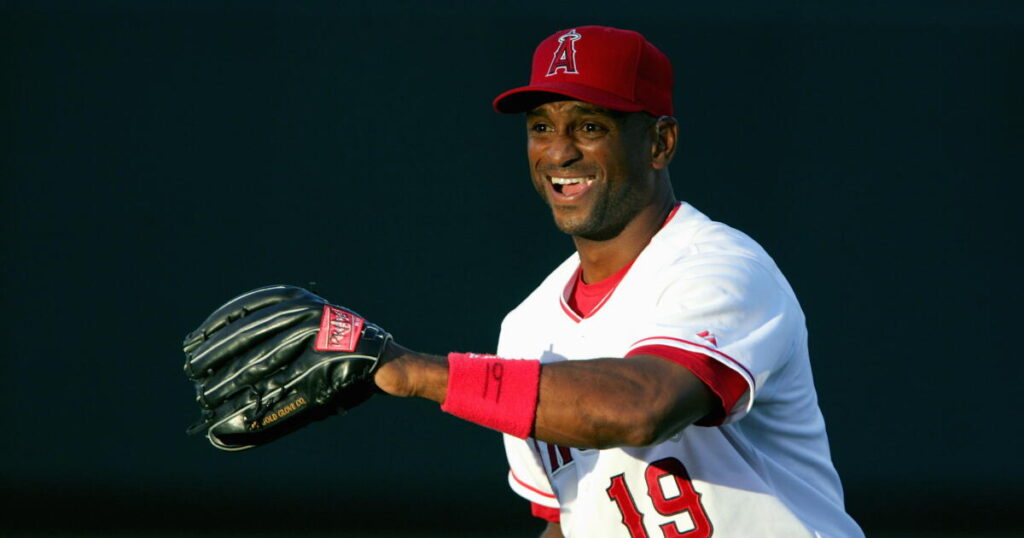
Curtis Pride was born deaf, and when he started playing baseball he was doing it mainly for himself. But the closer he got to becoming the first deaf major leaguer in nearly half a century, the more he realized he was actually playing for a far bigger audience.
“Growing up, I never really had a role model,” he said. “I wanted to be that person because I wanted to tell people that no matter what kind of disability you have, we should not let those disabilities stop us from pursuing our golden dream.”
Yet seven years into what seemed like endless minor league purgatory, Pride’s dream had become a nightmare. He was stuck in double A, where he batted .227 and struck out 110 times in fewer than 400 at-bats. His longtime girlfriend had just broken up with him, his teammates were mocking him behind his back and, at 23, he had crossed the line from prospect to liability.
With a finance degree from William & Mary, he could surely do better things with his life.
So he put away his bat and glove and took a temporary job with a special education program at John F. Kennedy High, his old school, in Maryland, where he quickly learned quitting wasn’t an option. When the students, all of whom had disabilities, found out what he did during the summer, they threw his own words back in his face and insisted he go back. How could he urge them to chase their ambitions if he was willing to give up on his own?
“It kind of hit me. What kind of message would I be sending to them if I walked away from baseball?” he said. “So I thought maybe I should give it another try and see what happens.”
Less than a year later, Pride was standing at second base in Montreal’s Olympic Stadium, doffing his batting helmet to a long-standing ovation he couldn’t hear after doubling in his second big-league at-bat.
“I shed a tear,” said Jim Tracy, Pride’s manager at double-A Harrisburg, where he began his comeback. “That was, for me, a sense of accomplishment for a young man that was driven his whole life to eventually be standing there.
“It was a moving moment.”
“He wanted to be an inspiration,” added Mike Scioscia, Pride’s final big-league manager with the Angels. “He is an inspiration.”
Pride would go on to play 15 more seasons and wouldn’t take the uniform off again until he was forced to, teaching thousands of children (and almost as many adults) that success is possible if you refuse to quit.
“I’ve had so many parents come up to me [and say] ‘wow, you have really given them hope,’” Pride said two days into September, which is Deaf Awareness Month. “To provide that inspiration, that’s more important to me than being a Hall of Famer.”
Pride first learned he could be that inspiration when, as a 17-year-old struggling through his first season of rookie ball in Kingsport, Tenn., he opened a letter from a blind elementary-school student named Amanda. She had always wanted to play baseball, but until she heard about Pride she felt there was no place in the game for a girl with a disability.
The same summer Pride made his professional debut, Amanda set aside her hesitations and joined a tee-ball league.
After his first major league game with the Expos, the trickle of fan mail became a deluge, with hundreds of letters arriving annually from children dealing with everything from hearing and vision loss to debilitating illnesses and injury. Pride answered every one.
“For parents of children with hearing differences, one of the hardest worries to carry is not knowing how to support your own child, or whether they’ll be able to communicate with the people who love them most,” said Cathleen Mathes, president and CEO of the John Tracy Center, a private, nonprofit education center in Los Angeles for infants and preschool children with hearing loss. “Curtis’ story proves that hearing loss puts no barriers on what can be achieved.”
“He’s a shining light,” added Scioscia, who managed Pride for three seasons in Anaheim. “He’s got so much to offer — not only the baseball world, but just [to] people who strive for their goals.”
One of Pride’s goals now is to stay busy.
“I play pickleball every morning. And golf,” said Pride who, 18 years after his last game, isn’t far off his playing weight of 205 pounds.
Pride and his wife Lisa, a former TV journalist, have two children, a daughter Noelle, 22, who is a senior at Ohio State, and son Colten, 19, a sophomore at Central Florida. Noelle has bilateral cochlear implants while Colten has hearing loss in his left ear; both children appeared alongside Judd Hirsch and Amy Smart in the 2024 coming-of-age movie “Rally Caps,” and are active in their father’s advocacy for deaf and hard-of-hearing youth.
For Pride, who has lived most of his life on someone else’s schedule, the free time of retirement in South Florida can be both a luxury and a burden. After his final season as a player with the independent Southern Maryland Blue Crabs in 2008, Pride was hired as the head coach at Gallaudet University, a school for deaf students, taking the team from an 8-23-1 record in his first season to 27 wins in 2014. He was also appointed to the President’s Council of Fitness, Sports and Nutrition under Barack Obama, represented the U.S. at the closing ceremony of the 2012 Olympics in London and worked as an ambassador for inclusion with Major League Baseball.
But Gallaudet dropped baseball two years ago and MLB scaled back much of its inclusion programming two months into the second Trump administration, so now Pride, 57, coaches part-time with the Louisville Slugger Warriors, an amputee and limb-difference baseball team made up primarily of former and current military members. Pride shares his story in motivational speeches and through his book, “I Felt the Cheers: The Remarkable Silent Life of Curtis Pride” (co-written with Doug Ward, the former publications manager for the Angels).
“I never really thought [I was] different from everyone else,” Pride said on a videoconference call, where he fielded questions by reading lips and real-time captions that scroll across his computer screen. “I never knew what hearing is like so there was never an adjustment for me to make.”
In clinical terms, Pride is profoundly deaf. While others with hearing disorders can perceive certain low-frequency vibrations as sound, for Pride almost everything is completely inaudible without powerful hearing aids. And even then loud environmental vibrations such as a low-flying airplane or a heavy truck passing are no more than faintly perceived.
Pride was 6 months old when doctors told his father John, who served eight presidents in a long government career during which he helped investigate the civil rights noncompliance of Southern states, and mother Sallie, a nurse, their son was deaf. After meeting with doctors, audiologists, speech therapists and the families of other deaf children, Pride’s parents made a series of decisions that would change the course of his life.
Pride could learn to communicate orally, through cued speech or in American Sign Language, they were told. Sign language, or the use of hand signals that correspond to separate words or phrases, is the most common choice in the deaf community while oral communication, which involves reading lips and learning to pronounce words you’ve never heard, is by far the most difficult. Yet that was also the option that presented the best chance for Pride to achieve his maximum potential.
So the Prides chose that one, moving to Silver Spring, Md., and enrolling their son in top educational programs for deaf children. At age 6 they also signed him up to play tee ball with the other neighborhood kids, teaching him his deafness may be an obstacle to a normal life but it was not a wall that separated him from one.
“My mom, she explained to me that it was something that I was born with and that I had to make the most of my situation,” recalled Pride, who speaks clearly but with atypical speech patterns since he cannot hear his own voice and adjust his pronunciations.
“[It] should not keep me from fulfilling my dreams and goals.”
And those dreams and goals weren’t confined to the baseball diamond. As a senior at Kennedy High, where he was the only hard-of hearing student, Pride was arguably one of the greatest prep athletes in the country, batting .509 and making the all-county and all-state teams in basketball while becoming the first player at his school to score more than 1,000 career points.
Soccer, however, was his best sport. Pride was a Parade high school All-American, the national player of the year and was ranked by Kick!, a UK soccer magazine for kids, as one of the top 15 youth players in the world after scoring two of the three U.S. goals in the FIFA U16 world championships in China in 1985.
Pride was also an honor student academically, earning a 3.6 GPA despite not being able to hear any of his teachers. So after the New York Mets selected him in the 10th round of the 1986 amateur draft — ahead of future teammate Tim Salmon and future All-Stars Steve Finley, Chuck Knoblauch and John Olerud — his father insisted the Mets allow Pride to attend William & Mary on a basketball scholarship while playing minor league baseball in the summer, an arrangement that may have slowed his progress as an outfielder but one that allowed him to earn a bachelor’s degree in finance in four years.
Pride often refers to his deafness as a “hearing difference” rather than an impairment or handicap. He wasn’t disabled, he said, he was differently-abled — and in some ways, he thought his deafness actually helped him on the field.
“I relied on my other senses,” he said. “My other senses have been enhanced because of my lack of hearing.”
He had no problem communicating with coaches and teammates as long as they stood in front of him, where he could read their lips. And while his teammates could be distracted by raucous crowds and heckling fans, Pride heard nothing but silence. Some outfielders could be fooled playing balls off the crack of the bat, but Pride got good jumps by watching the swing. He also learned to avoid pickoffs by watching for the shadows of opponents sneaking up behind him.
“He had an innate sense of positioning and really relied on that sense,” said Scioscia, who never saw Pride make an error in parts of three seasons with the Angels. “He worked hard at his craft.”
The first deaf player to excel in the major leagues was Billy “Dummy” Hoy, an outfielder who debuted for the Washington Nationals in 1888. He would go on to play 14 years, batting .288, averaging more than 100 runs scored a season and stealing 596 bases before retiring as the all-time leader in career chances and putouts by an outfielder.
Both records have long-since been eclipsed, but Hoy’s influence lives on in the visual signals umpires use to indicate strikes at the plate and out and safe calls.
At the start of Hoy’s career, those calls were typically made verbally, meaning Hoy would have to turn around and look at the umpire to find out if a pitch was a ball or strike. Opposing pitchers would take advantage of that by quick-pitching Hoy, who eventually asked umpires to indicate strikes with a raise of their right hands.
By 1906, four years after Hoy’s final game, that practice was widespread and by 1908 umpires were required to use visible hand signals alongside verbal calls so players, fielders and fans could understand rulings.
At least six deaf men have played in the majors since Hoy, but Pride is just the second to do so in the last 112 years. And only Hoy appeared in more big-league games than Pride.
“Most of the deaf kids who follow sports know who he is,” Joe Strasser, Pride’s longtime agent, said of his client. “To a deaf kid he is like Babe Ruth or Michael Jordan. And when he talks to them, the kids realize that hey, this guy knows what I’m going through because he went through it himself.”
Pride, like Hoy, also left his own unique mark on the game by inspiring the now-ubiquitous practice of players and coaches covering their mouths during meetings at the mound.
Although there is some disagreement over exactly how that ritual started, Hall of Fame pitcher Greg Maddux insists it began after Pride was called up by the Expos in September 1993. Nine days later Maddux started for the Braves in Montreal and took the mound remembering something his brother Mike, also a major league pitcher, had told him about Pride.
“He always reads lips, then tells the coach or the manager exactly what they said,” Maddux later recounted to the Athletic. “When I started [covering my mouth], I started doing it because of Curtis Pride.”
That wasn’t Pride’s only contribution to the teams he played for. A slashing and slender left-handed hitter with blinding speed, Pride hit .300 or better six times, stole 20 or more bases seven times and reached double digits in homers in six seasons, mostly in the minors.
“His physical abilities were flooring,” said Tracy, who managed Pride during his best minor-league season, when he hit .356 with 15 homers and 21 steals in 50 games for Harrisburg. “I think he was driven to prove that hey, not only am I a player, I’m a major league player.”
That last part didn’t go so well. Because while Pride did everything every big-league team asked of him — homering in his first games for both the Red Sox and Yankees — it was never enough to make him an everyday player. Yet Pride wouldn’t quit, Strasser said, urging his agent to call around each winter hoping to get one club interested.
“I would say ‘Curtis, you understand that if you retire now, you would make more money working for an investment banking firm,’” Strasser said. “He wanted to keep playing as long as he could because he saw what kind of effect he would have on kids. That’s why he kept doing it.”
Pride hit .444 with three extra-base hits and five RBIs in nine at-bats as a September call-up for the Expos in 1993. But he got just 63 more big-league at-bats for Montreal before being let go two years later.
After signing with Detroit, he played a career-high 95 games for the Tigers in 1996, hitting .300 with 10 homers and 11 stolen bases — only one teammate with at least 300 plate appearances did better — then batted .252 in 70 games for Atlanta two years later, only to be released both times.
“If a team had given me a chance to be an everyday player, I have no doubt in my mind that I’d have done well,” said Pride, who spent parts of 11 seasons in the majors, hitting .250 in 421 games for six teams. “It’s one of those unfortunate situations where I [was] a pinch-hitter or the fourth or fifth outfielder off the bench.”
As for why he couldn’t stick, Pride has a theory, one that goes back to the second of two short trials with the Red Sox. In the 13th inning of a midseason game in Toronto, the Blue Jays’ Chris Woodward drove a ball to the alley in left-center that center fielder Carl Everett misplayed after he saw Pride closing in from his right.
The mistake cost Boston the game and even though Everett took ownership of the error, many incorrectly blamed Pride’s inability to hear his teammate calling for the ball. Boston released Pride less than two weeks later.
“That sort of reinforced his fear that he had to be twice as good to get half the chance,” said Ward, the co-author of Pride’s biography. “He just didn’t have the margin for error that maybe some of the other players had.”
Pride would play just 108 more games in the majors, making an encore with the Expos and spending a week with the Yankees before finishing with three short stays with the Angels; at 37, he walked and scored a run in his final plate appearance on the last day of the 2006 season.
He would play one more season in the minors and another in the independent Atlantic League before retiring after 23 pro seasons and 1,853 professional games, his debt to the special education students at John F. Kennedy High more than paid off and his legacy as an inspiration secure.
The post Curtis Pride turned his MLB journey into a lifeline for deaf and hard-of-hearing kids appeared first on Los Angeles Times.