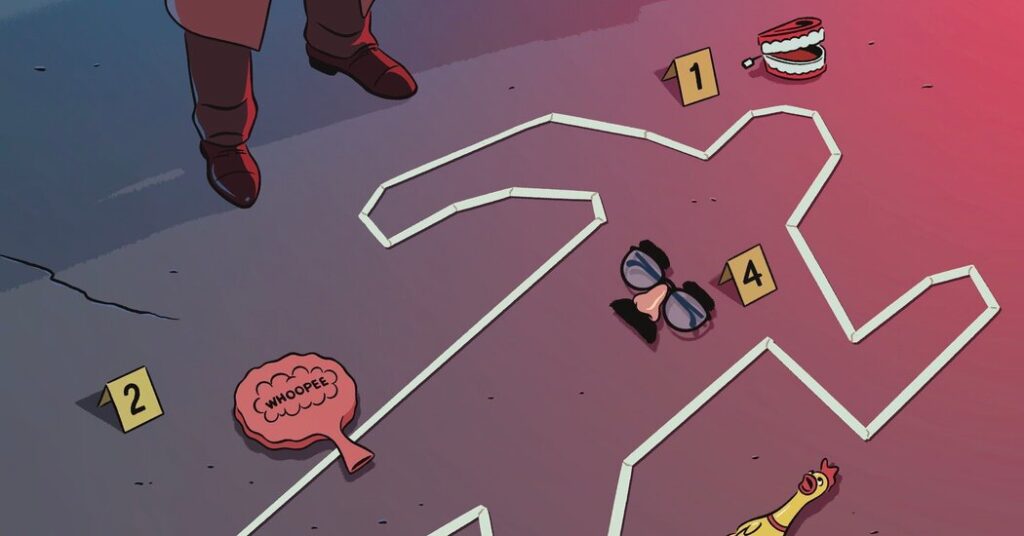
At the Emmy Awards on Monday, one of these eight shows will receive the award for outstanding comedy series: “Hacks,” “Margo’s Got Money Troubles,” “Widow’s Bay,” “Shrinking,” “Nobody Wants This,” “Only Murders in the Building,” “The Bear” and “Abbott Elementary.” If there’s any justice in awards shows (there isn’t), “Abbott Elementary” will win. Not because it’s the best show, but because it’s the only undiluted comedy.
Watching “Abbott Elementary,” we laugh easily at the characters, who are funny because of their faults (and have managed to maintain these faults for five seasons), and we can rest assured that almost all of its episodes will tie up with a happy ending, in classic comedy fashion, even if it’s a small victory.
Watching the other nominees, we laugh, for the most part, infrequently, if at all. If we laugh at the characters, it’s often in spite of their faults, and there are no happy endings, because there are no endings: These shows are designed for us to click onward to the next episode. And the one after that. And so on.
It’s no coincidence that “Abbott Elementary” is also the only outstanding comedy nominee made for broadcast television — and that the other nominees are all the products of streamers and skew more toward dramedies (drama-comedy hybrids) or, in the case of “Widow’s Bay” and “Only Murders in the Building,” mysterdies. (Both shows kick off with mysterious, unsettling deaths, ha ha.)
Or, in the case of “The Bear,” a straight-up drama that just happens to be about half an hour long. Future academics may pinpoint 2023, the year “The Bear” won the Emmy for outstanding comedy series, as the year the sitcom entered hospice care.
The demands of streaming, which is now how most viewers watch TV, are not suited to just plain old comedy. Broadcast TV wants you to watch a show and then, after you’re done, watch a different show on the same channel. Streamers have a different agenda: They want you to watch 10 episodes of that same show back-to-back. They want you never to leave. (The Netflix co-founder Reed Hastings famously stated that his streamer’s real competition is sleep rather than other TV networks or streaming platforms.) The comedies of streamers, then, need to hypnotize their viewers and keep them clicking on the “next episode” button with the effectiveness of a true-crime thriller. And so: A body washes up on a beach. A pregnancy test is revealed as positive. An alcoholic takes a drink. Oh my God — what’s going to happen next? Any number of things, but probably not laughter.
As a comedy writer for TV and movies, I find this climate daunting. After recently pitching a workplace comedy to a streamer — they passed — part of the feedback I received was “not propulsive enough.” “Propulsive” turns out to be a hot buzzword in development, and the current comedies are slick with propulsion (propulsivity? propulsiveness?).
On the outstanding comedy series Emmy nominee “Margo’s Got Money Troubles,” money troubles are the least of it. Margo has to deal with an unexpected pregnancy, her violence-prone mother, her father’s drug addiction and the challenges of fighting for custody of her child when her occupation as a sex worker is revealed by the vengeful father of her child. Are you laughing yet? (That the creator of this “comedy” is David E. Kelley, the mind behind such hilarity as “Boston Legal” and “Big Little Lies,” tells you more than this piece can.)
Another nominee, “Nobody Wants This,” repeatedly detaches its star-crossed lovers, a rabbi and a sex-and-dating-podcasting shiksa, with the precision of a mohel’s izmel, while “Hacks” has tortured the two women at its center by setting them against each other, turning the show into a bitter, toxic take-no-prisoners fight for most of Season 4. Oscar and Felix fought on “The Odd Couple,” it’s true, but their fights never carried over beyond one or sometimes two commercial breaks.
From the dawn of TV until a few years ago, popular sitcoms like “The Odd Couple,” “All in the Family,” “The Mary Tyler Moore Show,” “MASH,” “Cheers,” “Friends” and “Seinfeld” trafficked in situation comedy that reset every week, much like “Abbott Elementary,” allowing the same characters to make similar mistakes over and over again, and for us to laugh at those mistakes. In other words, the characters didn’t learn or grow. Yes, there were sometimes larger arcs woven into their many seasons (Meathead moved away, some of the Friends hooked up, the Korean War eventually ended), but they were peripheral to the comedy, which was focused on those characters, who exemplified our own foibles and exploded them with great catharsis.
These days, the characters in comedies have no choice but to grow.
Unfortunately, growth is antithetical to comedy.
We used to learn from watching people who didn’t learn. But the characters who were once the bedrock of the sitcom, such as the harebrained schemer (Lucy Ricardo), the unrepentant misanthrope (Archie Bunker), the pompous idiot (Ted Baxter), the total idiot (Homer Simpson) and the selfish, cynical, unchanging jerk (the entire cast of Seinfeld), don’t exist anymore. Sitcoms today are populated with more well-meaning people than an infomercial for Save the Children. Dead spouses and family members regularly haunt these shows (including five of the eight Emmy nominees and yes, I’m still talking about comedies).
Even while the genre of comedy is being diluted by more and more propulsivity, production of new sitcoms as a share of all new TV shows has decreased sharply, from 12 percent in the 1990s, to 1.7 percent now. This drop is difficult to fathom, given that this is the genre that, until this decade, boasted the biggest hits on TV. In fact, the four biggest moneymaking TV shows of all time are comedies: “The Simpsons,” “Friends,” “The Big Bang Theory” and “Seinfeld.”
This year, some networks and streamers didn’t even bother making a comedy pilot.
I’m used to comedy getting no respect, especially in the face of new technology. The peak of my professional TV writing career was showrunning “Key & Peele,” episodes of which were immediately disassembled and disseminated as residual-free “publicity clips” on the internet. (You may think you’ve seen “Key & Peele,” but what you’ve probably seen is a pirated piece of the show.) This was followed by the dissolution of the cable network behind the show, Comedy Central, and ultimately the entire sketch-comedy genre. In 2015, the last year “Key & Peele” aired, there were 12 sketch shows on the air. Right now, there’s just one being made. Why? The only show that relies on resets more than the traditional sitcom is the sketch comedy, which resets after every sketch and is therefore the very opposite of binge-worthy, so … goodbye.
“Key & Peele” won the Emmy for outstanding variety sketch series in 2016. (OK, there is some justice in awards shows.) By 2023, the category had been subsumed into outstanding variety series. The nominees this year are four talk shows and “Saturday Night Live,” the last sketch show on TV.
Comedy has always been something of an embarrassing stepchild for Hollywood — the Greeks gave comedy and tragedy equal standing, but, by my count, tragedy (or drama) has won 88 of the last 98 Oscars for best picture. Personally, I hope (for both selfless and selfish reasons) that the pendulum swings back the other way — that the entertainment business can grant us a respite from murder shows, find its way back to embracing comedy, and bring us characters who never learn. Ever.
We could all use a laugh.
Jay Martel is a former showrunner for “Key & Peele” and has written novels and screenplays.
The Times is committed to publishing a diversity of letters to the editor. We’d like to hear what you think about this or any of our articles. Here are some tips. And here’s our email: [email protected].
Follow The New York Times Opinion section on Facebook, Instagram, TikTok, Bluesky, WhatsApp and Threads.
The post What’s Happening to TV Comedies Is Not Funny appeared first on New York Times.