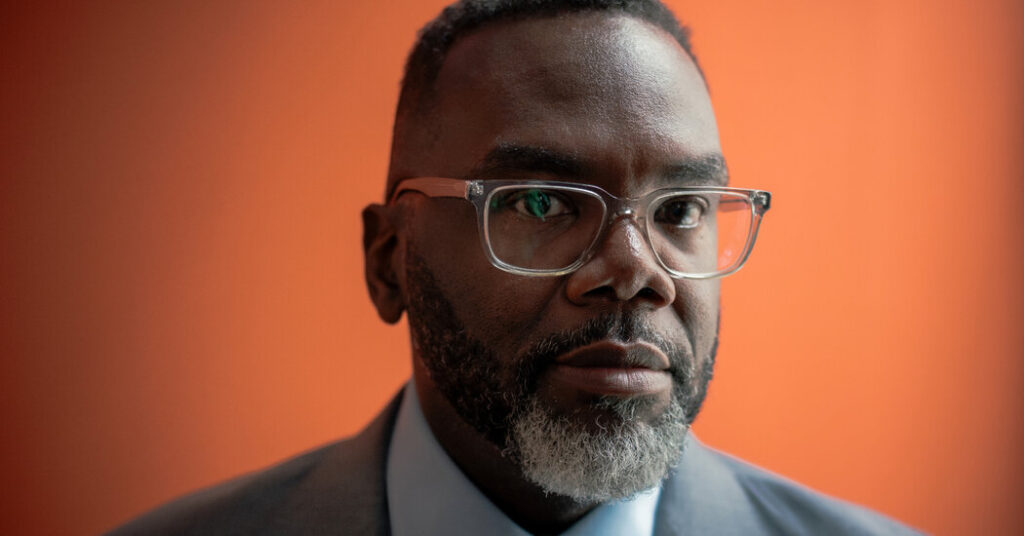
Mayor Brandon Johnson has put an end to months of speculation in Chicago over his political ambitions, declaring in an interview that he will seek a second term as mayor of the nation’s third-largest city.
At his campaign office downtown last week, Mr. Johnson, 50, said that he intended to double down on his progressive agenda and continue to push for a city that is accessible to the working class.
“I made a commitment through the lens of working-class leadership that we would take on the billionaires and the corporate interests to prioritize working people to build the safest, most affordable big city in America,” he said. “That’s what we’re doing.”
Mr. Johnson, a former labor organizer who catapulted over an incumbent mayor, Lori Lightfoot, to win election in 2023, plans to formally announce his re-election campaign at the DuSable Black History Museum and Education Center on Sunday.
The nonpartisan election is set for February 2027, with a possible runoff in April if no candidate secures victory with more than 50 percent of the vote.
The election will be a formidable test of his brand of progressive politics.
Although he is not a democratic socialist, Mr. Johnson stands out even among fellow Democrats for his liberal policies, his willingness to raise taxes and his tendency to spurn moderates and business leaders. Mr. Johnson has fought to raise wages for workers, expand social programs and make deep investments in public education, even as the city carries budget deficits and alarming pension obligations.
Early polling suggests that many voters are not enthralled with Mr. Johnson’s performance. In July, a poll from the Mansueto Institute for Urban Innovation at the University of Chicago found that only 14 percent of Chicagoans wanted Mr. Johnson to run again, and 23 percent of Chicagoans approved of his job performance.
In 2023, Mr. Johnson was backed by high-profile democratic socialists, including Senator Bernie Sanders of Vermont, who flew to Chicago in the closing days of the campaign and drew thousands to a rally.
Mr. Johnson said that despite the new prominence of democratic socialists in national politics, many of their ideas are rooted in the approach taken by decades of Black leaders in Chicago.
“Bernie Sanders came to Chicago to study Reverend Jesse L. Jackson Sr.,” he said last week. “The O.G. democratic socialist is the retiring congressman from the 7th Congressional District, Danny K. Davis. Like this idea of the rise of democratic socialism, quite frankly, it erases Black leadership.”
When Mr. Johnson was elected in 2023, he had created a coalition of voters in a deeply Democratic city, dominating in wards with Black majorities while also winning whites and Latinos on the North and West Sides and so-called lakefront liberals.
Part of Mr. Johnson’s renewed pitch to voters is what he considers a signature accomplishment during his first term: the major drop in crime.
According to police data, murders citywide have decreased by 39 percent in the last four years and shootings are down 49 percent. Burglaries, robberies and sexual assaults have all decreased in the same time period.
Despite a general feeling in Chicago that the city is safer, more vibrant and filled with more tourists compared with its post-pandemic funk four years ago, many Chicagoans have been frustrated by Mr. Johnson and what they see as his divisive rhetoric.
In 2024, voters roundly rejected his effort to raise a real estate tax that would have poured funds into homeless services. He has pushed policies, including a tax on employers based on the number of workers they have, that have been blocked by the City Council and criticized by business leaders, who say that Mr. Johnson’s ideas would hurt the local economy and discourage corporations from expanding in the city.
Earlier this year, two ratings agencies downgraded Chicago’s credit rating, pointing to budget shortfalls and a lack of long-term financial planning. The downgrades could lead to higher borrowing costs that are picked up by taxpayers.
Many members of the City Council have staged an all-out revolt against Mr. Johnson, blocking his policy initiatives at every possible turn.
Dan Lurie, the chief executive of the Metropolitan Planning Council, a nonprofit think tank in Chicago, said that the Johnson administration was facing hard realities: Once-guaranteed federal money has disappeared under the Trump administration and the state’s finances continue to be in flux.
“Communicating a vision for change is only the first step in a mayor achieving it,” he said. “Grappling with how to confront systemic barriers, dismantle them and build coalitions around policy is the true test for any leader committed to protecting what many Chicagoans love about our city and taking the necessary next step of making it accessible and sustainable for all.”
A long list of challengers are hungry to take Mr. Johnson’s place.
Some are particularly well known and well funded. Alexi Giannoulias, currently the Illinois secretary of state, had close to $22 million in his mayoral campaign account, as of the latest campaign filings, swamping the $631,309 that Mr. Johnson’s campaign had on hand.
Mr. Giannoulias, a more moderate progressive, has garnered support from trade unions and the city’s financial class, which has largely coalesced around him as a competitor to Mr. Johnson.
“Chicagoans are tired of being told to settle for dysfunction,” said Jordan Abudayyeh, a campaign spokeswoman. “Alexi has a record of tackling big problems, fixing government and delivering results, and he’s running to bring that same leadership to City Hall.”
United States Representative Mike Quigley, from the North Side of the city, has also declared his candidacy, as has Susana Mendoza, the state comptroller.
The post Brandon Johnson to Seek Second Term as Mayor of Chicago appeared first on New York Times.