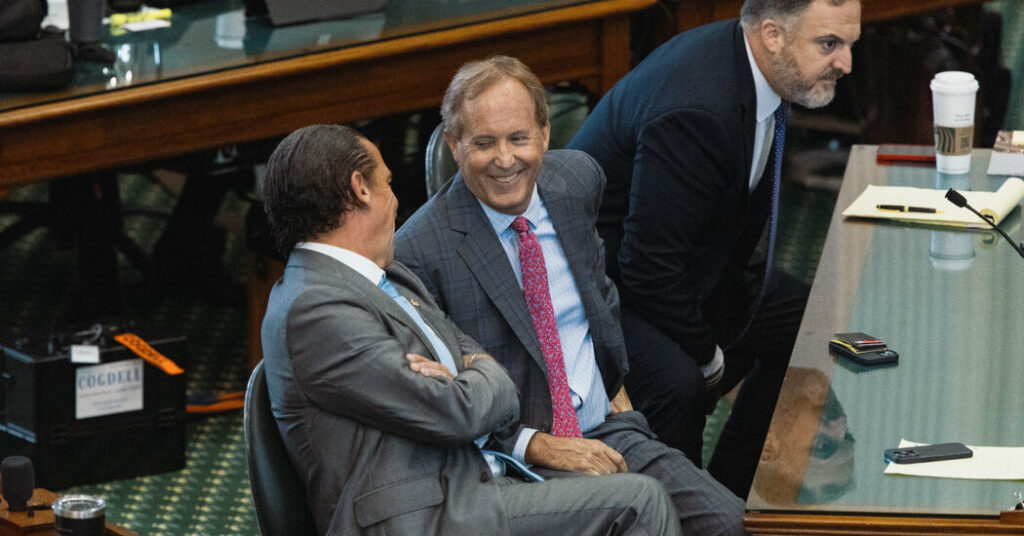
On the eve of the verdict in Ken Paxton’s impeachment trial, the prosecutors were unwinding over Mad Dog Margaritas at Texas Chili Parlor, a casual hangout in the shadow of the State Capitol in Austin.
Mr. Paxton, the state’s Republican attorney general, stood accused of abusing the power of his office to protect a campaign donor under federal investigation, who, in turn, had purportedly remodeled Mr. Paxton’s home and helped him conceal an extramarital affair. A majority of Republicans in the Texas House had joined with Democrats to vote for impeachment, a stunning development that turned state senators into jurors for a nine-day trial in September 2023.
The lead prosecutors, Dick DeGuerin and Rusty Hardin, were feeling cocky that evening, reliving the highlights of the case.
“We were chest thumping,” Mr. DeGuerin said. They stepped outside to greet one of the defense lawyers, Dan Cogdell, who offered Mr. DeGuerin a cigar. He, too, thought the prosecutors had won.
The next day, a cacophonous thunderstorm passed over the Capitol as the members of the Texas Senate rose from their seats, one by one, and offered a “yea” or “nay” on each of the 16 articles of impeachment. A two-thirds majority on just one article would have cost Mr. Paxton his job.
He was acquitted across the board.
Now, as Mr. Paxton campaigns for the U.S. Senate in one of the most high-stakes races in the country, his impeachment stands out as the defining episode in a scandal-plagued career. It was the moment that he came closest to political ruin, and it was a testament to his uncanny resilience — a trait not unlike the survival skills associated with his twice-impeached ally, President Trump.
James Talarico, Mr. Paxton’s Democratic rival, has seized on the impeachment as the centerpiece of his argument that Mr. Paxton is “the most corrupt politician in America,” a critique that the attorney general and his allies shrug off. After all, he has outrun accusations of corruption for years.
“The impeachment trial was nothing more than a politically motivated witch hunt orchestrated by the establishment, said Nick Maddux, Mr. Paxton’s campaign adviser, “and it ended with Attorney General Paxton being proven completely innocent and the sham allegations against him completely debunked.”
A New York Times examination of the impeachment, including more than two dozen interviews with key players as well as a review of the trial transcript, court exhibits and media coverage, revealed how the defense team’s shrewd political instincts during a trial in which pivotal witnesses were never forced to appear allowed Mr. Paxton to triumph.
No smoking gun ever surfaced. And several rules set by the Republican-led Senate for the impeachment trial — the first of a statewide officeholder in Texas in more than a century — tilted in Mr. Paxton’s favor.
Mr. Paxton, who was absent for most of the trial, never said a word under oath. His alleged girlfriend did not take the stand. Nor did the campaign donor whom Mr. Paxton tried to help or the contractor who worked on his home.
Lt. Gov. Dan Patrick, who is not a lawyer, wielded significant authority over the proceedings as the presiding officer. He had recently accepted $3 million in contributions and loans from a PAC attacking pro-impeachment lawmakers.
“It was rigged,” Mr. DeGuerin said. “I was naïve enough to think we stood a chance.”
Mr. Patrick did not respond to requests to discuss his oversight of the impeachment proceedings. In an interview after the acquittal, he defended the process. “There is no bias,” he said. “I ran a fair trial.”
Mr. Paxton declined a request for an interview.
One of the biggest challenges facing the prosecution took place outside of the legislative chamber: a relentless pressure campaign waged by Mr. Paxton’s right-wing supporters, who embraced him as a frontline warrior against the Obama and Biden administrations. Donald Trump, who was planning his return to the White House, vowed to punish lawmakers who backed impeachment. “I will fight you,” he warned.
The impeachment drama cemented Mr. Paxton’s bond with the MAGA movement and derailed the careers of his political foes. In a sign of how he came away with the upper hand, a few of the Republican lawmakers who pushed for impeachment are now stumping on his behalf.
Mr. Cogdell, however, recently endorsed Mr. Talarico, arguing that the attorney general has become too beholden to President Trump. And though he still believes Mr. Paxton did not commit a crime, he harbors serious qualms about the proceedings.
Not Tony Buzbee, another lawyer for Mr. Paxton
“Ken Paxton won that trial fair and square,” Mr. Buzbee said. “I told him then: ‘We will win this, and you will be the next U.S. senator from Texas.’ I was right on the first prediction, and I expect I will be right on the second on as well.”
‘He wouldn’t listen’
Mr. Paxton’s impeachment began with a mutiny.
In 2020, high-ranking staffers in the attorney general’s office were resisting Mr. Paxton’s appeals to intervene on behalf of Nate Paul, a real estate investor under federal investigation who had donated $25,000 to his re-election campaign.
Mr. Paxton had his own legal problems. Just a few months after being sworn in as attorney general in 2015, he had been indicted on felony charges of securities fraud. Mr. Cogdell, who also represented Mr. Paxton in that case, said the attorney general had sympathized with Mr. Paul’s claims that he was the was the target of a conspiracy involving the F.B.I., federal judges and state regulators.
Mr. Paxton’s deputies didn’t buy it. They thought Mr. Paul was seeking political favors that compromised the office’s integrity.
“We had all tried to talk Paxton into backing off and to talk him off the ledge, and he wouldn’t listen to anybody,” said Mark Penley, who served as Mr. Paxton’s deputy attorney general for criminal justice. “We were the only ones that knew it and we were the only ones that could stop it.”
David Maxwell, Mr. Paxton’s director of law enforcement, was on vacation in Colorado when his colleagues sent an urgent text. He drove his Ford truck to the bottom of a mountain to get a cellphone signal.
“They said they were going to band together,” Mr. Maxwell recalled. “They said they were going to go to the F.B.I. I said, ‘That’s amazing guys. But we’re all going to lose our careers. He’s never going to back down.’ ”
The group met with law enforcement on Sept. 30 and notified their boss the next day. Within the week, they had all either resigned or been forced out.
Four of them, including Mr. Penley and Mr. Maxwell, argued in a whistle-blower lawsuit that the dismissals were acts of retaliation. Mr. Paxton eventually agreed to a $3.3 million settlement and an apology for having disparaged them as “rogue employees.”
But he then turned to state legislators, expecting them to allocate tax dollars to make the payment. House members balked and launched an investigation, leading to an outcome neither Mr. Paxton nor anyone in Texas politics could have predicted.
In May 2023, the Texas House voted 121-23 to impeach Mr. Paxton, temporarily removing him from office. The articles of impeachment charged him with using his public office to serve Mr. Paul’s private interests, including intervening in a lawsuit between his companies and a nonprofit, trying to help him avoid foreclosures on his properties, and hiring an outside lawyer to investigate Mr. Paul’s objections to a federal probe. He was accused of bribery, dereliction of duty, obstruction of justice and abuse of the public trust.
Mr. Paxton called the process “illegal, unethical and profoundly unjust.”
His fate would lie with the Texas Senate, the chamber more aligned with the right-wing activists who were rallying behind him. At the helm would be Mr. Patrick, a staunch conservative with an overlapping political base.
‘Impeaching for the next 100 years’
In a state known for swagger, Mr. Paxton’s impeachment saga scaled the heights of political drama. Colorful characters took center stage, from Representative Andrew Murr, an impeachment manager with a handlebar mustache so distinctive it had inspired its own social media account, to Mr. Maxwell, a career lawman standing 6-foot-6 in his trademark boots and white cowboy hat.
Mr. Paxton’s wife, Angela, a member of the Texas Senate, sat stoically through the entire trial, as prosecutors contended that her husband deployed burner phones and a secret Uber account paid for by Mr. Paul to cover up his illicit activities. Mr. Paxton’s alleged girlfriend, Laura Olson, made a much-anticipated appearance at the Capitol in a white sheath dress.
At the defense table sat Mr. Buzbee, a trial lawyer known for his deep tan and courtroom theatrics. “Imagine if we impeached everybody here in Austin that had had an affair,” he quipped at one point. “We’d be impeaching for the next 100 years, wouldn’t we?”
Prosecutors were confident in the strength of their case. They believed that the evidence was compelling, and they had Mr. Paxton’s top aides, conservative lawyers themselves, prepared to testify about his eagerness to help Mr. Paul.
Still, the ground rules approved by the Senate set a high bar for the prosecution. The presentation of evidence would be limited to 24 hours, a brief time frame for such a sweeping and complex case. Most notably, the rules invested Mr. Patrick with what Senator Sarah Eckhardt, a Democratic former prosecutor, called “near total control over the proceedings.” On the first day of the trial, Mr. Patrick granted one of Mr. Paxton’s most important requests, declaring, “You may not call the attorney general as a witness.”
Mr. Paxton’s attorneys had argued that the trial was a criminal proceeding and that criminal defendants cannot be forced to give evidence against themselves.
The rules also addressed Mrs. Paxton’s role. She could not participate in the deliberations or vote, but she would be counted as present. That meant it would take one additional vote to reach the two-thirds majority required for a conviction.
In contrast, Mr. Paxton was not required to attend. He left during lunch on the first day and didn’t return until closing arguments.
It was a decision that divided the defense team.
“I thought that was a horrible look for Ken not to be there,” Mr. Cogdell said. “You’re not going to show up for your own trial while your wife is sitting there suffering through all these accusations of adultery?”
Mr. Buzbee disagreed. “I wanted to avoid the distraction of press trying to speak to him or focusing cameras on him,” he said. “I wanted the focus on the evidence, or lack thereof. I believe that was effective.”
The two sides deployed such different strategies at trial that they barely seemed to be playing the same game. The prosecution treated the proceedings like a standard courtroom trial. The defense hammered the process as a vendetta conjured up by an anti-Paxton cabal.
Day 7 of the trial was particularly trying for the prosecution. In a conversation out of public earshot that later became part of the trial transcript, Ms. Olson’s attorney argued that her client should not have to take the stand because she intended to assert her Fifth Amendment right against self-incrimination and it would prejudice the jury for her to assert it over and over in response to questions. Mr. Patrick agreed, rejecting prosecutors’ arguments that Ms. Olson did not face any criminal exposure.
Later that day, a former aide to Mr. Paxton, Drew Wicker, testified about a key element of the alleged bribe: the renovations to the attorney general’s home in Austin. Mr. Wicker said he had overheard Mr. Paxton and the contractor, Kevin Wood, discussing a $20,000 upgrade to kitchen countertops and cabinets. According to Mr. Wicker, Mr. Wood said he would “check with Nate,” presumably referring to Mr. Paul.
But under cross-examination, when Mr. Buzbee showed what he said were before and after photos of the kitchen, Mr. Wicker said the fixtures “appear to have not been altered.”
That moment overshadowed other evidence: emails between Mr. Wood and Mr. Paul discussing renovations in other parts of the house, and records that showing Mr. Paxton did not pay for the repairs until after staff members had notified him of their meeting with law enforcement. Those payments, documents showed, went to a company tied to Mr. Paul.
Closing arguments epitomized the strategies deployed by the two sides. The prosecution delivered a methodical summary of its case. Mr. Buzbee issued a battle cry, calling the process a “political witch hunt” in a direct appeal to the Republican senators.
“My goal was to speak to them through their constituents,” Mr. Buzbee said. “Each day Twitter was on fire, as I revealed what I believed to be a larger effort to get rid of Paxton. Once those on the fence saw that the evidence was flimsy, and once they saw the fervent reaction of the activists, we were able to sway those senators.”
Senator Bob Hall, a Republican who voted to acquit, said he had scrutinized all the court exhibits with a yellow highlighter and a red pen.
He said he had assumed the prosecutors would end their case with dramatic new evidence. “They’re going to drop the big bomb,” he recalled thinking. “But they didn’t, and that’s because they didn’t have anything.”
In the end, only two of the 18 Republican senators voted for conviction.
Senator Robert Nichols, one of those two votes, said he had received 1,400 threats of political reprisal through emails, texts and phone calls. The message was clear: Mr. Paxton’s hard-fought battles against illegal immigration, the Affordable Care Act and the results of the 2020 election had mattered far more than the evidence presented at trial, he said.
Mr. Nichols lamented that the impeachment proceedings seemed warped by outside forces. “It was a trial of social media and public pressure,” he said.
Shortly after the vote, Mr. Patrick pivoted from judge to politician, ripping into the House Republicans who had voted for impeachment. “Millions of taxpayer dollars have been wasted,” he said.
Mr. Cogdell was horrified.
“If those were truly his feelings, there’s no way it didn’t affect his decision making,” Mr. Cogdell said. “I thought it brought shame on the process.”
Mr. Paxton blasted the trial as a sham. And in the years since the trial, Mr. Paxton has gloated about his victory.
An F.B.I. investigation into the allegations at the center of the impeachment never resulted in charges. In 2024, shortly before Mr. Paxton would have faced trial on the security fraud charges, he cut a deal in which he paid $300,000 but admitted no guilt.
Last year, a judge awarded $6.6 million to the top aides Mr. Paxton forced out, a payment that would have to be approved by the Texas Legislature. But the former staffers aren’t optimistic. Several Republican lawmakers who had backed impeachment either bowed out of politics or lost their seats after Mr. Paxton and his allies campaigned against them.
And of those Republicans who took on Mr. Paxton and survived, some are stumping for the man they once accused of abusing the public trust.
At a recent campaign event in Frisco, north of Dallas, conservative influencers and politicians warmed up the crowd for Mr. Paxton. One more supporter stepped up to introduce him. It was Representative Jeff Leach, a Republican who had helped spearhead Mr. Paxton’s impeachment, and is now running for re-election.
“You might be surprised to see me standing in front of you tonight,” Mr. Leach said. “The choice in November for all of us is clear.”
Mr. Paxton then strode onstage.
The post Inside the Impeachment Trial that Threatened to End Ken Paxton’s Political Career appeared first on New York Times.