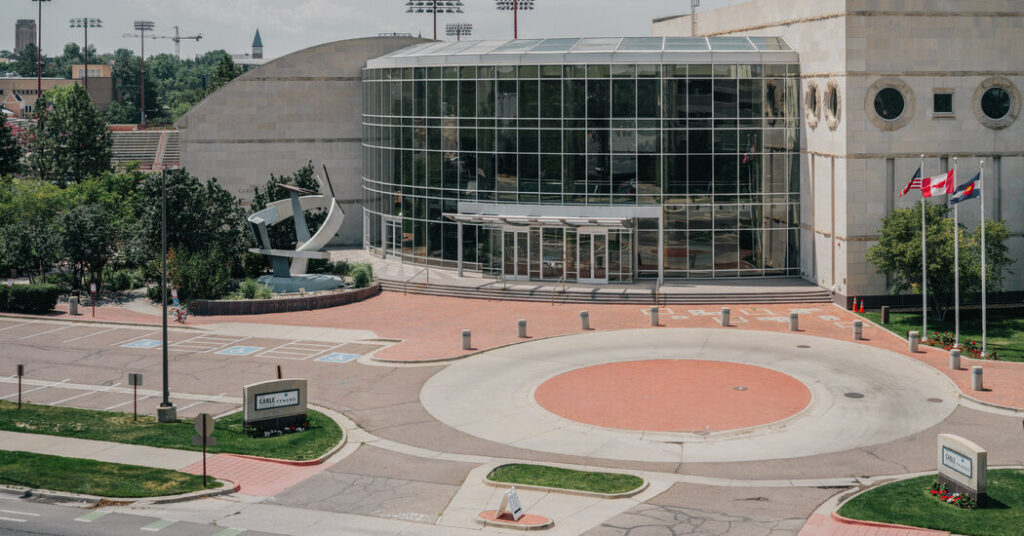
A few miles south of downtown Denver stands a gleaming, sun-soaked building erected as a shrine to cable television.
The modern glass exterior gives little hint of the treasure trove of cultural touchstones housed inside: an MTV Moonman trophy, a “Sex and the City” telephone in the shape of a stiletto, a box of macaroni with branding from “The Sopranos.” And then there’s the giant tower right near the entrance, extending nearly three stories tall, designed to show a live feed of dozens of cable networks.
The goal was to establish a place to celebrate the popularity, power and prestige of cable TV.
“We like to say that radio and TV is the past and cable is the future,” John Malone, one of the numerous industry titans who backed the project, said shortly before construction of the building began in the late 1990s. “This will look toward the future.”
Instead, it now symbolizes the industry’s flipped fortunes.
This summer, the Cable Center sold and abandoned its 75,000-square-foot headquarters. It whittled down its giant catalog of artifacts to fit into storage and a temporary headquarters of just 8,500 square feet, an anonymous office on the fourth floor of an administrative building nearby.
The institution’s downsizing, formally because of mounting bills and lagging fund-raising, parallels the declining fortunes of cable itself. At its height, in the 2010s, more than 100 million American households had a cable subscription — more than three-quarters of the country. Even five years ago, 40 percent of all TV consumed in the United States was from a cable network, according to Nielsen.
But today, nearly half of all TV watched in the United States comes via streaming services. Just 19 percent of television viewing comes via cable.
By this summer, the remotes and splitters and stiletto telephones that once filled the center were in boxes, and the Cable Hall of Fame plaques had been removed from the walls, leaving a spare space pockmarked with nail holes.
Like the cable feeds in many houses, the video tower at their old headquarters was now dark.
The Cable Center was always supposed to be more than a repository for several thousand old remote controls and other pieces of equipment. It was educational — the center’s relationship with C-SPAN, the cable-industry-sponsored public affairs channel, gave it access to guest speakers like Hillary Clinton and John Kerry. It built an extensive oral history archive with key programmers and executives, part of a significant research library. And it was meant to be inspiring: The building, as the Cable Center’s former chief technical officer put it, was to be “state-of-the-art forever.”
The nonprofit set up its home in Denver, a hub for several cable companies as well as the industry trade news media, as the cable industry was booming in the 1990s.
It never drew the 100,000 annual attendees that its leaders had hoped for — it turns out that Denver may not have been an ideal spot for a cable museum and that cable itself “maybe was not as compelling as to draw that kind of crowd,” said Diane Christman, the president of the Syndeo Institute at the Cable Center. (The center added Syndeo, the Greek word for connection, to its name in 2023.) But the institution was on steady ground for some time.
When inquiries came in to see if the building was for sale, as one did in 2012, the Cable Center could easily turn them down.
“It’s a real, true American success story,” Ms. Christman said of the cable industry. “You have people who made fortunes, lost fortunes, made fortunes again, and who put everything into this business. There’s a lot of pride in this industry.”
Ms. Christman, who has been working at the Cable Center for 20 years and has been its leader since 2022, has been trying to secure the nonprofit’s future.
For years, the signature fund-raising event for the center was an annual banquet, the Cable Hall of Fame gala, timed each year to coincide with the so-called Cable Show, a trade conference that once anchored the industry calendar. The Cable Show brought together programmers, distributors and operators and was a key dealmaking opportunity, as well as a show of force for the sector.
The Hall of Fame dinner could draw more than 700 paying attendees; tables at the event could cost more than $20,000 each. As recently as 2015, the banquet raised $1.2 million.
But as cord-cutting and declining viewership forced many cable and media companies to consolidate, the Cable Show lost its relevance. By 2017, it was canceled outright — and the dinner dwindled to half its previous size.
Over the years, the Cable Center was forced to shrink its work force. At its high-water mark, it employed about 36 people, Ms. Christman said. Now, the employees total a third of that.
Costs were mounting, too, and the building was not living up to its technological promise. The HVAC system was frequently on the fritz, and energy bills were soaring to $22,000 a month, a daunting expense for a building with just a handful of full-time workers.
“The worst bill I recall was for $28,000, and I was having a minor heart attack,” Ms. Christman said.
Last year, when the University of Denver made an aggressive push to buy the building, Ms. Christman felt she had little choice but to take the offer. She worried about the response given that the building was such a “symbol to the industry,” she said. But she was relieved when she heard few objections to the $19.5 million sale.
“I really thought after the news broke that I was going to get a lot of phone calls and people were going to be like, ‘What did you do?’” she said. “But it didn’t happen.”
Now, she and Brian Kenny, the Cable Center’s longtime librarian, will determine exactly how to preserve cable’s history.
They know the industry — and the center — is “at a crossroads,” as Ms. Christman put it. But she isn’t giving up on the Cable Center. She is just looking for a smaller, perhaps more manageable home for it.
Cable, after all, still accounts for a fifth of all television viewing. Cable companies like Comcast, Charter and Optimum are still offering a critical service by providing broadband and internet to homes. NBCUniversal may have spun off cable networks like USA, CNBC and Syfy into a new company, but that company, Versant, remains quite profitable.
Ms. Christman insists there will be a long future for the nonprofit. The sale of the building helped secure it. “This isn’t our end,” she said. “It’s the next chapter.”
Mr. Kenny pushed off his retirement to make sure he oversaw the entire move. “You build collections to pass it forward,” he said. “That’s the whole thing.”
On one of their last visits to the old building, Ms. Christman and Mr. Kenny gestured toward a photo still hanging near the second-floor balcony. She reeled off the names of cable’s titans of yesteryear, identifying one chairman, chief executive and cable pioneer after the next in the portrait. Nearly all of them were dead.
“Brian and I can come in and can tell you the names of everybody here,” she said. “But the people who can come here and identify all these people are dwindling. That’s why the work that we do is so important.”
The post They Built a Shrine to Cable TV. Then Everyone Cut the Cord. appeared first on New York Times.