The Reflecting Pool in Washington, which stretches eastward along the National Mall from the foot — or should that be the feet? — of the Lincoln Memorial, has been the site of high legal and political drama in recent months.
But the Mall has long been contested territory: the stage for recurring, and often searing, controversies about the role design should play in making sense of national identity and America’s role in the world. Just ask Maya Lin, who was forced in the early 1980s to defend her design for the Vietnam Veterans Memorial against the charge that its minimalism made it unpatriotic.
Two projects set to open within a week of one another this fall at opposite ends of the Mall show the scars of debates that go back decades, long before resealing the Reflecting Pool became a curiously pressing White House priority.
They’re among the highlights of an unusually busy fall architecture season that features a crop of ambitious buildings on college and university campuses, a scholarly spotlight on America’s pioneering Black architects and new museums in Los Angeles, Sydney and Brussels.
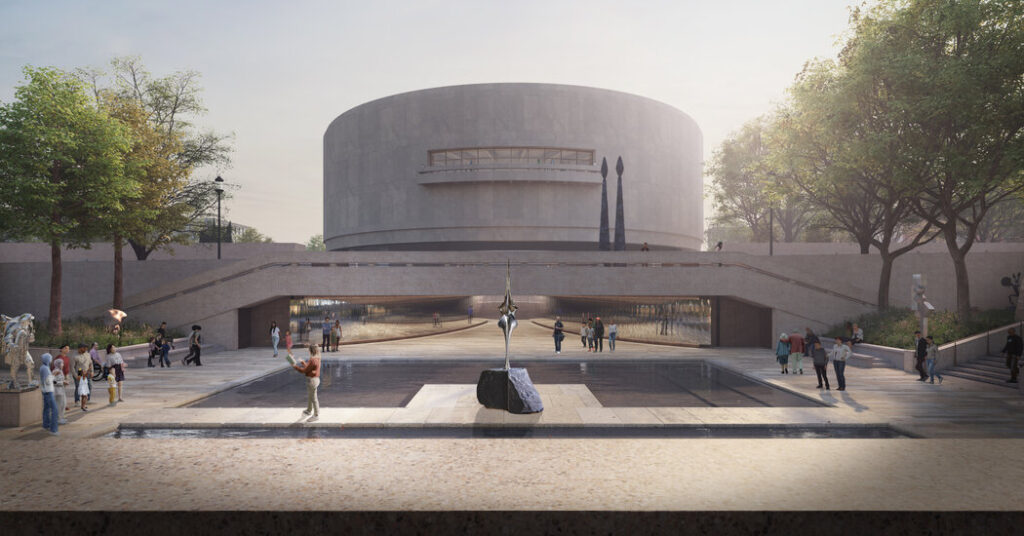
The Hirshhorn Museum and Sculpture Garden, as the arm of the Smithsonian dedicated to modern and contemporary art, has been a lightning rod on the Mall since its doughnut-shaped building, by Gordon Bunshaft of Skidmore, Owings & Merrill, opened in 1974. (Call it Late Modern; call it Brutalist; just don’t call it windowless!) The sculpture garden in particular struck even some of Bunshaft’s fans as overly severe. The museum enlisted the landscape architect Lester Collins to add lawn, shade and access ramps, in a sophisticated update finished in 1981.
A recent attempt to rethink the garden, led by the Japanese artist and architect Hiroshi Sugimoto, also tapped to redesign the Hirshhorn lobby, has been even more ambitious — and contentious. Unveiled in 2019, it drew complaints from preservation groups worried it would erase Collins’s contribution. They were especially exercised at Sugimoto’s decision to trade the original concrete walls for new ones of dry-stacked stone.
But Sugimoto stayed the course. His $68 million redesign, which will open Oct. 31, widens the connection to the garden along the Mall from 20 to 60 feet; adds new overlooks on its east and west edges; and reopens the underground passage, closed since the 1980s, connecting the museum with the garden beneath Jefferson Drive.
Those controversial walls, installed by a team of American and Japanese masons, were largely in place during a recent tour. So was the outline of a new water feature that can be drained to accommodate outdoor performance, as well as a collection of shade trees and newly acquired sculptures by (among others) Izumi Kato, Pedro Reyes and Chatchai Puipia. No longer, as Ada Louise Huxtable wrote in The Times in 1974, do “the pieces seem to do battle with the hard, bleak geometry of their setting.”
Less than two miles to the west, near the Lincoln Memorial, the landscape firm Olin, building on an initial proposal by CSO Architects, has squeezed in the new Desert Shield and Desert Storm Memorial, set to open Oct. 24.
The two-acre project honors both the military buildup in fall 1990 to protect Saudi Arabia from a potential Iraqi invasion, known as Desert Shield, and the 100-hour operation in early 1991, Desert Storm, in which President George H.W. Bush recruited forces from three dozen countries to chase Iraqi troops from Kuwait.
Though some commentators argued that it made little sense to memorialize such a brief operation — or that its limited scope made the second Gulf War, in 2003, all the more intractable — veterans countered that Desert Storm helped lift Americans’ view of the military after Vietnam. The project, one of the last to secure a coveted spot on the edge of the Mall, with future planned memorials now scattered further afield, will lead visitors along a spiral path with canted stone walls, minimal forms that suggest the outlines of desert dunes while also forming the backdrop for a series of bas-relief combat scenes.
“We tried to be focused and compact,” said Skip Graffam, who led the project for Olin.
The New College Try
In recent decades, debates over the architecture of the American college and university campus have been nearly as fraught as battles over the National Mall. Many schools still struggle to move past debates about what to do with the Brutalist landmarks that appeared in the 1970s — and the postmodern buildings, typically draped in ornament, that soon followed. Several are preparing to open high-design projects that finally point the way to a new creative energy in campus architecture.
Among the most assured is the Ford Student Center at Amherst College, designed by the Swiss firm Herzog & de Meuron, with Sasaki Associates. Perched on the southeastern corner of Amherst’s traditional quad, a site offering broad views of the Holyoke Range, it connects the center of campus with athletic fields and new dormitory buildings down the hill.
Campus officials had envisioned an entirely new ground-up building, replacing the 1968 Merrill Science Center by the Boston firm Campbell, Aldrich and Nulty. But Herzog & de Meuron, which of late has embraced an ethos of sustainability with all the zeal of a recent convert, argued for saving the earlier building’s concrete columns and slipping a new mass-timber frame on top. The architects bring the two structural frames masterfully together inside the dining hall, the heart of the building, and have reimagined Amherst’s signature color, “mammoth purple,” as a shade closer to aubergine.
On the other side of the country, the firm Weiss/Manfredi, a veteran of the campus architecture wars, has added the 367,000-square-foot Barbara and Gerson Bakar Gateway building along the University of California, Berkeley’s northern edge. Replacing Gardner Dailey’s Corbusian and quasi-Brutalist Tolman Hall of 1963, the new building holds the recently established College of Computing, Data Science and Society. Like much of Weiss/Manfredi’s recent work, it combines a crisply tailored exterior of glass and metal panels with an airy, sunlit interior.
At many schools, the architecture department is easy to spot: It’s typically the biggest Brutalist hulk on campus. Not so at the Massachusetts Institute of Technology, where Diller Scofidio + Renfro and Leers Weinzapfel Associates have remade the 1894 Metropolitan Warehouse by Frederic Pope, prominently visible in Cambridge at the corner of Massachusetts Avenue and Vassar Street, as the new central hub for the School of Architecture and Planning. Slicing into the brick exterior of the warehouse a la Gordon Matta-Clark, the architects have added giant windows while hanging new studio spaces from the existing ceiling. This is adaptive reuse with some bite.
Focus on Pioneering Architects
In Los Angeles, a trio of exhibitions, accompanied by a catalog, will explore the career of Paul Revere Williams (1894-1980), the legendary L.A. architect who worked on projects as diverse as courthouses, churches and houses for Hollywood stars. The first, with a focus on Williams’s designs for apartments and public housing, opened Aug. 18 at the University of Southern California’s Fisher Museum of Art, to be followed by exhibitions at the Los Angeles County Museum of Art (Nov. 15) and the Getty Center (Dec. 15).
Williams’s body of work, executed in an endlessly adaptable range of period styles, was long overlooked by historians and critics who saw revivalist architecture as retrograde by definition. In fact the radicality of his career could be found in the way he built and maintained his practice, becoming one of Southern California’s most prolific and sought-after architects while designing elegant houses in neighborhoods where, as a Black man, he wouldn’t have been able to buy property himself.
Norma Merrick Sklarek, a generation younger than Williams, arrived in Los Angeles in 1960 to take a job with Gruen Associates, having already become the first Black woman architect to be licensed in New York. As “Norma Merrick Sklarek: Redefining Public” (Princeton University Press), a new book of essays on her career relates, she would help design the Pacific Design Center in West Hollywood and Terminal 1 at Los Angeles International Airport. The book focuses as much on the obstacles Sklarek faced as a woman in a predominantly male profession as those she encountered as a Black architect in a nearly all-white one.
One of Paul Williams’s young staffers in the late 1950s, meanwhile, was J. Max Bond Jr., who would go on to a prolific career detailed in Brian D. Goldstein’s superb new biography, “Max Bond: The Life and Work of the People’s Architect” (Princeton). Born in Louisville, Ky., and educated at Harvard, Bond as a child and young adult spent time in Haiti, Tunisia, France and Ghana; near the end of his career he helped lead the design teams for the Sept. 11 Memorial Museum in Manhattan and the Smithsonian’s National Museum of African American History. But the heart of Bond’s work, as Goldstein relates it, lay at the intersection of political activism — the civil-rights leader Julian Bond was a first cousin — and Modernist design.
“Architecture,” Goldstein writes, “was his weapon for social change.”
Design Worth Traveling For
The key Los Angeles building to debut this fall is the sleek and massive Lucas Museum of Narrative Art, by the Chinese architect Ma Yansong and his firm MAD Architects. Opening Sept. 22, it has faced down the challenge of bringing together George Lucas’s collection of Norman Rockwell and N.C. Wyeth paintings and his “Star Wars” memorabilia beneath a single swooping roof. The privately funded museum, with extensive rooftop plantings by the L.A. firm Studio MLA and total costs estimated at more than $1 billion, looms over one edge of Exposition Park, just south of the University of Southern California campus.
On the other side of the country, Highmark Stadium, a new home by the architecture firm Populous for the Buffalo Bills, maintains the N.F.L. team’s snowy home-field advantage by eschewing a dome. Early reviews from fans have not been kind, though the team insists many of the problems so far, including a patchy field of Kentucky bluegrass, will be fixed in time for the regular season.
In “Helen,” an exhibition opening Oct. 16 at Museo Jumex in Mexico City, the Spanish artist Álvaro Urbano explores the overlapping legacies of the modernist architect Juan O’Gorman, his botanist wife, Helen Fowler, and the sculptor Helen Escobedo. These histories converge inside O’Gorman’s legerndary Casa Cueva, or Cave House, which Escobedo had a hand in demolishing.
November will bring the debut, in Brussels, of Kanal, an arts complex developed in partnership with the Pompidou Center in Paris. Occupying a 1930s Citroën showroom updated by EM2N, noAarchitecten and Sergison Bates architects, Kanal also operates as the new home for CIVA, the city’s well-regarded architecture center.
In Cleveland, look for the sizable wedge-shaped addition by PAU, the New York firm led by Vishaan Chakrabarti, to I.M. Pei’s Rock & Roll Hall of Fame to open late this year, as the firm’s efforts to remake Penn Station move forward.
Finally, Powerhouse Parramatta in Sydney, a 323,000-square-foot museum for contemporary art designed by the Franco-Japanese firm Moreau Kusunoki and Genton, ranks as Australia’s most ambitious new cultural complex since Jorn Utzon’s Sydney Opera House opened in 1973.
The post Can Design Heal Battles on the Mall and the American College Campus? appeared first on New York Times.