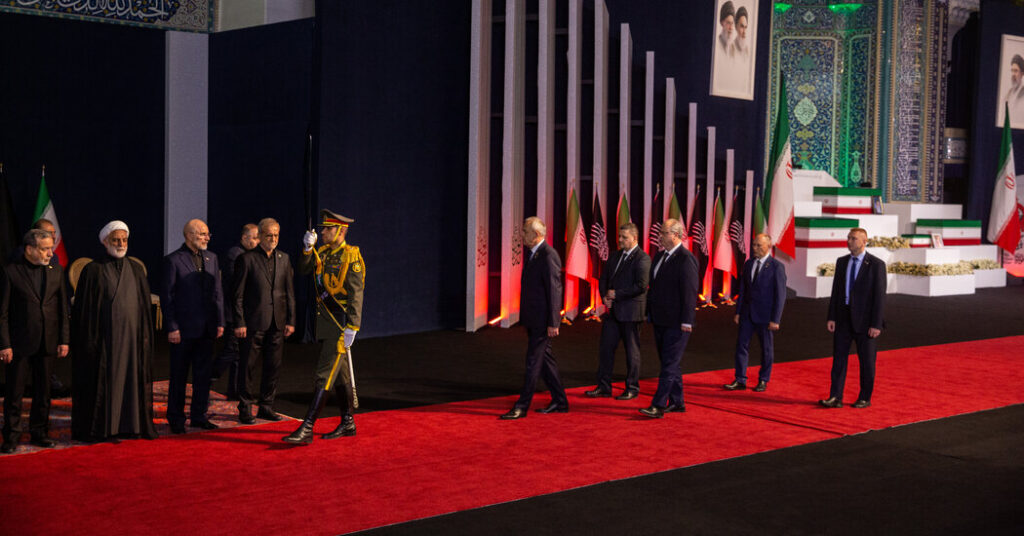
Masoud Pezeshkian, the president of Iran, was riding high in early July, fresh off the successful negotiation of a peace agreement with the United States, and had traveled to neighboring Iraq for part of a weeklong funeral spectacle for Iran’s slain supreme leader.
Suddenly he got stunning news.
Iranian forces had opened fire on three commercial ships in the Strait of Hormuz, setting ablaze a Qatari L.N.G. tanker and damaging other vessels. Iran was under siege in world opinion.
Outraged, Mr. Pezeshkian phoned Gen. Ahmad Vahidi, the commander in chief of the powerful Islamic Revolutionary Guards Corps, and in a raised voice called the actions reckless and demanded answers, according to five Iranian officials and two Guards members familiar with the events.
General Vahidi told the president that he had neither authorized nor had advance knowledge of the strike, the five officials said. The nation’s Supreme National Security Council, which plays a critical role in both the war and negotiations, had also been in the dark, he said.
In fact, much of the country’s leadership was unaware that a fringe hard-line faction had decided to act on its own. Ultimately, those clandestine efforts derailed a push by more moderate pragmatists in Iran to reach an end to hostilities with the United States and repair their nation’s ailing economy.
The hard-liners succeeded in part because the only figure with the authority to resolve such disputes — the new supreme leader, Ayatollah Mojtaba Khamenei — has been a phantom since taking office in March. He has not been seen, and his voice has not been heard. And the authenticity of written statements and messages attributed to Ayatollah Khamenei has been questioned, including by Mr. Pezeshkian, according to three Iranian officials.
Mr. Pezeshkian immediately returned to Tehran. By the next morning, even as the funeral ceremonies were still underway, the United States had retaliated with airstrikes on Iran. The two countries were back at war.
Senior Iranian officials and a Guards member said in interviews that what followed were some of the most volatile political confrontations within Iran’s leadership in memory. Officials engaged in shouting matches. Two senior generals threatened to resign. Accusations of treason and betrayal flew.
The reverberations, officials said, contributed to a shake-up at the National Security Council and the supreme leader’s appointment of Gen. Mohsen Rezaei, a seasoned politician and former commander in chief of the Guards, to lead the council, as he was thought to have the skill to mediate among political factions.
But divisions persist, and the hard-liners who have committed Iran to escalation are in an even stronger position. This past week, Iran and the United States traded attacks, with Iran repeatedly targeting American naval vessels for the first time, and the United States blowing up at least eight Iranian oil tankers.
This account of the inner deliberations of Iran’s leadership is based on interviews with eight Iranian officials, three members of the Revolutionary Guards, four former officials and a review of dozens of speeches and comments by government officials and military generals from June to September published in the Iranian press and social media. The officials interviewed for this article spoke on the condition of anonymity to discuss delicate issues of national security.
Influential Spymaster
Three Iranian officials said inquiries by the government and security forces traced the decision to strike the three commercial ships in July to the cleric Hossein Taeb, an influential spymaster who had opposed the peace deal with the United States from the outset. Mr. Taeb had been telling the new supreme leader that Iran had made a mistake in ending the war and agreeing to the deal, they said.
Mr. Taeb, in a recent speech to military families, said that he was not opposed to talks but that “negotiations that ignore the rights of our people and concede to the excessive demands of the enemy have no place in Iran’s politics.”
Ayatollah Khamenei recently appointed Mr. Taeb as the head of the Basij militia, which is responsible for quelling domestic dissent. He had previously served for more than 20 years as chief for the Revolutionary Guards’ intelligence agency before the previous supreme leader ousted him in 2022 over failures such as Israeli infiltration of his rank and file, and a foiled plot in Turkey. Mr. Taeb re-emerged after that supreme leader, Ayatollah Ali Khamenei, was killed at the start of the war, and he played a key role in the selection of the son Mojtaba as the successor to his father, officials said at the time.
“The attack on the ships was orchestrated with the goal to blow up the memorandum of understanding with Trump and to kill the prospects of any future negotiations and deal,” Alireza Namvar Haghighi, an Iran expert and former official who still has close contacts in the government, said in an interview from Canada.
When Mr. Pezeshkian demanded to know who had struck the three ships, he was told that commanders in the field had acted on their own, in line with an order empowering them to attack any ship violating Iran’s control of the Strait without waiting for approval from central command, according to the officials with knowledge of these discussions. In one sign of the dispute, the Guards’ Khatam al-Anbiya headquarters never issued a statement claiming responsibility for the July 7 attack, as has been routine in other attacks before and since.
Iranian officials relayed this same account to the United States and some of its regional allies in the immediate hours after the attacks, blaming rogue operators, according to U.S. officials who briefed reporters at the time and the three Iranian officials. Abbas Araghchi, the Iranian foreign minister, was dispatched to Oman, a key mediator, to try to defuse tensions with Washington.
On the streets and on state television in Iran, meanwhile, the hard-liners openly attacked the negotiating team and its peace deal, and at nightly rallies, crowds chanted for a return to war.
The Iranian government has devised an official narrative deflecting blame for the collapse of the agreement, saying Washington violated it first by not stopping Israel’s attacks on the militant group Hezbollah in Lebanon, by withholding Iran’s frozen assets and by sneaking ships through a portion of the Strait of Hormuz not controlled by Iran. But few inside Iran’s political circles are convinced by this version, including Mr. Pezeshkian himself, five officials said.
Mr. Pezeshkian said publicly last month that every agreement sees violations and that they should be addressed through talks, not confrontation. When he was privately told by generals that Ayatollah Khamenei had approved the July attack on the three ships, the president demanded proof, according to three Iranian officials.
Phantom Leader
Under the Iranian form of government, the supreme leader has ultimate authority to settle internal disputes. But Ayatollah Khamenei’s whereabouts, his physical health and mental acuity, and the extent he is involved in state affairs have become subjects of fevered speculation.
“The security situation requires for him to be protected, but I’m asking, how long is this supposed to go on? Six months? One year? Five years? Ten years?” Hojatoleslam Alireza Pirouzmand, a senior cleric and academic at Iran’s National Defense University, said on state television in late July. He added that if “we can’t see our leader, then we will remain in a perpetual state of weakness and decline.”
This month Ayatollah Khamenei’s mother-in-law, Tayebeh Mahrouzadeh, gave a lengthy video interview to a local reporter, describing the extreme security precautions surrounding family members and saying they had no news of the ayatollah and his three children. Her husband, the politician Gholam-Ali Haddad Adel, told the Iranian news media in July that while Ayatollah Khamenei had no contact with anyone for security reasons, “God willing, he is healthy.”
The few comments attributed to the missing leader about the peace deal have added fuel to the dispute. After the agreement was signed, a statement in his name was issued saying he had approved because it had been endorsed by the president and a majority of the National Security Council — but that he was of a different opinion “on principle.” That phrase — “on principle” — has been repeatedly used by hard-liners to attack the deal.
In May, Mr. Pezeshkian said he met with Ayatollah Khamenei but did not say when or where. Two Iranian officials and a former official said the circumstances of the encounter were bizarre.
They said an ambulance with blacked-out windows was used to drive Mr. Pezeshkian around, while a secure video connection was established. A person who said he was an interlocutor for Ayatollah Khamenei appeared on a monitor and purportedly passed messages between the two men.
Mr. Pezeshkian confided to a close ally that he was unsure whether he had actually been communicating with the supreme leader, according to the officials with knowledge of the meeting.
Last month Mr. Pezeshkian said he had been granted a second meeting and that it had lasted for seven hours. “We spoke about all the issues facing the country,” the president told Iran’s state television, listing them as affordability, unemployment, sanctions, unity and resilience during wartime. He did not describe the circumstances of the meeting or reveal what Ayatollah Khamenei had said.
War Plan
For weeks, the political leaders and generals running Iran have debated two ways to break the stalemate with the United States, officials said.
Under one approach, Iran could seek to return to negotiations. Under the other, it would escalate attacks on American targets, aiming to strike naval vessels, kill American troops and raise global oil prices.
Both would aim to end the U.S. naval blockade on Iran’s southern ports, which have paralyzed trade and brought oil sales down to zero, according to officials. Iran’s economy is deteriorating, with the currency plunging daily, inflation soaring and the government facing a cash deficit.
Hard-line generals, including Brig. Gen. Seyyed Majid Mousavi, who commands the Guards’ Aerospace Force, pressed for confrontation, officials and two Guards members said. The generals told the National Security Council they had devised a detailed war plan in which Iran and allied militias, in particular the Houthis in Yemen and armed Shiite Muslim groups in Iraqi, would intensify attacks, including on regional oil facilities, further widening the scope of the war and raising its costs for the United States and its allies.
Mr. Pezeshkian and Gen. Mohammad Bagher Ghalibaf, who is the speaker of Parliament and the top negotiator with the United States, were among the officials who warned that the war plan risked dragging the country into an abyss, with even fiercer U.S. airstrikes and more crippling economic pressure.
But by last Saturday, the hard-line faction had gained the upper hand. “The war between Iran and the United States,” said Mahdi Mohammadi, the top adviser to General Ghalibaf, “has entered the phase of escalation.”
The post How Iran’s Hard-Liners Prevailed and Sabotaged U.S. Peace Deal appeared first on New York Times.