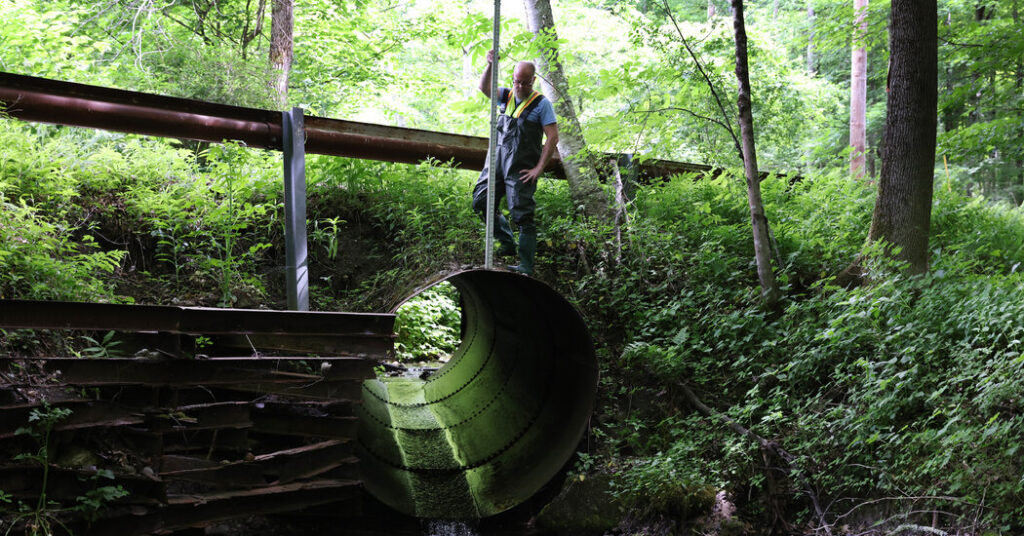
Culverts aren’t nearly as inspiring as bridges. Looking for the Golden Gate Culvert? Well, it doesn’t exist. Neither do any romances about the culverts of Madison County, or tender folk songs about culverts over troubled water. These utilitarian tunnels or pipes that divert or direct streams and storm runoff under roadways don’t enjoy much public affection.
But if a culvert doesn’t do its job, it can mean catastrophe: Failed culverts leave people stranded and cut off from emergency services. And failures are looking more likely. Almost two-thirds of the nation’s six million culverts “were built to standards insufficient for today’s storms,” according to Headwaters Economics, a nonprofit research organization.
That’s why Jessica Boakye, an assistant professor of civil and environmental engineering at the University of Massachusetts at Amherst, decided to undertake an unusually thorough case study of simulated culvert failures, the results of which were recently published in the journal Risk Analysis.
Dr. Boakye and her co-authors studied a section of Franklin County, in western Massachusetts, called the Deerfield River watershed, which has 783 culverts, 1,350 miles of road and a single hospital.
She created a geospatial model of the region, with 5,881 nodes, such as population centers, and 7,039 road segments. She then used existing county data to calculate the probability that each culvert would fail during a catastrophe.
Assigning failure probabilities of these culverts was only possible because county staff members had looked at the condition of each one. Those observations, as well as existing hydrologic and other data, were combined into “risk of failure” scores.
“Culverts are that unseen hero of our infrastructure,” said Megan Rhodes, a planner for the Franklin Regional Council of Governments, who started the project about a decade ago. “Once you start looking for them, it’s all you see.”
Franklin County was settled by English colonists in the 17th century; the region’s infrastructure can show evidence, in places, of a way of life that has changed less quickly than in other parts of the country. One culvert that seemed an unusual shape, for instance, turned out to be “designed tall enough and just wide enough for cows to be able to pass through,” Ms. Rhodes said.
“A lot of them are 100 years old,” she said. “They’re made up of stacked stone that local people did with their hands.” Another culvert she and her team documented used old train parts.
Her work was partly precipitated by the region’s experience with Tropical Storm Irene, which slammed into New England 15 years ago. But it’s not just large, named storms that are a problem. “A lot of what’s been happening lately is these kind of small microbursts that just dump an immense two inches an hour,” Ms. Rhodes said. “These old things just can’t deal with it anymore.”
Take, for example, a 78-foot-long culvert known to be in poor condition that failed in 2021 in Addison, Maine. As a result of the failure, an ambulance trying to reach a person experiencing a medical emergency was forced to take a detour, and a response that should have taken 15 minutes instead took an hour, with what one report described as “tragic” results. (Maine is now replacing the culvert.)
In the simulations for the Deerfield River watershed, Dr. Boakye found that 242 culverts were crucial connectors: When only one failed, at least one population node would be completely disconnected (in that scenario, there was also no option for residents to leave the area).
When the simulated storm rose to five on a one-to-10 scale, more than 10 percent of the population was unable to reach the hospital; if the intensity reached a rating of seven, an average of about 350 culverts failed and roughly 30 percent of the study area’s population would be thwarted trying to reach the only nearby E.R.
The study comes as many other counties and states are evaluating their own culverts, especially in the wake of catastrophic collapses. Throughout the summer, culverts have collapsed in Georgia, Florida and Kentucky because of heavy rain. A culvert failure on the Tulalip Indian Reservation in Washington State left two dozen residents stranded in 2024. “Frustrated residents,” a local outlet reported, were “forced to use ladders and makeshift walkways.”
“As we get more intense rainfalls, we’re going to have more failures,” said Robert G. Traver, a professor of civil and environmental engineering at Villanova and the former and founding director of its Center for Resilient Water Systems, who was not involved with the study.
Adam D. Matteo, the state structure and bridge engineer for Virginia, criticized the focus of Dr. Boakye’s study, however. “We have more concerns, at least here in Virginia, with bridges,” he said in an interview, later adding, “That’s not to say it has no merit.”
Municipal funds for infrastructure repair may be chronically tight, but Dr. Boakye said she wasn’t trying to shift priorities. “I would never argue that we should neglect bridges or even larger culverts. I’m more arguing here that even small-scale infrastructure can cause large damage,” Dr. Boakye said of Mr. Matteo’s criticism.
Many states are starting to take their culverts seriously. New York University researchers are now evaluating some 80,000 small culverts across the state; VT Culverts documents the condition of the more than 114,000 culverts around Vermont.
Because the number of aging culverts in any one county or state can be so overwhelmingly large, studies like the one conducted by Dr. Boakye can help local and state governments order their priorities. “There’s just so many, and it’s so expensive to do it properly,” Ms. Rhodes said. “This will really allow us to plan for which ones need to get replaced first.”
The post Most People Don’t Think About Culverts. Their Failure Can Be Deadly. appeared first on New York Times.