Times Insider explains who we are and what we do and delivers behind-the-scenes insights into how our journalism comes together.
Europe is cluttered with castles. Castles here, castles there, so many castles that they can become a monotonous blur of stones to even the widest-eyed tourist.
So why did I decide to write a story about yet another Irish castle? After all, my responsibilities at The New York Times do not include keeping abreast of developments in medieval castles; I’m more of a wandering generalist in the United States.
The answer is it’s personal.
Many years ago, in the early spring of 2000, I needed to breathe different air. The previous year had been lost to a life-threatening illness. Emboldened by clean scans, I fled with my wife and 2-year-old daughter to the west of Ireland, with no plans other than to inhale and exhale.
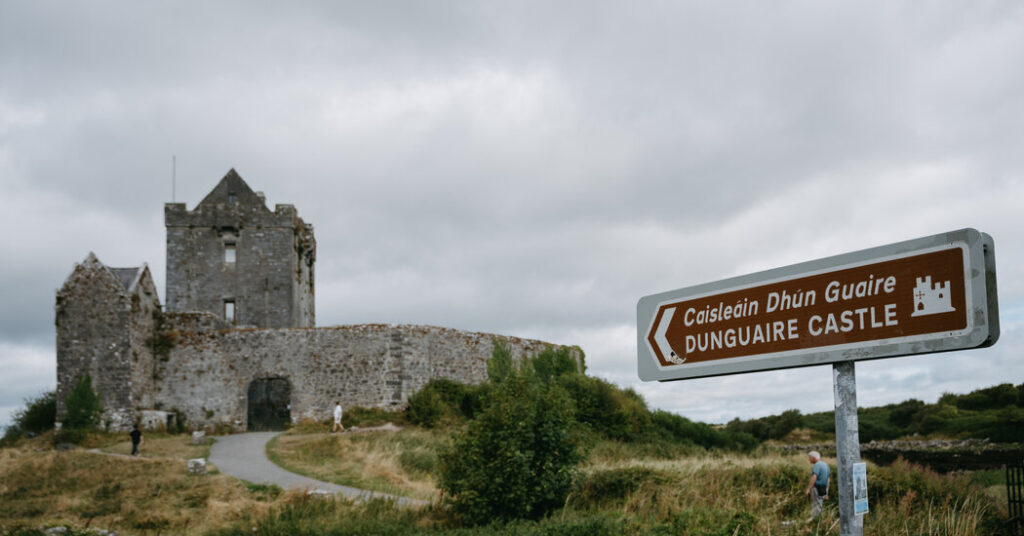
One evening we found ourselves in the County Galway village of Kinvara, a few miles from where my mother had grown up. The setting swelled the heart: Galway Bay at high tide lapping against the pier, brightly painted shops and pubs in communal huddle — and, rising in the near distance to center it all, Dunguaire Castle.
A few months later, The Times generously assigned this cancer-shaken employee to spend a couple of months sending dispatches from Ireland. Rather than open a home office in the more logical location of Dublin, I chose to set up shop in Kinvara, in the metaphorical shadow of Dunguaire.
Over that summer, my family and I established close friendships in the village that endure to this day. We have been back many times, hiking through the limestone lunarscape of the Burren; attending the annual festival of the boats known as “Galway hookers”; listening to the music at Green’s pub, where the likes of John Prine often showed up; and, yes, visiting Dunguaire Castle, where, for a few euros, you could step into the 16th century.
But during a visit to Kinvara in July, I walked up to Dunguaire to find the gate leading to the castle’s entrance chained shut and a sign saying that the local landmark was closed to the public. I then noticed a crowd of people stepping off a sightseeing bus to visit what was essentially a shuttered attraction.
Sure enough, throughout that day and the days that followed, I saw bus after bus pulling into a nearby parking lot, and dozens and dozens of people trekking up to certain disappointment.
What made this especially puzzling was that Dunguaire isn’t just another castle. The residents of Kinvara will tell you with unabashed pride that Dunguaire is Ireland’s most photographed castle, often featured in its tourism marketing.
Well, I thought. There’s a story here somewhere.
From an international perspective, the reasons for the castle’s closure were, at best, mildly interesting. As my story would lay out — in echo of reporting by several Irish media outlets — the closure was rooted in a familiar dispute among various government agencies over responsibility for operating and maintenance costs.
But I thought this local standoff presented the opportunity for a richer story: a chance to cast the castle as the central character in an article touching on the ghosts that inform everyday life in a small community.
First, I read area histories and talked to local experts about the castle, which was built around 1510 as a defensive lookout and residence. Its name translates to “Fort of Guaire,” after a seventh-century king who, legend has it, was so generous that his right arm grew longer than his left.
Next, I tried to nail down exactly how to pronounce Dunguaire. For 25 years, I had been saying dun-GOO-ruh, only to have a local academic gently tell me that he’d never heard it pronounced that way. It was karmic payback for all the times I’ve haughtily corrected visitors to New York for saying HEW-ston Street, instead of HOW-ston.
To settle the matter, Fran O’Reilly, a retired researcher leading the campaign to reopen Dunguaire, put the question to a few patrons at Fahy’s, a wonderful pub just outside the village. The consensus: doon-GWEER-ah.
Finally, after gathering comments from the various vested parties, I sat down to personify the castle. I imagined the stone structure bearing centuries-long witness to the evolution of a small village on the west coast of Ireland. Through famine and war, prosperity and deprivation, as actors came and went across the Kinvara stage, including more than a few I had come to know.
The publicans and farmers, the shopkeepers and churchgoers. The fisherman forever chasing mackerel and the woman forever baking scones, the businessman glued to his phone and the lost soul surviving on ice cream. The boatman who, at the slightest nod, will sing for you “The Queen of Connemara.”
The castle has seen it all, including an American journalist who paused in Kinvara long ago to breathe in the sea-scented air.
The post An Irish Castle Keeps a Piece of a Times Reporter’s Past appeared first on New York Times.