When thieves broke into a museum on the French Riviera last Tuesday and made off with two paintings by the Impressionist master Pierre-Auguste Renoir, President Emmanuel Macron had just been a few miles away presiding over a conference about how to save the art of filmmaking.
The robbery, the latest in a string of thefts since the sensational heist of crown jewels at the Louvre last October, suggested that France has a bigger challenge protecting its artistic treasures.
Chinese porcelain, Huguenot crosses, gold and silver coins, Art Nouveau jewelry pieces, a jersey worn by the soccer star Zinedine Zidane in the World Cup — all have been purloined from museums, large and small, across the country.
The spate of thievery even extends to churches: People have stolen chalices, communion plates and other holy relics. Museum workers, the police and government officials are rattled. They worry about how to protect France’s cultural patrimony in an era of increasingly violent criminal gangs, some of whom have broken into museums in broad daylight.
“There is a kind of collective psychosis that is being created,” said Théo Caviezel, the mayor of Langres, a small town in eastern France. A day after the heist at the Louvre, thieves broke into a museum there dedicated to the French philosopher Denis Diderot, and stole a collection of gold and silver coins.
Experts attribute the crimes to a confluence of factors including the ubiquity of social media, which makes it easier to recruit criminals for jobs and to identify the treasures held by even obscure museums. There is also the rising price of gold and silver, which makes coins and other precious objects tempting because they can be melted down and sold. And then there is what might be called the Louvre factor.
“Thieves all around the world are watching the news, too,” said Arthur Brand, a private art detective in Amsterdam, who has helped retrieve museum goods. “So, they see the Louvre and they think ‘Hey, don’t we have a local museum?’ What we see now is a plague of copycats.”
There is no sign that Macron’s conference in Saint-Paul-de-Vence, a hilltop town west of Nice, had any connection to last week’s robbery. The police arrived at the scene, in the neighboring Riviera town of Cagnes-sur-Mer, within five minutes of an alarm ringing at 5:48 a.m. They narrowly missed the thieves. But in their haste to escape, the intruders left two of four Renoir paintings in the garden of the museum, which is housed in a stone villa where the artist once lived.
Because the stolen works are so well known — one, a portrait of the French actress Colonna Romano, painted around 1910, and the other, “Young Woman at the Well,” an oil painting from around 1886 — art experts said they would be easily traced, and impossible to sell in the open market. Works such as these, they said, usually end up being traded on the black market.
Pierre Noual, a French lawyer who specializes in recovering art, said robberies like this were often ordered by “sponsors, probably foreign, who want to have great works, such great masters, in their private collections.”
Noual noted that the Louvre heist had been preceded by several other robberies. Two happened in the same week at the Museum of President Jacques Chirac in Sarran, in central France, which houses 5,000 diplomatic gifts given to Chirac during his presidency, from 1995 to 2007. The museum was hit a third time last month, when the jersey belonging to Zidane, the soccer star, was stolen.
The vulnerability of museums, Noual said, has also been laid bare by a series of episodes in which vandals, some of them political activists, have defaced artworks by spraying or slashing them. France’s weak legal response to these crimes, he said, has emboldened would-be thieves.
For all the publicity about museum thefts, though, the number of them may not actually be higher than normal. A report by the French National Assembly noted that since 2011, the number of thefts of museums has fluctuated, but within a range of 15 to 25 a year (the report does not cover 2026).
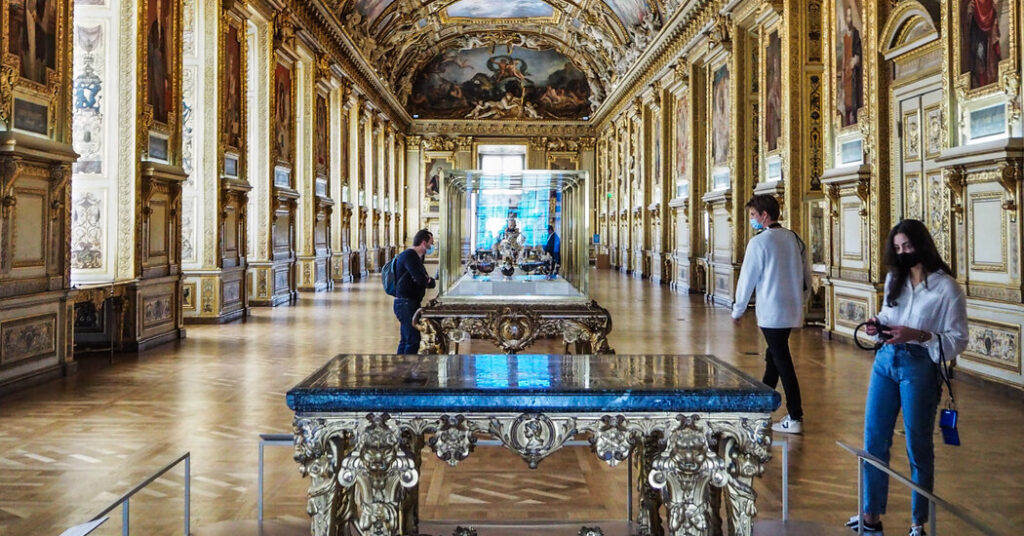
Some experts say that robberies may appear to be on the rise because museums are more open to talking about them. Thefts have historically been taboo because they expose weaknesses in security. The director of the Louvre, Laurence des Cars, resigned in February in part because of the swirl of questions about the brazen daylight robbery of the museum’s Apollo Gallery.
But Charlotte Chambers Farah, a manager at the Art Loss Register in London, a service that maintains a database of lost or stolen art, said, “Museums are more transparent about disclosing items that have been stolen or missing, and appealing to people like us or the public for help returning things.”
The Louvre heist has thrown a harsh spotlight on security at museums across France. In July, the culture ministry published a plan with 33 proposed measures, including mapping out the most vulnerable sites, recruiting specialized police officers and adding extra security for particularly at-risk pieces.
For local officials like Caviezel, of Langres, however, there is no quick fix. He said the museum’s staff had been traumatized by the robbery even though it occurred when the museum was closed. They are now being trained to deal with security threats, which he said could make it harder to hire people. Two people have been arrested in connection with that case.
The town has installed additional surveillance cameras outside the museum, which is in a restored 16th-century mansion known as the House of Enlightenment. It plans to put bars on the windows and install a machine that, if triggered by an alarm, generates smoke, obscuring escape paths for intruders.
But, as Caviezel noted: “A building has front doors, it has windows, there is a roof. So, it is vulnerable.”
The theft of art, experts like to say, is as old as art itself.
Caviezel pointed out that the Mona Lisa was stolen from the Louvre in 1911, a century before the latest heist.
“Even the Louvre, with a budget of millions and millions, the most visited museum in the world, is vulnerable,” he said.
Giulia Imbert contributed reporting from Paris.
The post It’s Not Just the Louvre. Museums Across France Are Ripe Targets for Thieves. appeared first on New York Times.