Taking a break from the noisy work of leading a school of over 500 students, Madhav Lamichhane would ride his motorbike down to the riverside Betrawati Bazaar every week. The principal skipped the busy shops around the town’s clock tower, preferring a quiet moment by the Ram temple to take in the “very beautiful flow” of the Trishuli River.
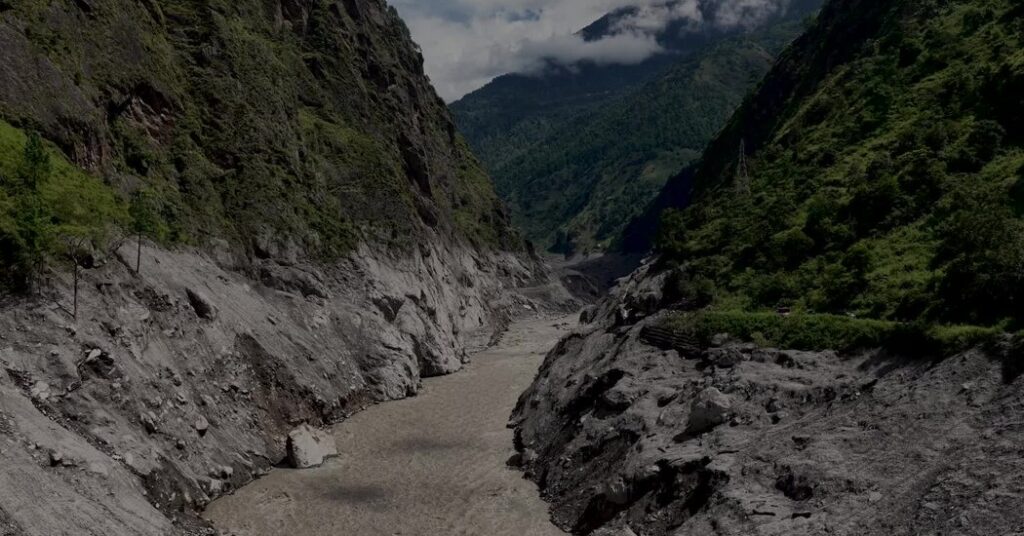
But on Aug. 26, as he was in school preparing for the first morning bell, the river below suddenly became a violent torrent that obliterated much of the town of Betrawati, erasing its square from the map. It left no trace of the temple, the market or the concrete bridges, and only fragments of the hundreds of homes that dotted either side of the river.
Mr. Lamichhane and the school, up on a hillside, escaped its wrath.
But about 200 students did not. The younger children, ages 5 to 11, had been waiting in the riverside town for a yellow school bus. The oldest, backpacks strapped on, had been slowly making their way uphill to the school when the deluge swallowed them.
“What can I say to the river?” Mr. Lamichhane sighed. He said that fewer than a third of the town’s families had scraped through without losing anyone, with many wiped out entirely.
“It was very beautiful previously,” he said. “It is a cultural and historical place, too. But all that became the past.”
When part of a Himalayan glacier near Nepal’s border with Tibet collapsed late last month, the ferocious water and debris that barreled through the gorge wiped out almost everything in their path for tens of miles. Two weeks later, the death toll stands at over 1,300, with 5,000 others missing, many most likely buried beneath the mud.
In the days after the floods, reporters from The New York Times traveled along the path of destruction, trying to reach areas cut off in a poor country with difficult terrain. What we found was towns and villages wiped off the map. Small reminders of life before remained in the sludge: a buried roof jutting out from the mud, a student’s backpack, an empty reading glasses case.
The dozens of bridges and the tens of miles of destroyed roads will surely be rebuilt. Technical assessments are already underway for a financing plan. The expected billions in costs will add to the debt of a small country still paying back loans it took to rebuild after a catastrophic earthquake just over a decade ago.
But helping to count the number of dead and telling the stories of wiped out communities is left to loved ones who were away at the time or who climbed to higher ground as the water closed in — now unsure whether to consider themselves lucky to have survived, or cursed to bear the crushing grief and loneliness.
The only lifeline connecting the remains of those settlements is a narrow dirt track that skirts the hills. The drive between some of the towns, which would have taken 15 minutes before the floods, took us seven to eight hours — the path was jammed with traffic and frequently blocked by mudslides caused by the last of the monsoon rains.
The Chilime hydropower tunnel, 10 miles from the border with China, was as far as we could get before the road collapsed into a dirt track along the river that was not safe to trek. Helicopters frequently flew through the narrow gorge on search and rescue operations to several tunnels in the area, where workers are feared trapped.
Officials who had flown into Syrabrubesi and Timure — the stretch beyond what was accessible by road — and survivors who were airlifted out said that hundreds of buildings had vanished, with nearly 1,000 people missing.
“The area is deserted now,” said Dolma Thangjen Sherpa, an elected member of the ward where Syabrubesi is, who was sheltering in a monastery in Kathmandu.
In the urban pockets along our journey — from Kathmandu to an army base and to a city nearly 100 miles downstream from where the floods originated that saw over 350 bodies wash up on its riverbanks — people flipped through lists of the dead, which ran multiple pages, and searched for clues in the lines of mangled bodies.
Most left in disappointment. Kami Delma Sherpa stared at a photograph of a woman with a golden tooth posted on the wall outside a hospital in Kathmandu, thinking she had finally found her sister, who worked at the border crossing. But when she went inside and looked at the body, it was not her.
Miracles in the Mud
As we traveled along the floods’ path of destruction, there were still small miracles to celebrate.
A green house in Dhunge Bazaar remained standing, saving its residents, who had watched from their balcony as a whirlpool of mud and debris threatened to close in on them. A principal evacuated all of his students to safety, before his school was washed away. Three of the hundreds of workers trapped in hydropower project tunnels were pulled out alive more than a week after the floods.
Another unlikely escape was hiding in plain sight. We watched night fall over Betrawati last Friday, staring at a three-story house buried so deep in the sludge that only its roof and a sliver of its upper windows were visible. The search and rescue teams had moved on, the disposal of a decaying cow their last act that afternoon.
As we began our drive out of the ghost town late at night, we could hear only crickets and the roar of water. No one knew that a woman, Chandika Shrestha, was still clinging to life inside the house. Her family was among hundreds who had resigned themselves to their loss and had begun final ceremonial rites by cremating effigies of their loved ones.
The next day, locals heard a faint cry. Rescuers scrambled to dig her out.
But those kinds of miracles were few.
Betrawati, the site of a 1792 treaty that ended a war between Nepal’s kingdom and the Qing dynasty, laid bare the extent of the floods’ devastation.
What was once the town square, surrounded by lush paddy fields, now looks desolate — as if it had always been a riverbed, but the stream had shrunk. The two-story police station had been uprooted and deposited hundreds of feet away. A school bus with red seats was flipped on its side. Strewed around it were school bags, baby sandals, a broken speaker. A stench filled the air.
Pavitra Lamichhane, 32, took us to the riverbed to show where the house she had lived in with her 12-year-old son and mother-in-law once stood. She had been “going mad” searching for her son, her only hope, but they all survived.
With her husband, who died in a car accident two years ago, they had built a house in concrete to help it withstand earthquakes. But it was no match for the wall of mud from above.
“See that tree,” said Ms. Lamichhane, pointing to the ridge as her reference. “This should be the spot.”
Officials estimated that of a population of a little over 1,000 people, 315 people were lost in Betrawati. A large number of the survivors are homeless, sheltering on higher ground. In one hostel, aid workers prepared warm meals for 200 people. A generator hummed, powering mobile charging points for about 300 people.
Haunting Phone Calls
The school where Mr. Lamichhane is principal had become the town’s relief hub, with trucks offloading aid material and social workers trying to console and entertain children uprooted from their homes.
On the morning of the floods, as Mr. Lamichhane was preparing for the day in his office, he got a call from the school bus driver saying he had heard of flooding upstream.
The driver had delivered two busloads of students to the school and was on his way to the town square for his final run.
“I scrolled on my mobile but did not see any news of the flood,” the principal said. He phoned a friend upriver, who told him the market had collapsed. “The flood is coming,” the friend exclaimed.
Mr. Lamichhane told staff to evacuate the 250 students already at the school to the forested areas above, while he and others rushed down toward the river to see what they could do.
He called anyone and everyone he could reach along the river: his staff who had not arrived at school yet, the parents of students.
Two phone calls, in particular, haunt him.
The first was to his elementary schoolteacher, whose riverside house he had often visited for a cup of tea. She had told him, “We are escaping! We are escaping!”
“The connection was lost,” he said. “She is among the missing.”
He remembers the second call, to another colleague, Ajay Kumar Yadav, with anger.
“I told him to come out. But he did not believe that the river could come up to there,” he said. “And he lost his life.”
As the principal spoke, he took his cap off to show his head, which he had shaved in a ritual performed to mourn dead relatives. (He lost two cousins who had been truck drivers along the border.)
Attendance had not yet been taken when the floods came, making identifying the missing students a challenge.
When we asked if he had to rely on families reporting their children as missing, he said, “There is no family to report,” adding, “The families are gone.”
Closer to the border with China, in the hillside village of Thulo Bharkhu, just before the road collapsed, a Buddhist monk held a vigil at his home for three members of his family — his son and two daughters-in-law — who were lost in the flood.
Singi Nurpu Lama is 80 and has difficulty walking. But he still went to other homes in the village to help lead their mourning prayers.
“There was flooding in the past also, but nothing like this,” the monk said.
One of the monk’s sons, Kshokyal Dorje Lama, was working in a bank in Kathmandu when he heard news of the flooding. He worried about his wife, Pratima Tamang, a nurse who was elected four years ago as the local municipality’s vice chairperson.
Mr. Lama tried to reach her on the phone, and the call went through.
“I felt like she was running, but I couldn’t hear anything,” he said. “Then the connection was lost.”
The couple had fallen in love when Ms. Tamang was still in nursing school and later married in a two-day ceremony in the village with over 1,000 guests. The houses were decorated with strings of lights. There was a feast of meat and rice and drinks. A large group of guests sang and performed a circle dance to celebrate.
Ms. Tamang could have gone abroad for better pay, as many Nepali nurses do. But she chose to go back to the village. The couple had planned to have their first child soon.
“I feel so alone,” he said. “Like fish without water.”
Maps by Pablo Robles.
The post Along Himalayan Floods’ Path, Wiped Out Towns and Mounting Grief appeared first on New York Times.