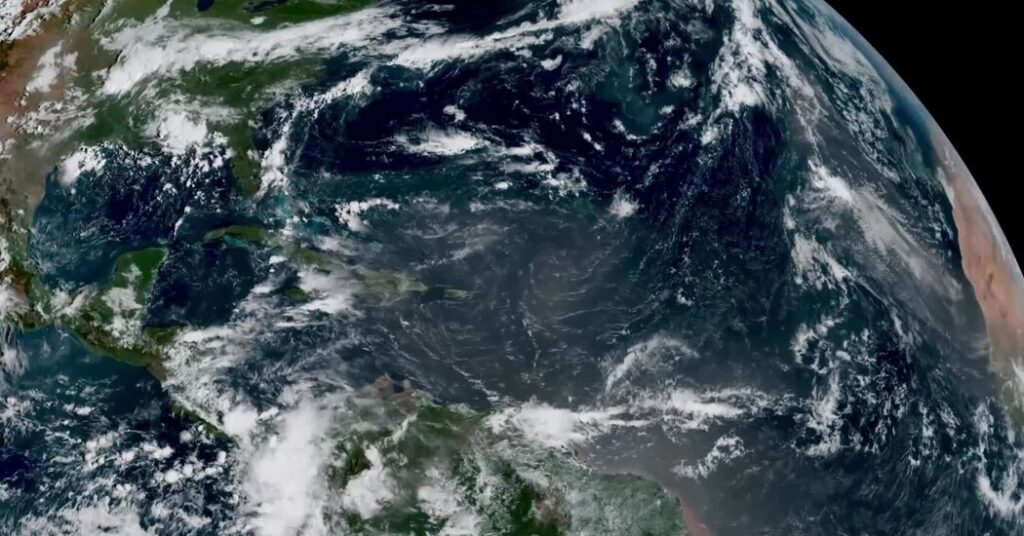
A layer of Saharan dust half the size of the continental United States filled the atmosphere over much of the Caribbean on Saturday and was filtering into South Florida.
The cloud is unusually large for this time of year. Dry, dusty air collects from North Africa and moves across the Atlantic Ocean multiple times every year, but it is more common from mid-June through mid-August.
“These plumes are still coming off Africa in September, but they’re smaller and they usually don’t reach a place like Miami,” said Jason Dunion, a research meteorologist at the University of Miami who monitors Saharan dust.
The worst of the dust was expected in the Caribbean but light concentrations were reaching southern Florida on Saturday morning as the cloud brushed the tip of the state.
“It looks like it will stick around through the weekend and then starts to dissipate early next week,” said Chris Fischer, a meteorologist with the National Weather Service office in Miami.
The transport of dust from the Sahara to places around the world is a sublime occurrence in the weather world.
Wind pulls the dust from the desert floor and pushes it as much as a mile above the Earth’s surface. Depending on the direction of the winds high in the atmosphere, the dust can drift into the Middle East or Europe or travel to the United States.
The particle-filled air makes skies hazy and can degrade air quality, especially when the dust drifts toward the ground. It also suppresses rain clouds and thunderstorms, bringing dry weather.
“The clouds bubble up into the dry air and collapse,” Mr. Dunion said.
It also hinders the formation of hurricanes over the Atlantic Ocean, he said.
On Friday, the dust layer hovered over the Caribbean, and the Weather Service office in Puerto Rico warned of reduced visibility and deteriorating air quality.
“The sky is not the ‘blue, blue’ that we normally see,” Maria Novoa-Garcia, a meteorologist with the Weather Service in Carolina, Puerto Rico, said on Friday. “It’s more of a pale blue, grayish sky.”
Dust concentrations are usually highest in June and July on the island.
“This is very atypical for September,” Ms. Novoa-Garcia said. “Right now we are going through drought conditions. We’re not seeing the precipitation that we usually do.”
The post An Unusual Plume of Dust Is Headed to Florida appeared first on New York Times.