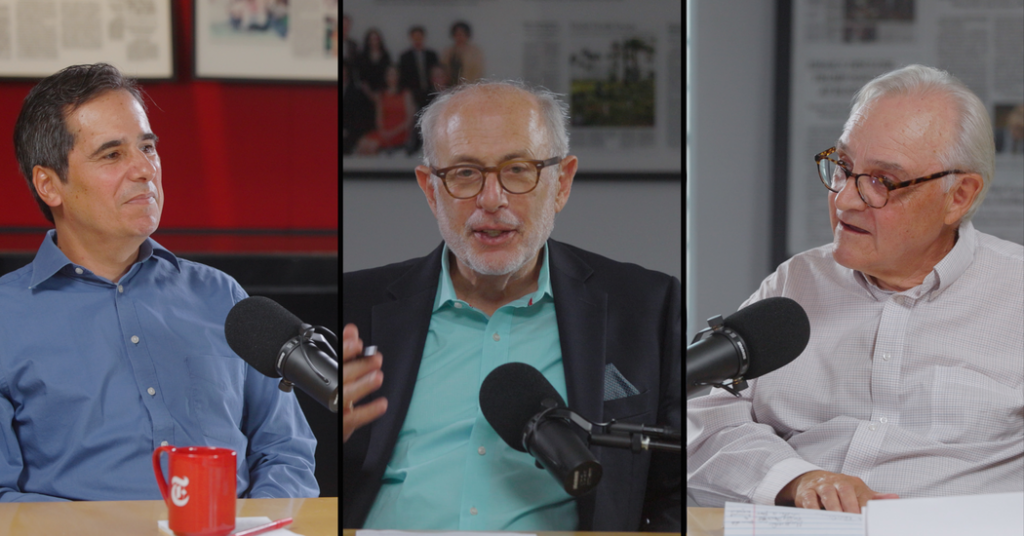
From the 25th anniversary of Sept. 11 to “Trumpapalooza,” on this week’s round table, the Opinion contributor Robert Siegel is joined by the contributing writer E.J. Dionne Jr. and the columnist Carlos Lozada to draw a direct line from the catastrophic terror attack that changed America forever to the strange state of our politics today.
Below is a transcript of an episode of “The Opinions.” We recommend listening to it in its original form for the full effect. You can do so using the player above or on the NYTimes app, Apple, Spotify, Amazon Music, YouTube, iHeartRadio or wherever you get your podcasts.
The transcript has been lightly edited for length and clarity.
Robert Siegel: In New England, two Senate races have produced, for this year, surprisingly unsurprising results. President Donald Trump, evidently undeterred by stories that Republican candidates are trying to distance themselves from him, has put on a special midterm convention — minus the platform, minus the nominating addresses.
It’s a “Trumpapalooza,” we’re told. And all of this contemporary politicking unfolded in a week when we recalled this being the 25th anniversary of 9/11 — an event that altered our politics, I would say, in more ways than we sometimes realize. Lots to talk about. And let’s start with Donald Trump’s attempt to rally Republicans and remind them of what he sees as his many accomplishments in office.
E.J., the president had C-SPAN. He had the C-SPAN audience. Fox dipped into his keynote address. I mean, after all, what else was on the air?
E.J. Dionne Jr.: You would have to remind me of the disastrous defeat of my New England Patriots at the hands of the Seattle Seahawks. I was switching back and forth, and I found neither experience very satisfactory, to quote the old Nero Wolfe line. I think what was so striking about what Trump did is that it shows how vulnerable he thinks he is in this election, and he’s not following the script Republicans might want, which is: Please go into hiding because you’re killing us in the polls.
But he wanted to change the nature of the conversation. At least the old political machines used to give you five bucks if you voted for the machine ticket; Trump is giving voters a $5,000 I.O.U., for this money he says he’s going to give them. And this, of course, from a guy who is famous for not paying his debts.
But the very fact that I am mentioning this is what Trump wants people to do, because he doesn’t want people to talk about the war or inflation, or lots of other things. And I think that this is going to be a real contest between whether it’s a normal midterm election, where Democrats can focus the election on Trump and his record. Which, as Charlie Cook says — the great political analyst, who’s very careful in what he says — a lot of Trump voters think they were victims of a bait-and-switch, given Trump’s priorities, when they voted for him in the presidential race.
And Trump goes: Here’s $5,000, and by the way, the Democrats are communists, and you can’t possibly elect them.
And it goes back to the great podcast Carlos did, actually, with Michelle Cottle and historian Nicole Hemmer, about McCarthyism that never died. And this is a real throwback to something that worked once before, and Trump, you know — communism plus crime, plus an obsession, which I thought was very strange, with dirty streets in Democratic cities. That’s what he wants us talking about, and I guess I just played his game because I did.
Siegel: Carlos, what do you make of Trump’s celebration of his own presidency? And do you think he believes that his negative approval ratings can be somehow washed away through his talents of persuasion?
Carlos Lozada: Well, far be it for me to parse exactly what is in Donald Trump’s mind. But in terms of the celebration, I think the entire Trump presidency is a celebration of the Trump presidency. Everything he does has to be the biggest and the best and the smartest and the most historic thing in the history of human events, right? And really, that’s part and parcel with what he’s been doing during the second term.
All these side quests that he’s been on about, you know, whether it’s the ballroom or the arch or renaming everything “America.” It’s all part of this effort to sort of burnish a legacy, rather than really earn one. And in terms of the midterms and what we saw at Trumpapalooza, those efforts are crashing up against a certain reality, right?
And the reality is the broken promises — the failed promises of bringing prices down and avoiding costly, prolonged wars. Now, will his persuasiveness help reshape that story? Following up on something E.J. said, he seems both confident and afraid at the same time. Confident, when he says, “Pretend that I’m on the ballot,” right?
He’s almost daring voters to judge him on this record, frankly, of promises he has not kept. But he seems afraid, when he essentially has to offer — he’s reduced to offering people money: I’ll give you five grand apiece, American adults, if the Republicans win.
In essence, it’s sort of being reduced to the offer of a bribe. If we’ve learned something about Trump, though, it’s that whatever happens in November, he’s going to declare victory. If the Republicans do better than expected, he’ll say, probably correctly, that it was because of him. It’s because of his coattails, because he asked people to vote as if he is on the ballot himself. If the Republicans get spanked, it’ll be because, when he’s not on the ballot, people just aren’t excited — because it’s really all about him. He’s always been able to separate his brand from that of the party. Trump is very good at declaring victory even when he loses — sometimes especially when he loses.
Dionne: You know, I think you really put your finger on something important about the paradox of what Trump was doing. What he’s trying to do, which is really hard in politics, is to have his own voters, but only his own voters think that he’s on the ballot.
Because he knows that there are many, many more — people who disapprove of him feel very strongly about it compared to people who approve of him, where the number who strongly approve of him is way down. Ruth Igielnik and Caroline Soler had a great piece in The Times about the sharp shift in party identification, where Republicans have lost 17 points net among young people, nine points net among Latinos in the last few years.
So he’s got this real problem, and that’s where the distraction comes in. That’s where he wants to believe his being on the ballot is the key, because of his own people. But he has somewhere inside him, as you suggested, I think there is this lack of confidence, and that’s why he’s doing the other thing.
The New York Times had a great editorial arguing that Trump was sabotaging the midterms by using the Postal Service to try to completely turn mail voting into chaos, and I think that’s the real tell. If he were confident in these elections, I don’t think he’d think he has to do that. And the Supreme Court may, at some point — maybe when this goes on the air — have ruled on this, but boy, is that the big tell.
Siegel: I think it should be noted that there is a new official answer as to when the war with Iran is going to end. Now we’re told it’ll be the day after Election Day. And there may be a little bit of truth there, remembering Jimmy Carter, and the Iranians stretching out the hostage crisis until Ronald Reagan was sworn into office, and they could humiliate Jimmy Carter one last time.
Dionne: Peace is at hand, and the hand is at the end of the tunnel. That’s really what we are reliving here.
Siegel: Well, I mentioned at the outset the surprisingly unsurprising primary results in New England. In Massachusetts, Senator Ed Markey decisively turned back a challenge from Congressman Seth Moulton, whose main argument seems to have been: I’m 47; he’s 80.
E.J., how did Markey do it?
Dionne: Markey did it by running a very similar campaign to the one where he defeated Joe Kennedy six years ago. He made himself the tribune of the left side of the Democratic Party. He turned it into an ideological choice, and ideology trumped age in that race.
And I also think that Congressman Moulton wasn’t that popular. A lot of establishment Democrats, and just rank-and-file Democrats, weren’t crazy about Moulton, and that was enough for Markey. And I think it showed a mechanical view of politics where, you know, it’s all about age or it’s all about ideology — actually, it depends.
And then, in New Hampshire, Chris Pappas, the congressman running for the vacated seat of Senator Jeanne Shaheen, won very handily over a candidate of the left. And I think this should be a lesson to the media, when D.S.A. candidates — Democratic Socialists of America candidates — were winning this summer, the talk — and Trump echoed it in his Trumpapalooza speech — the socialists are taking over the Democratic Party.
No. There is disaffection in the party. The party is almost certainly more progressive than it was 20 years ago. But no, there are plenty of normal elections that happened out there. And they don’t get as much attention because they’re normal. They don’t break new ground. And so, I don’t blame the media for highlighting a change, but it really can distort the larger picture of what’s happening inside the party and in the country.
Siegel: And the New Hampshire results were so normal that, first, the Republicans nominated for senator, the former senator John Sununu, who is, of course, the son of a former governor of New Hampshire.
And the Democrats, as you mentioned — Chris Pappas, the congressman, is running to succeed Jeanne Shaheen. They nominated Jeanne Shaheen’s daughter to run to fill the seat vacated by Pappas, so it doesn’t get more conventional than that.
Lozada: Dynastic. I defer to E.J. as our politics guru. I think, on your media critique, it is possible to overread or overthink some races at the expense of others. I think that the rise of D.S.A., and the D.S.A.-inflected Democratic Party, is a big story.
Dionne: I agree with that.
Lozada: And because a more conventional Democrat wins in Massachusetts doesn’t necessarily undercut the import of that story. These transformations don’t happen all at once, right?
And the rise of a new, more assertive D.S.A. wing of the party, I think, is meaningful. And, in part, it’s meaningful in all these races that you’re discussing, Robert, because both Democrats and Republicans are going to have to figure out who they are beyond being pro-Trump or being anti-Trump. And that’s been too easy and too pat for too long, and it’s not going to keep working. And I think these primaries and these midterms are a part of that process, a part of that debate. And so, I think it’s healthy. It’s healthy to see both of these forces working at the same time.
Dionne: I have to agree with Carlos’s, as always, carefully reasoned correction or modification of what I said. I certainly do not want to downplay the fact that the D.S.A. victories do tell us something; that the rise of this critique of the economy, whether people call themselves socialists or not, goes back to Occupy Wall Street and to Bernie Sanders’s campaign, and there is a frustration out there.
And there have been some really good stories, actually, out there: essays on Democratic Socialists of America and how complicated that movement is. It’s not a movement of a single wing that the Republicans love to quote, the most radical pronouncements of the most radical people in D.S.A., when, in fact, D.S.A. is a kind of collection of people on the left who range, if you will, from social democrats to something much harder on the left.
So that’s all true, but I do think there is still a hair-trigger tendency that exaggerates, or doesn’t get at the subtlety of what’s going on. And that’s why the results, like we had in Massachusetts, which by the way was about the power of the left — Ed Markey mobilized the left on his behalf. But also, the New Hampshire races, that we should do this carefully, not start jumping off a cliff over a few election results.
Siegel: But you mentioned echoes of the Red Scare earlier. I mean, do you think this Republican attack — that Democratic policies span the gamut from Bolshevik to Menshevik — do you think that it has any traction with people?
Dionne: I think that it’s more a mobilizing tactic than a persuasion tactic. I think that the issues he put on the table that might have more — a little more — persuasive power are the old staples, particularly crime.
I don’t think immigration works for him as much anymore, because people have sort of turned away from these pretty heinous policies he’s pursued on the streets of the country. I think the communism appeal may solve a small bit of his turnout problem — or so he hopes. But again, it seems so antique.
I think part of Trump’s problem now is that his act really has started feeling old. And I think that started a while ago. And to go back to communism — which was an issue about the 1950s — is kind of a reminder of how old that act is getting.
Lozada: Yeah. All I’ll add is that I would never bet against the paranoid strain in American politics.
Siegel: Well, many people have remarked this week on the 25th anniversary of 9/11. For me, it remains a watershed event in a variety of ways. Carlos, does it still resonate for you in what you see in American politics and life?
Lozada: Well, I mean, it certainly resonates politically. I think, first and foremost, it resonates tragically, viscerally, in the lives of people who survived the attacks and people who lost loved ones in the attacks.
Politically, it’s almost impossible to imagine our politics without it, right? If we just stay at the level of presidential politics and look at the presidents who have led us since 9/11 — President George W. Bush entered office sort of weakened, questioned, following the 2000 election, Florida recount, and the like. His leadership in the immediate aftermath of 9/11 was comforting, was popular. It really elevated him, and Congress and the American people handed him enormous powers as a result to respond. What he did with those powers then diminished him greatly, whether we look at ——
Siegel: Two wars. Yeah.
Lozada: Or the black sites, and torture euphemized as “enhanced interrogations,” and the like. But really, the expansion of the “global war on terror,” from Afghanistan into Iraq.
In fact, the two presidents that followed, Barack Obama and Trump, were, in some measure, able to reach power because of their position on the war. Obama famously had said early on, “I don’t oppose all wars. What I am opposed to is a dumb war,” right? And referring to Iraq as that dumb war.
Eight years later, when Donald Trump was running for the Republican nomination, he broke with G.O.P. orthodoxy and really was very critical of the Bush administration for having gone to war in Iraq. It was like Trump and Obama were running on the same antiwar ticket, just separated by eight years.
Joe Biden, trying to end the longest war in America’s history, was severely diminished due to the chaos of the withdrawal from Afghanistan in 2021, and the return of the Taliban to power so quickly. If there was a beginning of the end for Biden, it may have been that. What strikes me most, I think, right now, looking at the Trump era of American politics, is even though it comes 25 years later, so much of the rhetoric and the policy of MAGA, of Trumpism, to me feels impossible without 9/11.
It was enabled by the world that 9/11 created. Absent 9/11, I can’t imagine someone becoming a prominent political figure and winning a nomination based on birtherism, right? On the lie that the sitting American president was foreign, was Muslim, was therefore ——
Siegel: A constitutional fraud.
Lozada: Yeah, was therefore untrustworthy, right? Absent 9/11, I can’t imagine the first policy, out of the gate, of a new administration being a travel ban against people from Muslim-majority countries. Absent 9/11 and the war on terror, I can’t imagine Americans, who are exercising their right to protest government policy, being shot and killed and then branded as terrorists by the very agency that was created, in the aftermath of 9/11, to stop it — which was the Department of Homeland Security.
So all these years later, I feel there are ways in which we’re very much still living in the wreckage of 9/11.
Dionne: That is, I think, a brilliant analysis. I think all of us, whenever we talk about the political and historical meaning of 9/11, want to pause to remember that day and how horrible it was. A lot of my wife Mary’s family, at the time, lived in Rockaway, and that neighborhood suffered greatly — both because there were a lot of police and firefighters who lived in that neighborhood, and a lot of people who worked in that building. And I think it’s so important, for all of us who want to talk about the implications, to just try to remember what that was like for the lives of so many people in New York City. But I think Carlos is exactly right. First, the unexpected, but I think correct, point that in certain ways, 9/11 fueled Obama’s rise, but also Trump’s rise in all the ways that you said.
But I also think there was just a fundamental way in which the country went haywire for 25 years after that event. I think of this in terms of how our children see this. Our kids were all born in the ’90s. When they were born, I felt, “My Lord, they’re going to grow up in a great time of peace and prosperity, just like I did.”
I remember the presidencies of Ike and J.F.K. And then this event happens, and they all turned 4, 7 and 9 in the fall after 9/11. And what happened after 9/11? There was the attack itself. There were the endless wars that we suffered. There was the economic collapse ——
Siegel: The Great Recession.
Dionne: Of 2008, the Great Recession. And then lots of other things that were developing gradually but that really hit home. We lost industrial jobs, and parts of the country were being hollowed out, but the China shock really hit hard in that decade. And my Brookings colleague Bill Galston, in his Wall Street Journal column, made an interesting point that I had not thought about: The last balanced budget we had was dated Sept. 30, 2001. And we proceeded on an economic policy that involved a bunch of wars and tax cuts.
Siegel: We went to war on a tax cut.
Dionne: And that is not the normal way of pursuing things. And so, we talk about this now. I think that we should, in a way, be a bit charitable to all of us, as Americans, about our politics going haywire, because there was so much that went haywire that has led us here, which leads me to believe — and we’ll find out in a couple of years — the country is kind of crying out to get past this. I think there is an opening for a big leap forward.
Siegel: I think those three catastrophes — 9/11, the Great Recession, and the Covid-19 pandemic — went a long way toward undermining any confidence in American life, in the sense that, as you say, the world for kids who grew up at that time isn’t this warm, comfortable place. I’m reminded of being about 5 or 6 years old and learning in Sunday school — this is Jewish Sunday school — about the holiday of Purim, and that there had been Haman, an evil guy who wanted to kill all the Jews.
And the principal told us: Actually, there was a man who wanted to kill all the Jews. He was Adolf Hitler. And when I asked my mother about that — I don’t know, I don’t remember being terribly shaken, but I never heard this — she said: That’s why Daddy’s picture shows him in uniform. He was in the Army, and he went to Europe, and they defeated Hitler.
And I felt very good about that. I felt they’ve made the world good for me. And Covid — I was one of the kids who got the experimental Salk vaccines, part of the huge trial.
So I, rather than see some new incurable illness strike, I saw some terrible illness we lived with for years and centuries be defeated by American science. So I think the optimism that baby boomers had every reason to grow up with just seems to be gone. And to me, it’s evident in an attitude that begins with throwing the bums out. That’s the first option. And a sourness and a discomfort with the way things are.
Dionne: I so resonate with that. My dad enlisted a few days after Pearl Harbor. And what you said resonates with something Robert Reich, former labor secretary and intellectual, wrote many, many years ago, which is that the country, in the ’50s and ’60s had a kind of confidence in public life, generally because that generation defeated the Great Depression and won World War II. And there was an enormous confidence that you saw reflected in the Kennedy-Nixon campaign, where both had real confidence in the ability of public action to achieve great things. And that began to dissipate with Vietnam. It dissipated further with Watergate.
And we have been on a long slide since. And then, the period after 9/11 really accelerated what was already a very difficult trend. It was interrupted a bit by the Reagan era, but not that much. You’re so right about how generational memory is so different in our country right now.
Siegel: When 9/11 was studied by a bipartisan independent commission, one of the things the government was faulted for was a lack of imagination — being presented with facts about what Al Qaeda was up to and not imagining what they might possibly do. Are we any better on that score, do you think, as a result?
Lozada: Five years ago, for the 20th anniversary of 9/11, I went back and read, in full, “The 9/11 Commission Report,” and I was struck by that. It was one of four failures they identified. The others were failures of policy, of capability and management.
But the failure of imagination was their first one, the one they sort of led with. And that’s, as you say, it’s about not seeing something coming, or believing something was too unlikely or fantastical to ever come to pass. But in fact, many people did warn, right? Most famously, just a few weeks before the attack, President Bush received the Presidential Daily Briefing, which was titled “Bin Laden Determined to Strike in U.S.”
Of course, it didn’t specify how and why, but certainly there were — and even before that, there were others in the F.B.I. and other parts of the government that did have their hair on fire, that were warning about this. There’ve been many failures since that have been similar failures of imagination.
You mentioned the Great Recession — you know, the collapse of the housing market, right? The notion that this is a thing that could happen. The Jan. 6 assault on the Capitol, right? Which was an assault on the one building that the 9/11 hijackers weren’t able to hit. We did that ourselves, right?
That was another failure of imagination, even when there were warning signs, all along, by lots of people. I think the key question is: How do we increase the chances that we will be able to listen to those warning signs, to respond to those warning signs — to, in some ways, act on them?
“The 9/11 Commission Report” stated something that feels almost contradictory. It said that we have to institutionalize imagination. Even while acknowledging that we’re not very good at that. Bureaucracies aren’t great about thinking very creatively. But that doesn’t minimize its need, its importance, because what happens when you wait till after a crisis occurs to respond?
It means that you can’t prepare, it means that you’re being reactive, and it means that you often overcorrect or overrespond, as President Bush, for instance, did with 9/11 itself. And so, I don’t think that we’re getting better at it. There’s more crises to come. We could talk about artificial intelligence and where that is taking us; and yet, we’ve had warnings in the culture, in literature, in the tech and science realm, with that for a long time as well.
Siegel: That one being an extremely unusual one, in which business is saying: Don’t leave us to our own devices. Come regulate us.
Lozada: Protect us from ourselves.
Dionne: Right. And actually, we have a successful tradition in our country of sometimes protecting business against itself, which, in the long run, is actually good for business. I just feel, in the country, there is this desire for a kind of seriousness, hopeful seriousness, that we can actually get a handle on these things. And I think of three eras where we made a leap in some way: the F.D.R. election; in some ways, the Eisenhower and J.F.K. elections. You know, J.F.K. — let’s get the country moving. To some degree, the Reagan election. I think we are looking for that leap, because we are so aware, as a country, of how much these past difficulties weigh on us right now.
Siegel: I was trying to think whether the Iranians’ seizure of the Strait of Hormuz was a failure of imagination, or whether the people whom we pay to imagine such things warned the president that this could very well happen, and it was a failure of something else, which is listening to the people who ——
Dionne: I think that’s the “under your nose” category.
Lozada: That’s been sort of, like, No. 1 on the list of things that can happen if you engage in conflict with Iran, you know? That the military has planned for. There’s that tendency with President Trump: He just thinks things are going to work out for him.
Venezuela went the way he wanted it to go, so this’ll probably go the same way. He was fed that story also by Benjamin Netanyahu in that now famous meeting in the Situation Room. And so, that is a prime example of having the information, having the warning, knowing what is likely to come, but simply deciding that you’re just going to bet against it.
Siegel: Well, guys, it has been as ever enlightening for me to listen to the two of you. But before we go, after every conversation, I want to hear from all the people: What’s brought some joy into your life recently? Carlos, why don’t you begin?
Lozada: Well, E.J. kicked us off, mentioning his Patriots, so in football season, I will mention my Fighting Irish of Notre Dame. I’m fated to be a college football fan, because I went to Notre Dame, and this year our opening game was against the Wisconsin Badgers at Lambeau Field, at an N.F.L. stadium — home of the Green Bay Packers. Now, one of my closest friends from college is from Wisconsin, and so a few of us — we were all roommates together in school — decided that we would travel to Wisconsin and go to the game together, and spend this past weekend together. Now, the game gave me joy. Being at Lambeau gave me joy. But what really gave me joy was this time that I had to reconnect with old friends, in some cases, see their families, see their kids, get to know them a little better and really just be able to reminisce and revisit and think about all that’s happened in the decades now since we were in college together.
Notre Dame won the game. That was good. We’re considered one of the contenders to win it all this year. I hope that happens. But whatever happens on the field, just having this time with close friends and their families — that was the victory for me, and that was a moment of joy.
Dionne: That’s a beautiful thing.
My friend, Peggy Steinfels, the former editor of Commonweal magazine, once wrote a hilarious piece that was a papal statement that anyone should be excommunicated if they don’t root for Notre Dame. Any Catholic should be excommunicated. Those of us who teach at Georgetown, or people who went to B.C., have other views on this, but that was a beautiful story.
I have a perhaps unusual one this time. I read a book by a wonderful historian, Kim Phillips-Fein, on the New York City fiscal crisis, called “Fear City.” Now, you would say, how in the world can a book about the New York City fiscal crisis give you joy? Partly, for me, it was that I covered, as a reporter, the tail end of the New York City fiscal crisis.
But it was so insightful about why New York was there, and it opened a debate about whether the solution of cutbacks that seemed to be required after that, were they required? Were there other ways out of it? And like all good history — first, it’s beautifully written, but secondly, it’s something that gives an account of the past that forces us to think, and in some cases rethink, the past, but also gives us something to think forward. Because I thought her account made us think about all these new movements in cities with very different kinds of mayors — like Mayor Daniel Lurie in San Francisco on the one end, or Zohran Mamdani in New York on the other end.
I think we might be seeing a time where we really want to rethink urban policy. I think that’s a subject now. But anyway, it was a beautiful book, and it reminded me of how much joy reading great history has given me over a long period of time.
Siegel: You guys both have had more joy recently than I’ve had. My idea of joy in the past few weeks has been when the temperature in Washington has gone below 89, which has been rare. Well, we had a couple of lovely get-togethers with family and with two old college friends and our wives, and had a wonderful dinner together.
E.J. Dionne and Carlos Lozada, thank you very much for this conversation about politics.
Dionne: Thank you.
Lozada: Great to be here with you.
Thoughts? Email us at [email protected].
This episode of “The Opinions” was produced by Vishakha Darbha. It was edited by Alison Bruzek and Kaari Pitkin. Mixing by Pat McCusker. Video editing by Julian Hackney. The postproduction manager is Mike Puretz. Original music by Carole Sabouraud. Fact-checking by Mary Marge Locker and Kate Sinclair. Audience strategy by Shannon Busta and Kristina Samulewski. The director of Opinion Video is Jonah M. Kessel. The deputy director of Opinion Shows is Alison Bruzek. The director of Opinion Shows is Annie-Rose Strasser. Special thanks to Derek Arthur.
The Times is committed to publishing a diversity of letters to the editor. We’d like to hear what you think about this or any of our articles. Here are some tips. And here’s our email: [email protected].
Follow the New York Times Opinion section on Facebook, Instagram, TikTok, Bluesky, WhatsApp and Threads.
The post His Act Is Getting Old appeared first on New York Times.