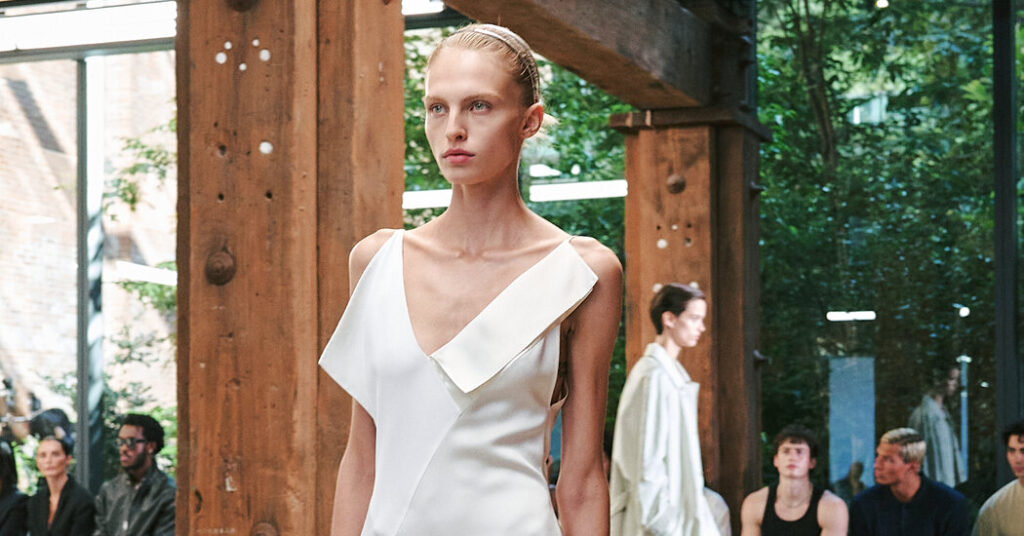
Just how influential Calvin Klein has been on fashion and everyone’s wardrobe was clear from the Calvin Klein show.
In her fourth outing, the designer Veronica Leoni abandoned the gimmicks of her first three collections — the underwear winks, the inexplicable bouncing pompoms — to strip away decoration and return to first principles: the rigorously narrow pantsuit, the slip of a camisole, the hipster trousers. A sleeveless evening dress had a deep U of a neckline cut just a bit too low and wide for comfort. A streamlined jumpsuit had a scarflike turtleneck, the ends fluttering behind. Denim was faded and tailored almost into abstraction.
That’s classic Calvin territory, the provocation disguised as Puritanism on which the name was built. It’s about time the brand staked its claim on the power of its own source material, seven years after stepping away from the runway to focus on jeans and 18 months after returning.
You could see the ambition in the three enormous geometric stainless steel sculptures by Walter De Maria that grounded the show space, one etched with the words “truth” and “beauty,” like a mantra of minimalism. And you could see it in the clothes.
The problem is, when it comes to Calvin, it may be too little too late.
In the intervening years, an entire generation of designers and labels have rushed to fill the vacuum. Looking at the show I couldn’t help but think: Hmm, that reminds me of Khaite … of Fforme … that’s very Jil Sander … the Row ….
They all speak Calvin now.
In fact, we all speak Calvin now, if you consider how much 1990s nostalgia has defined the current decade, how relevant it feels to shrug off adornment at a time of growing chaos and how much the series “Love Story: John F. Kennedy Jr. & Carolyn Bessette” did to popularize Klein’s signature look. This way of dressing has infiltrated pop and political culture alike.
It’s a testament to its enduring appeal, but it makes the current Calvin seem less like the claiming of a birthright than a copy of a copy of an original.
“I feel this is very radical in a way,” Leoni said backstage after the show, after greeting Katie Holmes and Sadie Sink and an entire row of jeans-clad influencers. She was talking about the apparent simplicity of the looks, which was not simple to achieve at all. (When there’s no frippery, every seam is on stark display.) But in fact she didn’t go far enough.
On the soundtrack Solange (also in the front row) intoned, “The truest practice of minimalism is determining what is 100 percent necessary.” That doesn’t just mean determining the barest requirements for a dress or a jacket.
It means offering clothes that in their originality and relevance feel singularly suited to the moment, that feel necessary to getting you through the day. Minimalism is not about merely taking adornment away. It is the search for the essence of something. And that isn’t found in an archive or imitation, but in invention.
The post Calvin Klein Strips Down appeared first on New York Times.