Deep beneath the Himalayas, six men were harnessing the fierce force of glacial melt that provides electricity to Nepal when a terrible deluge struck, filling their workplace, an underground powerhouse, with a churn of silt, rock and water. Floor by floor, life was extinguished.
But two and a half weeks after that devastating flooding, rescue crews digging through a silt-swamped tunnel at the Chilime hydropower project have made a tantalizing discovery. The area toward the top of the five-floor underground facility appears to be fed by a pocket of air.
In a drowned and battered landscape, the presence of oxygen, cool and fresh according to rescue workers, lit faint hopes that the six workers — the only ones still unaccounted for at the facility — might have somehow survived.
Chances of life are still slim. While three workers were pulled out of tunnels at other hydropower projects on the ninth and 10th days after the floods, another week has now passed. The floods have killed at least 1,385 people in Nepal and left 5,130 missing, along with hundreds more unaccounted for in neighboring Tibet.
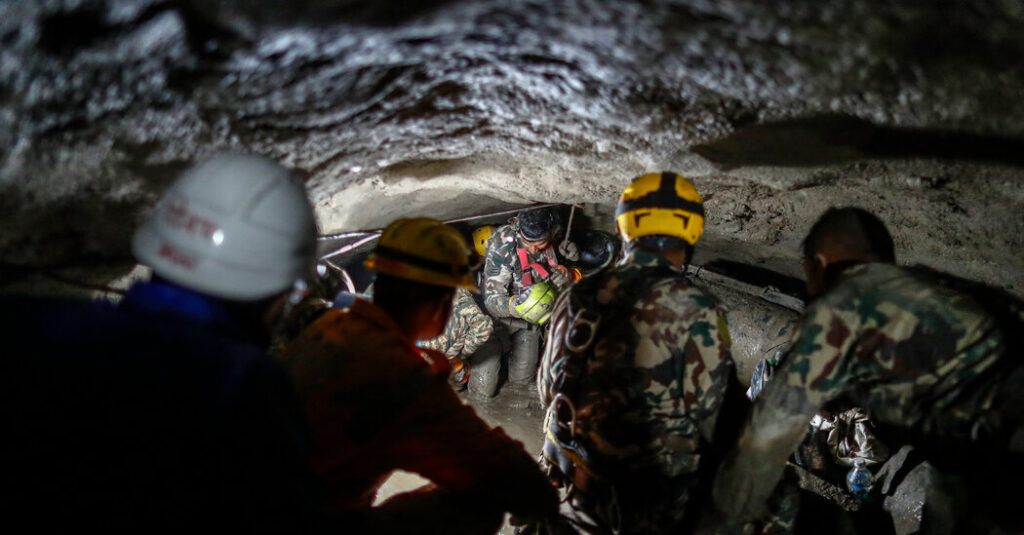
Still, for days, rescue crews brought in by helicopter — Nepali and Indian soldiers, veteran mountaineers, Australian engineers and locals who had themselves lost relatives to the natural disaster — clawed through the silt by hand, sometimes crouching on planks to prevent the earth from claiming them, too. Efforts to pump out the sludge failed. Roads and bridges in the mountainous region were washed away, so heavy machinery could not be brought in to excavate the tunnel until Friday, 17 days after the floods.
“My heart is breaking for the six workers, and we have to do everything to try to save them, if there is even a small, small chance,” said Kulman Ghising, the former managing director of the Chilime Hydropower Company, who has lent his expertise to the recovery effort.
More than 900 hydropower workers are dead or missing from the floods, which appear to have been caused by a plummeting chunk of glacier and bedrock. Fourteen hydropower projects were destroyed, along with a large solar power station. Roughly 10 percent of Nepal’s electricity generation was wiped out, in a country that counts hydropower as one of its major exports.
Mr. Ghising, who, as the longtime head of the Nepal Electricity Authority, presided over the rapid electrification of one of Asia’s poorest nations, said he had personally hired one of the six men who is believed to be trapped in the powerhouse. He also helped build six hydropower projects in the region.
“In one, two moments, everything is gone, everything we built for decades,” he said.
The rush of water, debris and mud from the Trishuli River in Nepal swept into the 820-foot tunnel to Chilime’s underground powerhouse, choking it shut. As of Saturday night, the crews had fully cleared about 200 feet of the tunnel, with a route in the upper part excavated deeper. For days, they had used buckets, shovels and bare hands, “digging like a rabbit,” according to Manish Bista, the plant manager.
Then, on Friday night, heavy machinery brought via a newly cleared road finally started to move earth in the tunnel. But hours later, a wheel loader tumbled over. Another machine suffered a flat tire. Most supplies are still flown in by helicopters landing on a perilous patch of riverside.
“We are isolated on all sides,” said Baburaja Maharjan, the current managing director of Chilime Hydropower, who has been at the rescue site since the day the flood struck. “We have no spare parts or machines. We have very limited resources.”
The teams are now working 24 hours a day, with no way out if another big flood were to come, Mr. Maharjan said.
But late this week, a breakthrough spurred on the exhausted rescue crews.
As Nepali Army soldiers crawled into a crevice in the muck, about 350 feet into the tunnel, they felt a gust of cool air through a tiny gap. Yelling into the space, they heard an echo and determined that there was an air pocket ahead.
One tunnel in the underground network slopes upward and connects to the top floor of the powerhouse. Rescue crews think that this tunnel may be free of debris as it inclines. Mr. Maharjan said that during emergencies, the engineers stationed in the powerhouse have been trained to run from their computer stations one story below to an assembly point on the top floor. That area may also have access to filtered water and a basic kitchen, where workers usually cooked their instant noodles or rice and lentils.
“There is some hope of life inside,” Mr. Maharjan said. “That is why we are continuing with extremely difficult work.”
Saroj Pandey is one of the six workers who was on duty in the powerhouse when the deluge came, according to Chilime directors and engineers.
Mr. Pandey, a computer engineer, was married two years ago and welcomed his first child last year, according to friends. One of them, Swoorup Joshi, lives in Australia and used to spend hours video chatting with Mr. Pandey, playing guitar or just talking about life.
Hours before the flood, Mr. Joshi texted his friend a single word: “Bro.”
Mr. Pandey did not respond.
“He’s just a chill, happy guy,” said Mr. Joshi, who created a website to document the efforts to locate the missing men. “I can’t imagine he’s gone.”
The post In Flood-Stricken Nepal, a Cool Gust Carries Hopes of a Miracle Rescue appeared first on New York Times.