When world leaders gather in New York this month for the United Nations General Assembly, I expect them to studiously ignore the world’s worst humanitarian crisis, the horror in Sudan that both the Biden and Trump administrations termed a genocide. President Trump has set the tone by cutting aid there.
What does the crisis look like on the ground? Let me tell you about a very bright 13-year-old girl who asked not to be named, because then she might be killed along with her parents. She has smooth skin, an oval face with a high forehead, and a red head scarf to cover her hair.
Last year she was near the top of her fifth-grade class of 60 students in the city of El Fasher, in the Darfur region of Sudan. She dreamed of being a doctor when she grew up. “I wanted to support people and give first aid,” she told me.
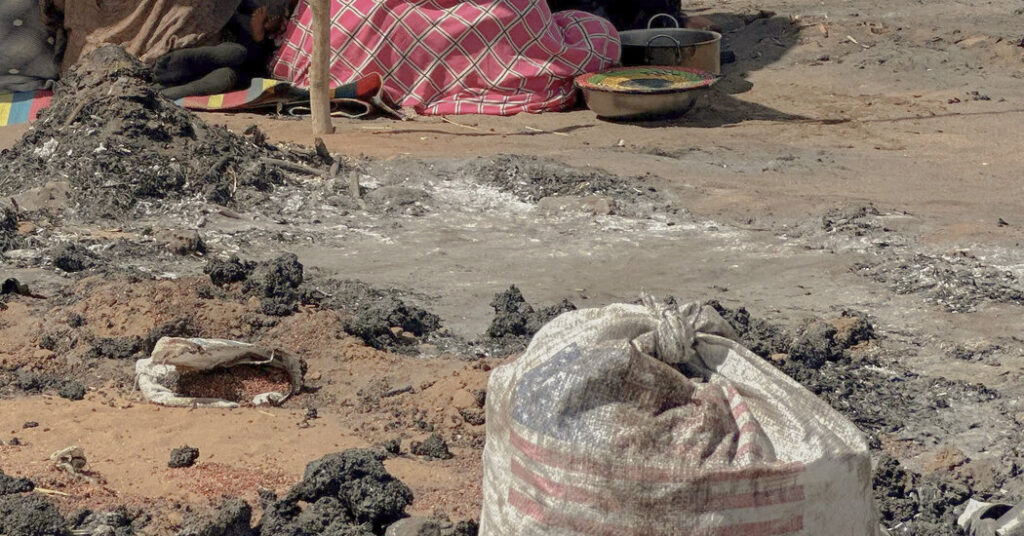
But a brutal militia called the Rapid Support Forces besieged the city and cut off most food supplies. Aid workers and policy experts pleaded with world leaders — including first President Joe Biden and then Trump — to try to block the R.S.F. from massacring the city’s people. Neither did much, so last October, as long predicted, the R.S.F. overran El Fasher and massacred perhaps 60,000 people.
The girl’s family tried to flee but was stopped at an R.S.F. checkpoint, according to accounts of the girl and four other family members I interviewed by Zoom with the help of an aid worker I know. The men and boys were separated at gunpoint, and then the women and girls were held for four days in a kind of rape camp, they said.
The girl, then 12, told me that her ordeal started when two men stripped her and assaulted her.
“Every day they came to rape me,” she said in the smallest of voices, looking down at her lap. “Sometimes one at a time, sometimes two, sometimes three of them. I was crying.” Her sister and mother were also gang-raped each day, they said, and an older aunt told me she tried to intervene and was beaten.
The militia commander agreed to release the women and girls on the fifth day, but said the men and boys would be killed. “We begged them not to,” the girl’s mother said, and finally the commander let the group walk away, men and boys included, after taking their possessions. Some in the group had all their clothes taken and resorted to taking clothing from bodies of people who had been killed at the checkpoint, they said.
Yet the girl had suffered one more terrible cruelty that she and the family talk about only with great difficulty.
Her ethnic group does not practice female genital cutting, while many other groups in Sudan do, often the most extreme kind, called infibulation. The gunmen held the naked girl down and a gunman sliced off her genitals, according to the girl herself and the other female members of her family.
Her aunt, a midwife, made a traditional herbal remedy to stop the bleeding and then stitched the girl’s genitals with needle and thread, she said. The wound became infected and may be complicated by a sexually transmitted infection as well, her family members said.
The family eventually reached a camp for displaced people called Tawila and settled there, along with some 700,000 other survivors of the conflict. The girl’s sister gave birth this year to a baby resulting from the rapes; she nursed the baby as she spoke. The men won’t talk about what happened to them when they were held, but the women say they saw some boys and men raped as well.
What drives such savagery? In part it is interethnic competition for land. In part it is the desire of outside powers for control over Sudan and the Red Sea. And in part it is racism toward non-Arab Black Africans.
“They were saying very bad words and called us slaves and dogs,” the girl’s mother recalled. “They said African people are their slaves.” Comments like that have been routine during attacks on African ethnic groups.
I can’t confirm details of this attack, but multiple members of the girl’s family corroborated the account. Two aid workers in the camp, who asked not to be identified for their safety, said they had heard the same account from the family. Aid groups like Amnesty International have also reported on mass killings and rapes there, and these accounts parallel my own reporting about the slaughter in Darfur.
Janti Soeripto, president of Save the Children, said that the accounts of the girl’s family meshed with what she learned on a trip to Darfur this year to visit her group’s operations there.
“I saw the aftermath of that violence and the scars it left behind — both physical and emotional,” she said. “I spoke with a colleague who bore facial scars from fighting to protect her 16-year-old daughter.”
Soeripto added that conditions are desperate. “The response remains wholly inadequate to meet the country’s growing humanitarian needs,” she said.
In one sense this isn’t a newsworthy column, because none of it is truly news. For more than three years of this war, gunmen in Sudan have been killing and raping with impunity, as ordinary people starve.
Here’s another way of framing the same thought. After the Holocaust, after the Cambodian and Rwandan genocides, the (not entirely honest) refrain among leaders was: If only we had known. In Sudan, there is no such excuse. World leaders are well aware of these mass atrocities, yet their response has been largely to carefully avert their eyes and remain silent.
There is overwhelming evidence, reinforced by a U.N. report this month, that the United Arab Emirates arms and backs the R.S.F., yet Biden refused to publicly call on the Emirates to halt these arms shipments. Trump, whose family has benefited financially from business ties with the Emirates, has been even less willing to hold the Emirates accountable.
It’s not just the Emirates. Other countries, including Egypt and Iran, are reportedly supporting the Sudan Armed Forces, the other side in the civil war, and it too has committed atrocities — and, as The Times and The Washington Post recently reported, may have used chemical weapons. Both sides in this war will be remembered for their cruelty, just as ordinary citizens will be recalled for their heroism and world leaders for their indifference.
Today the girl still has not recovered from the violence she endured.
“I cannot walk normally,” she said, because of pelvic pain from the rapes and genital mutilation. At the Tawila camp, there is no adequate medical care for her. Nor is there a school for her to attend. Her family has been unable to get a tent, so she and the others are living in a grass hut they made; when it rains, they get wet. Some food is distributed, but not enough.
“People are really suffering for not having enough food,” her mother said. Aid workers confirmed that there is a desperate need for more food and other care.
Perhaps this girl can be considered lucky, for she did not lose family members and, unlike her sister, is not struggling to raise the baby of her rapist. On a previous trip to the region, I wrote about a village where the R.S.F. massacred every man and boy over the age of 10.
Yet the fact that one can muse about whether this girl is lucky underscores that we have utterly failed the people of Sudan.
One more thing. When I write about human rights catastrophes in places like Sudan, the conversation is often diverted by debates over Gaza. Supporters of Israel ask, with some justice: Why aren’t pro-Palestinian university students denouncing the even greater death toll in Sudan? And the students reply, also with some justice: At least in Sudan we’re not helping to pay for war crimes.
My view is that if you are disgusted by rapes of Sudanese by Arabs only, or by rapes of Palestinians by Israelis only, then your concern isn’t for human rights but for the team you’re on.
In fairness, many in the human rights community do stand against all atrocities. It’s notable that some of the members of Congress most committed to holding Israel accountable, like Senator Chris Van Hollen of Maryland, are the same ones trying hardest to get the United Arab Emirates to stop underwriting atrocities in Sudan.
Meanwhile, two-thirds of Sudan’s population of about 53 million needs lifesaving aid, the United Nations says — yet the U.N. has received barely 40 percent of the funding it has requested. Last year, one expert, Tom Perriello, estimated that Sudan’s civil war may have claimed 400,000 deaths from violence, hunger or disease, but he and others acknowledge that no one really has much idea of the death toll.
World leaders at the U.N. General Assembly no doubt will offer lofty speeches about peace, but they seem uninterested in providing either accountability or adequate aid.
“The people of Sudan need food, water and medicine,” Tom Fletcher, the U.N. humanitarian chief, told the Security Council in a grim briefing. “Yet the world sends drones, weapons and mercenaries.”
“This Council is not powerless,” he added, making a critical point: “The international community is not powerless. The tragedy of Sudan is not that we do not know what to do. It is that we have not yet found the will to do it.”
The Times is committed to publishing a diversity of letters to the editor. We’d like to hear what you think about this or any of our articles. Here are some tips. And here’s our email: [email protected].
Follow the New York Times Opinion section on Facebook, Instagram, TikTok, Bluesky, WhatsApp and Threads.
The post Biden and Trump Called It a Genocide and Then Turned Away appeared first on New York Times.