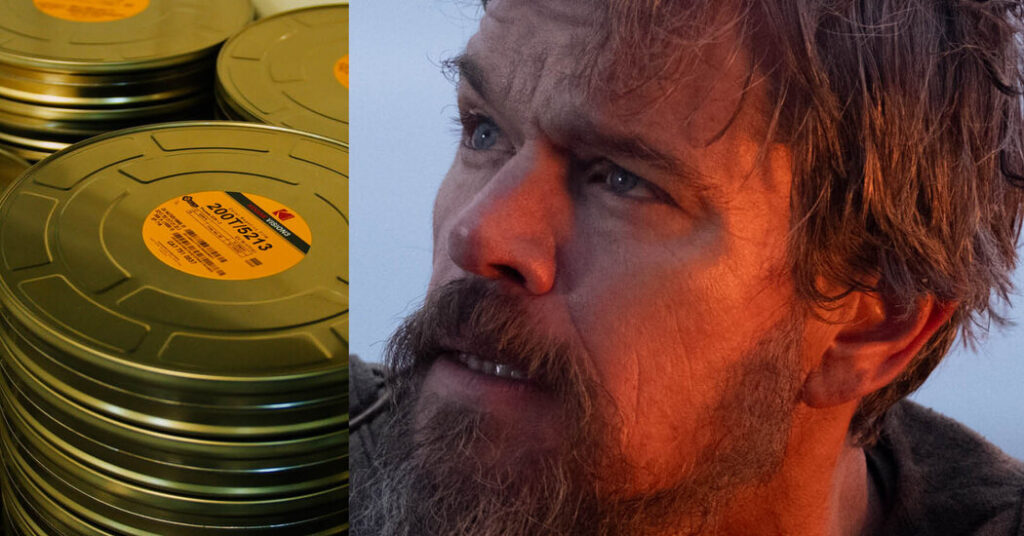
This was the summer that buying movie tickets became like buying concert tickets. Moviegoers crashed websites to secure premium admission to one of a few dozen theaters in the world that can screen films in the coveted 70-millimeter IMAX format.
The movie that inspired this was “The Odyssey,” the director Christopher Nolan’s adaptation of the ancient Greek epic that become a rare monoculture moment and has made more than $1.6 billion at the global box office.
To see “The Odyssey” in IMAX 70-millimeter was a cinephile flex. Nolan’s latest epic is the first feature film shot entirely in this specific medium.
Beyond specific formats, Nolan and “The Odyssey” are part of a broader revival of physical film after the digital revolution seemed to have left it for dead. The director has been an evangelist for the medium made of plastic, and other filmmakers are increasingly choosing to shoot and project that way — including action thrillers like “Disclosure Day” and character studies like “The Invite.”
Nolan mostly wants you to see his movie on film — IMAX or not. “It is not just nostalgia,” he said in an interview this summer.
“Projection of the movie is literally light and shadow and color,” he continued, “and when you shoot on film and you project on film, all of those prints are made from the original negative, which itself was in the camera, the light actually hitting it, creating shadows on that film that then get re-projected.
“It’s just a magical thing,” he added.
Filming on film begins at a company that was once synonymous with photography: the Eastman Kodak Company. Kodak gave The New York Times rare access to its manufacturing campus to capture how plastic and chemicals are combined, sliced, rolled and shipped out.
Made in Rochester, N.Y.
For all of film’s renewed presence at the center of Hollywood, every high-quality color reel for shooting and projecting is manufactured in one place. And that is Rochester, a city in western New York known for cold winters, industrial decline and the Eastman Kodak Company. Decades after both the medium’s and the corporation’s heyday, the city’s Eastman Business Park is where this product is manufactured. Throughout the 20th century, Kodak loomed over Rochester as its headquarters loomed over the skyline.
George Eastman began hand-manufacturing gelatin dryplates there in 1880, and by about 1915, his company was the world’s driver of photographic film. It stayed that way until the latest turn of the century, as digital cameras overtook the analog medium. Kodak filed for bankruptcy in 2012, and the company today is a fraction of its size at its peak.
But the 1,200-acre Eastman Business Park still stands, just across the street from the cemetery where the Europeans who started a settlement first known as King’s Landing are buried. (Eastman’s remains reside on the Kodak campus.)
Nor is Eastman Business Park a ghost town. Since emerging from bankruptcy in 2013, Kodak has increasingly pivoted toward manufacturing pharmaceuticals. And it still makes film, still in Rochester.
Watching the Film Get Manufactured
When film manufacturing threatened to disappear about 15 years ago, Nolan and other directors helped persuade Kodak and Hollywood to think of film not as an antiquated format, but as an alternative canvas — in the same way that vinyl albums persist in a music world dominated by digital files and streaming.
“If you view film as a technology, then it becomes obsolete and supplanted,” Nolan said. But film is not a technology, he argued, adding: “It’s a medium. It’s a very important medium. And media, they don’t become obsolete. They exist in parallel.”
It starts with plastic. Kodak makes polyester on-site. Then it adds microscopic layers of chemicals that turn a sheet of plastic into film. From this point until the product is sealed in its canisters, the process must take place almost entirely in the dark: Light, as some may remember from high school photography class, can ruin film. (In its demonstration for The Times, Kodak used “NG” — for “no good” — film so that we could photograph it.)
After the chemical treatment, massive sheets of film are dried, packaged, and shipped within the campus to Building 326 in light-tight boxes known around the campus as “caskets”:
The film’s next stop is a splitter. This K6 Splitter takes raw plastic base 54 inches wide and as many as 12,000 feet long …
… and cuts it into narrow strips small enough to fit through a camera or a projector:
Next the film is perforated: Holes are made on both sides to allow a camera’s or a projector’s sprockets to pull the film through. Kodak’s custom T-perforators can process 3,000 feet of film per minute:
The discarded bits of material from the perforating process (think: doughnut holes) are known colloquially around Kodak as “fairy dust.” Kodak recovers silver from the fairy dust — silver halide is among the chemical compounds it uses to make the film — and recycles it:
Next the film is spooled so that it can be vacuum-sealed in a device that resembles a gigantic panini press, packaged in the iconic steel canisters with gold varnish and shipped to film labs or movie sets.
A reel like the ones Nolan used when filming “The Odyssey” can have up to 1,000 feet of film.
Here’s How It Gets on the Screen
The gold standard for seeing “The Odyssey” was at one of the approximately 40 screens around the world where it was projected in IMAX 70-millimeter. We went to AMC Lincoln Square 13 in Manhattan to see how an experienced projectionist loads the film, which becomes the massive image shown on the screen.
In a small room above the highest audience seat, Chuck Snow, a veteran projectionist, went through the meticulous routine. He loaded the film onto the IMAX projector, which uses a unique rolling loop mechanism to drag the film horizontally through the projector at a very fast speed in order to achieve the rate of projection: 24 frames per second.
The process is both technically challenging and aesthetically involving: an art unto itself. This summer the director Olivia Wilde wrote of projectionists, “They are, it occurred to me, the last members of our crew.”
There is a “tactility” to film, Nolan said, for which digital cannot substitute. And seeing a movie that was shot on film projected on film means a fidelity of image. “If you’re seeing a print of ‘The Maltese Falcon,’ that’s what it really is,” Nolan said. “If you’re seeing a DVD, that’s a different thing. It’s valuable in certain ways, and in terms of people’s access to cinema it’s an incredible thing. But you can’t say that it’s the same thing.”
Nolan has a long relationship with IMAX, the company whose large distinctive cameras and gigantic screens were for much of its nearly 60-year history associated with documentaries often encountered at museums. The first moment filmgoers encountered any part of a Hollywood feature shot on IMAX cameras was when they took in the daring bank heist masterminded by Heath Ledger’s Joker at the beginning of Nolan’s 2008 movie, “The Dark Knight.”
In 2014, after Nolan had also shot parts of “The Dark Knight Rises” and “Interstellar” on IMAX cameras, Kodak hired a new chief executive, Jeff Clarke. David Keighley, IMAX’s chief quality officer, urged Nolan and Emma Thomas, his longtime producer (and wife), to meet Clarke and plead for the company to continue manufacturing film. They had lunch and made their case. Kodak listened.
In the credits of “The Odyssey,” Nolan dedicated the movie to Keighley, who died last year at 77. “Without him,” Nolan said, “there would be no shooting on film now.”
Amanda Webster contributed reporting.
The post ‘The Odyssey’ Was Shot on Real Film. This Is the Only Place Left Making It. appeared first on New York Times.