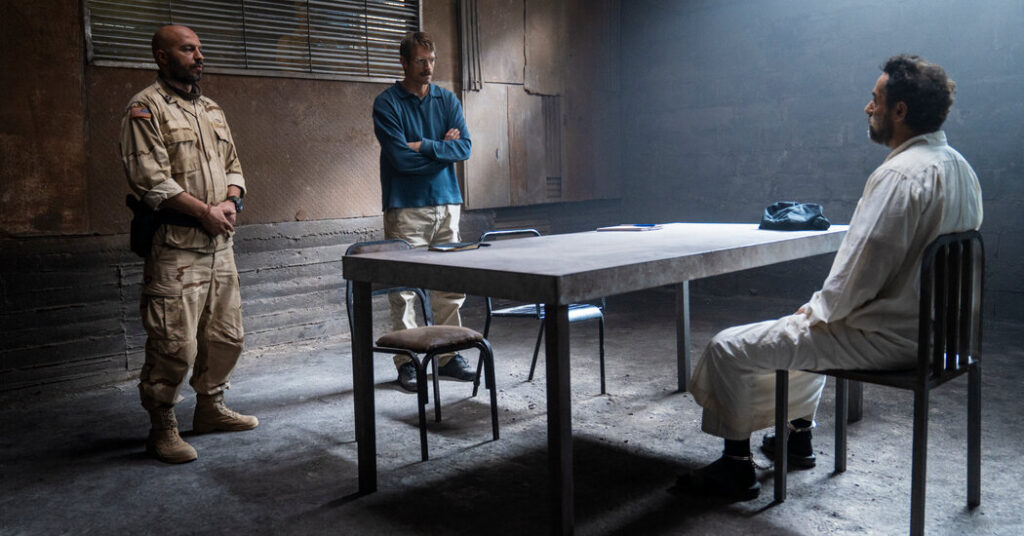
The capture and interrogation of Saddam Hussein after the American-led invasion of Iraq in 2003 did not go smoothly. Neither did recreating them.
“It was my ‘Heart of Darkness,’” said the Swedish American actor Joel Kinnaman, speaking of his role in the TNT limited series “High Value Target: The Hunt for Saddam.” Set in the chaotic early days of the U.S. occupation, the series, debuting Sunday, was shot almost entirely in Cairo — “the most challenging shoot I’ve had in my career by far,” he added, with one logistical hurdle after another.
“Sometimes the weather and the environment aren’t really working in your favor, and you’ve just got to dig in,” Kinnaman said in a recent video call, visibly relieved to have that part of the production behind him. “The daily Cairo mishaps fed into the feeling that we were in the middle of this fog of war.” Created by Daniel Stiepleman and Jonathan Wakeham, and overseen by Leslie Greif, “High Value Target” stars Kinnaman as a lightly fictionalized version of the former C.I.A. analyst John Nixon. As the agency’s foremost expert on Hussein, Nixon was brought to Iraq in 2003 amid a multiagency manhunt that the former dictator had managed to elude for many months.
Once Hussein was captured, in December 2003, Nixon’s first task was confirming that American forces had indeed found their man, not one of his rumored body doubles. Nixon then spent days interrogating Hussein, the first C.I.A. officer to do so. As it turned out, the real Hussein was substantially different than Nixon had expected.
“There’s a lot of mythology surrounding Saddam Hussein,” Nixon said in a joint call with Kinnaman. “A lot of us thought: ‘This man is 10 feet tall; he knows what’s going on, and he’s trying to outwit us at every step of the way.’ I used to be like that myself, until I started talking to him.”
In the course of his conversations with Hussein — detailed in his 2016 memoir, “Debriefing the President,” on which “High Value” is based — Nixon discovered him to be shockingly ignorant about the outside world, insulated by his advisers and more concerned with writing novels than with developing weapons of mass destruction in secret.
According to Nixon, Hussein (played in the series by Waleed Zuaiter) had a surprising amount in common with his American counterpart, President George W. Bush, whom Nixon finally briefed on his findings in 2008.
“They were both very astute politically, yet when it came to understanding how the international system works, they were out of their depth,” Nixon said. “When I went and talked with Bush, I walked out of there saying to myself, ‘These people have learned nothing.’”
With the United States once again at war in the region, Kinnaman and Nixon spoke about their collaboration, the verisimilitude of the show’s “pretend version” of history and the lessons they felt remained unlearned. These are edited excerpts from the conversation.
“High Value Target” doesn’t address war and politics allegorically with dragons or space travel, as TV often does. These are real people, real nations, involved in a real conflict. Does that add to your sense of responsibility?
JOEL KINNAMAN That’s why I chose to do the project. I grew up in a pretty political home: My dad deserted from the Vietnam War and ended up in Sweden for political asylum, so I’ve always had an interest in U.S. foreign policy. I always found John, with his inside perspective and his knowledge about Saddam, to be the most potent critic of the war effort and how we got into that debacle, which is one of the big blemishes in U.S. foreign policy history.
This show has been five years in the making; these kinds of projects are difficult to get off the ground. Even though when we started this, we didn’t know how timely it was going to end up being, we know how history continues to repeat itself when it comes to Middle Eastern politics. It makes it even more important to focus on voices like John’s, deeply insightful about the historical context of these events, but also with the courage to speak out and go against the grain.
Is the intelligence system constructed so that it inherently tells decision makers what they want to hear, or do events like those depicted in “High Value Target” require someone at the top who will not hear “no” for an answer?
JOHN NIXON In my experience, the more an issue becomes sensitive as it gets higher and higher among the top policymakers — the so-called elite of our government — the politics take over.
As an intelligence community, everybody’s fighting for the attention of the president. If he doesn’t like what you’re telling him, he might look elsewhere, and there might be another member of the intelligence community who’d be more than willing to tell him what he wants to hear to get a leg up on the competition. When you say something that they don’t want to hear, they will tune you out. It becomes a very fraught process.
In this case, you really had a White House that basically thought it knew better than anybody else what the story was. They had preconceived ideas, and they never deviated from them. They had a plan and an agenda, and they executed it.
The show depicts John asking Saddam questions with premises we now know were false. The weapons of mass destruction are not going to be there no matter how much rapport he builds. How close to reality are those early interrogation scenes?
KINNAMAN Part of the challenge for us was to find an evolution in John, and you take some liberties to make it fit the character arc a little bit better. We chose to make him a little bit more naïve in the beginning ——
NIXON Nope, I was naïve. Yeah, there are certain scenes that are dramatized a little, but overall they get it right almost all the time.
Coming from a profession where accuracy is paramount, what was that process of dramatization like for you?
NIXON I was out in Cairo last year during some of the filming, and Joel and I have talked a lot on the phone and on Zoom calls. He had a zillion questions. Despite the fact that Joel is not nearly as good-looking as I am and lacks my rugged charm, I’ve mentioned this to him once before: There was no video of it, but I remember how I felt identifying Saddam, and Joel’s facial expressions in that scene are exactly the way it was. It gave me chills.
In addition to interrogating Saddam, John is eventually brought in to share his findings with President Bush. How did it feel to be in those two rooms with those two people?
NIXON I’m one of the few people who actually shook the hand of both President George W. Bush and President Saddam Hussein. If I had one that I’d rather hang out with, it would probably be Saddam Hussein. I came away liking him a lot more than Bush.
But I found there were a lot of similarities between them. They’re surrounded by an inner circle that basically isolates them from the real world, so much so that they really are out of touch with reality. A week before the American Army’s going to end his reign, Saddam is working on a novel and asking Tariq Aziz, “Hey, let me know what you think of this draft — I think it’s pretty good.”
KINNAMAN Saddam thought 9/11 was going to bring the U.S. and Iraq closer because it was clear they had a common enemy. To hear that from Saddam is the biggest indictment of all the motivations of going to war with Iraq, because it just shows how 100 percent wrong those reasons were, especially in motivating the American people on a false premise. It’s terrifying how the men in these positions have such a shallow understanding of what’s actually going on in the regions of the world where they’re wielding their power.
[Smiling] Fortunately, we now have leadership that is so much more mature and thoughtful and are really just thinking of the common good of the entirety of the human race. I’m so glad we’ve evolved as a society, and that we’re finally past these petty tyrants.
The post ‘High Value Target’: Hunting for Saddam Hussein, and the Truth appeared first on New York Times.