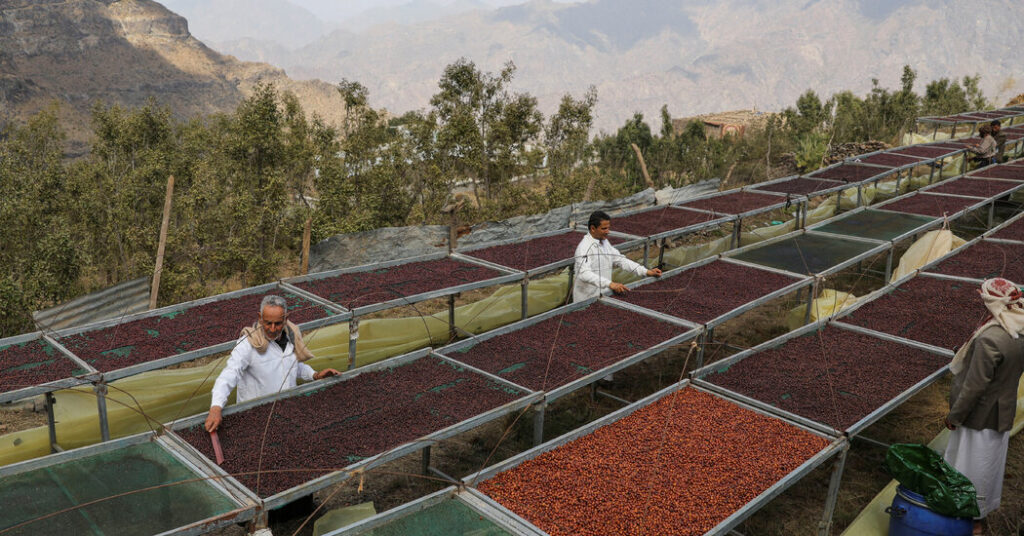
Long before it was captured by Houthi forces this week in Yemen’s civil war, the centuries-old Red Sea port of Mokha was famed as one of the original gateways of the global coffee trade.
At its height, from the 16th to 18th centuries, the city was a wealthy hub of merchants and coffee houses in a region that oversaw a monopoly on the world’s coffee bean supply for more than a hundred years. That legacy stretches into modern coffee culture, with the city giving its name to coffee beans, specialty products and the mocha, a chocolate and espresso drink.
Some of the traits that allowed Mokha to dominate the coffee trade centuries ago have also made it a strategic — and coveted — prize in the current conflict in Yemen.
Mokha’s proximity to the Bab el-Mandab Strait, a narrow waterway about 50 miles south of the city that links the Red Sea to the Indian Ocean, has for centuries given it leverage over one of the world’s most important trade corridors.
Here’s a look at the city’s history.
Rise of a Coffee Capital
The Ottoman Turks occupied Yemen in the late 1530s, and transformed Mokha from a small fishing village into a coffee superpower.
Coffee already had a foothold in the region. About a century earlier, scholars believe, people there were the first to consume a drink that modern coffee drinkers would recognize. The practice may have started with Arab Sufi monks, who drank the stimulating beverage to stay awake for midnight prayers. By the mid-1500s, coffee drinking had become widespread in the area, which saw a number of other coffee firsts.
“Yemen is the home not only of the social habit of drinking coffee as the beverage that we know today, it’s also the home of large-scale coffee cultivation and really the first purveyor of coffee to the world,” said Nancy Um, the author of “The Merchant Houses of Mocha,” about the city’s trade history.
In Yemen, the Turks began cultivating coffee on a commercial scale in the highlands around Mokha and exported it throughout their empire.
They also established a monopoly, banning coffee beans from leaving Yemen unless they were first boiled or roasted to prevent germination, wrote Mark Pendergrast in his 1999 book, “Uncommon Grounds.” (According to Mr. Pendergrast, in the 1600s, a Muslim pilgrim named Baba Budan smuggled seven seeds out by strapping them to his stomach and later successfully cultivated the plants in India, although scholars debate the story’s veracity.)
Mokha’s proximity to the Bab el-Mandab Strait was central to its rise, connecting it to the Mediterranean through the Red Sea, and to Asia through the Indian Ocean. Today, ships must pass the strait to reach the Suez Canal and European waters beyond.
Mokha’s population of multiethnic and multifaith traders moved products including metals, textiles and spices, but it became heavily associated with coffee in the 17th century, when major European trading houses, including the East India Companies of England and the Netherlands, set up shop there.
“They consolidated the association between Mocha and coffee by labeling all of the beans that they purchased in Yemen and shipped from the port of Mokha as ‘Mokha coffee,’” Ms. Um said.
By the 1720s, however, coffee was being cultivated in the Caribbean and in Java, Indonesia, and Mokha’s central role diminished. Its death knell came in the early 1800s when the British took Aden, a port city to the east, and made it their main trade hub in the region, Ms. Um said.
A Fragile Revival
A modern port was established in Mokha in the 1950s, but by then the region’s coffee industry had mostly disappeared.
Over the years, Yemen has converted much of its farmable land to the production of khat, a plant chewed for its amphetaminelike effects. That includes the country’s coffee-producing regions, which are largely under Houthi control.
“When coffee was replaced, it kind of doomed Yemen,” said Ibrahim Al-Marashi, an associate professor of Middle East history at California State University.
Mr. Al-Marashi said that khat, which is sold and consumed locally, is a drain on household savings and a drag on the economy. It is also water intensive, he said, giving more power to the Houthis, who control key water supplies in some areas.
In recent years, however, there has been a movement to reestablish the coffee industry in Mokha and Yemen, and to connect local farmers to Yemeni coffee shops around the world.
“Farmers are now seeing coffee as a potential alternative to khat and a way to uplift themselves,” said Mokhtar Alkhanshali, who owns a coffee business in Yemen that connects around 6,000 farmers to international roasters.
The recent-flare up of the conflict in Yemen, however, has jeopardized recent gains, he said. It has put farmers in physical danger, made it harder for them to export their products and threatened to push them back to khat, Mr. Alkhanshali said.
“For the first time in years, coffee was giving Yemenis something to hope for,” he said. “Now the port that should be shipping that coffee to the world is a battlefield.”
The post Why Mokha, Historic Port That Shaped the Coffee Trade, Is a Prize in Yemen’s War appeared first on New York Times.